

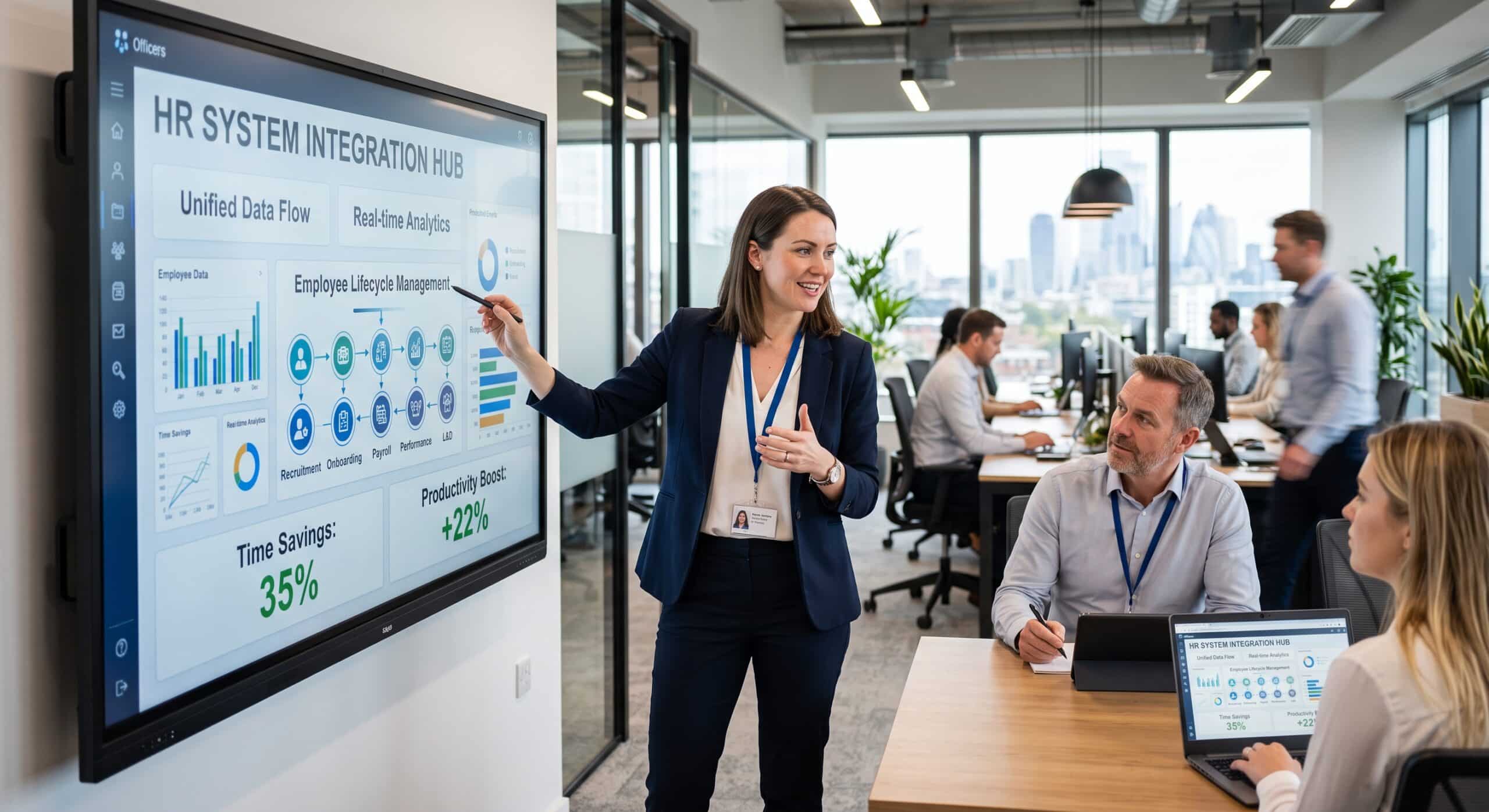
I have spent much of my career sitting across the table from HR directors drowning in spreadsheets. They are not bad at their jobs. Their tools just do not talk to each other, making seamless HR system integration the single biggest missing piece in their daily operations. The payroll platform does not know what the applicant tracking system knows. The benefits portal has no idea what changed in the HRIS last week. Someone, usually a stretched HR generalist, becomes the human bridge between all of it. That person copies numbers from one screen to another and hopes nothing slips through.
That is the quiet, expensive problem HR system integration solves. It is not a project you hand off to the IT department and forget about. It is the backbone decision that determines whether your HR function spends its time on people or on paperwork. I have guided mid size and enterprise organizations through this exact shift. In this article, I want to show you what integration actually changes. I will cover why the payoff shows up faster than most leaders expect. And I will show you how to build an HR data architecture that holds up as your company grows.
I should be upfront about something before we go further. Integration is not a magic switch. It takes planning. It takes honest conversations about who owns which piece of data. And it takes a willingness to fix messy records instead of just moving them faster. But every organization I have worked with committed to doing it properly. Each one came out the other side with fewer errors and calmer audits. Their HR teams finally had room to think beyond the next data entry task.
What HR System Integration Actually Means
HR system integration is the practice of connecting the separate software platforms your HR team relies on. Think of your HRIS, payroll engine, applicant tracking system, time and attendance tool, benefits administration platform, and learning management system. Connect them and data flows between them automatically. Nobody has to re-enter it by hand.
Most companies do not start out this way. They add tools one at a time as needs arise. A recruiting tool arrives in year two. A standalone payroll vendor joins the mix in year four, because the original HRIS payroll module felt clunky. By year six, the company runs eight or nine systems. Each one holds a slightly different version of the same employee record. Nobody trusts any of them completely.
Integration fixes that by creating a single source of truth. Someone updates an address, a salary, or a job title in one system. That change then propagates to every connected platform automatically. Nobody has to log in five more times to repeat the same update. This is the foundation of what I call HR data architecture. It is the deliberate design that structures, stores, and shares information across every tool your workforce touches.
The Real Cost of Manual Data Entry
Manual entry feels like a minor inconvenience until you measure it. Research from payroll compliance firm Coad found that one in five payrolls in the United States contains an error at any given time. The same research found that 33 percent of employers make routine payroll mistakes every year. Organizations average around 15 corrections per pay period. Companies with 1,000 employees spend roughly 29 workweeks a year just fixing those errors. The average cost of a single payroll mistake sits near 291 dollars. That figure includes the time spent tracking the error down and fixing it.
Those numbers only cover payroll. Widen the lens to the rest of the employee lifecycle and the picture gets worse. According to HiBob, 60 percent of people managers spend three or more hours assembling data from multiple systems before they can make a workforce decision. Another 83 percent say switching between disconnected tools slows them down at least half the time. Every one of those hours is time not spent coaching an employee, closing a requisition, or solving a retention problem.
Visier’s research on HR data integrity puts a dollar figure on the downstream damage. Data errors cost the average company tens of thousands of dollars a year. That total includes duplicate records, inconsistent metrics, missing fields, and outdated information that leads to bad decisions. Careless employees do not cause most of that damage. Bad architecture does. It forces people to re-key the same information over and over. Every keystroke then becomes a new opportunity for a typo, a transposed number, or a forgotten field.
How HR System Integration Cuts Errors
The mechanics of error reduction are straightforward once you connect your systems. Picture an HR coordinator who no longer exports a spreadsheet from the applicant tracking system and imports it into the HRIS by hand. The moment someone accepts an offer, the new hire’s data flows automatically. The identity management system receives the employee’s start date and department without anyone touching a keyboard. The benefits platform receives eligibility data the day it changes, not two payroll cycles later when someone remembers to update it.
This matters because most HR data errors are not judgment errors. They are transcription errors: a digit typed wrong, a dropdown left on the previous employee’s selection, a field copied from an outdated file. When the transfer step disappears, so does the opportunity for that mistake. Apideck’s research on HRIS integration backs this up. Payroll accuracy improves measurably when systems pull real time data directly from a single source, rather than relying on spreadsheet uploads. Employee information also stays consistent, whether you view it through a performance module or an accounting platform.
There is a second, less obvious benefit. HR teams stop spending their week reconciling three versions of the same headcount report. They start to trust their own numbers again. I have watched HR leaders change their habits completely. They used to double check every report before a board meeting. Now they pull live dashboards with confidence, because HR system integration removed the guesswork about which system held the correct figure.
The Compliance Angle Nobody Talks About Enough
Compliance is where disconnected systems create the most exposure. It is often the argument that finally gets leadership to fund an integration project. Coad’s research found that 53 percent of companies faced payroll noncompliance penalties within the past five years. The IRS penalizes nearly one in four businesses for payroll mistakes. Now multiply that risk across multi-state or multi-country operations. Tax rules, leave entitlements, and reporting deadlines vary by jurisdiction. Manual processes stop being merely inefficient here. They become a liability.
Integrated systems address this in a few concrete ways. First, they generate audit trails automatically. A pay rate change, a termination, or a benefits election happens inside a connected system. The system then creates a timestamped record. Nobody has to document it separately. Second, they support real time compliance monitoring. They flag discrepancies, such as a missing I-9 or an expired work authorization, the moment the data changes. That beats catching the problem during a year-end scramble. Third, they keep records consistent across every platform an auditor might request. HR no longer reconciles three conflicting reports the week before a Department of Labor review.
Visier’s data integrity research is blunt about what happens without this consistency. Missing fields delay reporting and increase compliance exposure. Outdated information leads to decisions that carry real legal risk. A strong HR data architecture treats compliance as a design requirement, not an afterthought bolted on during an audit.
Building a Resilient HR Data Architecture: 7 Core Elements
Over years of running these projects, I have found a pattern. Successful HR system integration efforts share seven common elements, regardless of company size or industry. Skipping any one of them tends to be where projects run into trouble.
The Seven Elements
- A defined system of record. Every data field, from job title to home address, needs one platform to serve as the authoritative source. Without this, integration just synchronizes confusion faster.
- A cross-functional project team. HR, IT, payroll, and finance all need a seat at the table before implementation starts. Each function understands a different failure mode the others will miss.
- Clean data before migration. Connecting systems does not fix bad data. It multiplies it. Resolve duplicate employee records and inconsistent formatting before the first sync runs.
- Clear field mapping. Two systems rarely label the same information the same way. Someone has to decide, in writing, how “department” in one tool maps to “cost center” in another.
- Automated validation rules. Good architecture catches errors before they spread. It rejects a record with a missing Social Security number, rather than passing it along to payroll.
- A testing period across a full business cycle. Running a new integration through one payroll cycle is not enough. It needs to survive a full year of events: a benefits open enrollment, a merit increase cycle, and a batch of new hires. Only then should you trust it fully.
- Ongoing governance. Someone needs to own the data architecture after launch. That person reviews new integrations, retires unused connections, and makes sure the system of record stays accurate as the company changes.
This last point is the one organizations underestimate most. HR system integration is not a project with an end date. It works more like plumbing. It stays invisible when it works, becomes disruptive when you neglect it, and deserves a regular inspection.
What This Looks Like in Practice
A manufacturing client I worked with several years ago had eleven separate HR tools by the time they called me. None of them talked to each other. Their HR team of four people spent an estimated 20 hours a week on data entry alone. They updated the HRIS, then the payroll system, then the time clock software, then the benefits portal, one field at a time. Turnover data disagreed with finance’s headcount numbers so often that leadership had stopped trusting either report.
We spent the first month simply mapping which system owned which field. That step took longer than anyone expected, because nobody had ever documented it. Once we established the HRIS as the system of record, we built automated connections to payroll, time tracking, and benefits. The weekly data entry load dropped to roughly four hours. More importantly, the finance and HR headcount numbers matched for the first time in years, because both teams finally pulled from the same source.
The productivity gain was not really about speed. It was about what the HR team did with the time they got back. They stopped being data clerks. They started running stay interviews, redesigning the onboarding experience, and building a real succession plan for the plant managers. That is the actual case for HR system integration. It does not just clean up your data. It changes what your HR team can do with their week.
Common Pitfalls Worth Avoiding
The projects that struggle tend to make the same handful of mistakes. Some organizations try to integrate everything at once. They should start instead with the highest volume, highest risk connections, like payroll and the HRIS. Others skip the data cleanup step. They assume the integration itself will sort out years of inconsistent entries. It will not. An automatically synced bad record is still a bad record. It just spreads faster.
Another frequent issue is treating integration as a one-time technical task rather than an ongoing discipline. Systems change. Vendors update their APIs. Well-meaning department heads add new tools and never loop in HR or IT. Without governance, the clean architecture you built in year one quietly degrades by year three.
Finally, some teams underestimate the change management side. Employees and managers have used a manual workaround for years. They will keep using it unless they understand why the new process is better. They also need proper training on it. The technology is rarely the hardest part of integration. The habits around it are.
Measuring Whether Integration Is Actually Working
Once a new HR system integration goes live, resist the temptation to declare victory and move on. The organizations that get the most out of their investment track a handful of concrete numbers before and after the rollout. Then they keep watching them.
Start with the error rate on payroll and benefits enrollment. That number tends to move fastest once manual entry disappears. Track how many hours HR staff spend each week on data entry and reconciliation tasks. Most teams have never actually measured that figure until someone asks them to. Watch how long it takes to pull an accurate headcount or turnover report for leadership. That turnaround time usually drops from days to minutes once every system pulls from the same source. Finally, keep an eye on audit preparation time. A team that used to spend two weeks gathering documentation for a compliance review should see that time shrink dramatically once records stay consistent automatically.
None of these metrics require sophisticated analytics. Track a simple spreadsheet monthly for the first year after implementation. That is usually enough to show leadership that the investment paid off. It also gives your team an early warning if someone adds a new tool without properly connecting it to the rest of the architecture.
Choosing the Right Approach for Your Organization
Not every company needs the same architecture. A 50 person startup with a single payroll provider has different needs than a 5,000 person enterprise operating across a dozen countries. The right starting point is usually an honest audit. Which systems currently hold employee data? Where does duplication already exist? Which manual process causes the most pain or the most compliance risk today?
From there, most organizations benefit from a phased rollout rather than a single massive cutover. Connect payroll and your core HRIS first. That pairing tends to produce the fastest measurable reduction in errors and the clearest compliance benefit. Once that connection is stable, extend the architecture outward to benefits, time tracking, and performance management. This sequencing keeps risk contained. It also gives your team a working proof point before you ask leadership to fund the next phase.
Vendor selection matters here too. Look for platforms with open, well documented APIs and a track record of maintaining those connections as they update their software. A system that integrates beautifully today but breaks with every vendor update will cost you more in the long run. A slightly less flashy tool with stable architecture is usually the safer bet.
The Productivity Payoff
Everything we have covered so far, fewer errors, stronger compliance, cleaner reporting, points toward the same outcome: workforce productivity. HR professionals stop re-entering the same employee record into six systems. They redirect that time toward work that actually moves a business forward. Managers get faster answers when they need workforce data for a decision. Employees experience fewer payroll mistakes. They also see fewer frustrating gaps between what one system shows and what another one says.
There is also a talent dimension worth naming. HR teams burdened by manual data entry struggle to retain skilled people. A job that consists mainly of copying numbers between spreadsheets rarely keeps ambitious professionals engaged. Give that same team a connected architecture instead. Their role shifts toward analysis, strategy, and employee experience, the work most HR professionals actually signed up to do.
HR system integration will not fix a broken culture or replace good management judgment. What it does is remove the friction that keeps good HR teams from doing their best work. It also closes the gaps where compliance risk tends to hide. Many organizations still run their people operations through disconnected systems and manual spreadsheets. For them, integration is one of the highest leverage investments available. That is not because it is trendy. It is because the math on errors, hours, and risk makes the case on its own.
If you are weighing whether now is the right time to invest, ask your team a simple question. How many hours did someone spend last week moving data between systems by hand? What could that person have accomplished instead? For most organizations, the answer alone is enough to justify the project.
Frequently Asked Questions
What is the difference between an HRIS and HR system integration? An HRIS is a single software platform that stores core employee data. HR system integration is the broader practice of connecting that HRIS with other tools, like payroll, benefits, and time tracking. Data then moves between them automatically. Paycor’s guide breaks this distinction down in more detail: HRIS Integration: The Complete Guide for HR Leaders.
How long does HR system integration typically take to implement? Timelines vary significantly by company size. HiBob’s research suggests small businesses under 100 employees can complete a basic integration in two to six weeks. Enterprise organizations with more than 2,000 employees often need three to six months or longer. See HiBob’s HRIS integration guide for the full breakdown by company size.
Does HR system integration really reduce payroll errors? Yes. Integrated systems pull data from a single, current source instead of relying on spreadsheet uploads or manual re-entry. That cuts the opportunities for transcription mistakes sharply. Coad’s analysis of payroll error costs shows just how expensive those mistakes get when nobody catches them early: The Cost of Payroll Errors.
Planning and Rollout Questions
What should a company clean up before starting an integration project? You should resolve duplicate employee records, inconsistent job title or department naming, and outdated fields first. Visier’s research on HR data integrity explains this well. Skipping this step causes integration to multiply existing problems rather than solve them: HR Data Integrity: Securing Trust Beyond Routine.
Is HR system integration only relevant for large enterprises? No. Smaller organizations often see a faster return. Their data volume is lower, and their teams feel the burden of manual entry more directly, relative to headcount. Apideck’s guide covers use cases across company sizes: A Guide to HRIS Integrations.
References
- HiBob. “HRIS integration: Types, benefits & a 7-step guide.” https://www.hibob.com/blog/hris-integrations/
- Visier. “HR Data Integrity: Securing Trust Beyond Routine.” https://www.visier.com/blog/hr-data-integrity/
- Apideck. “A Guide to HRIS Integrations: Best Practices, Use Cases, and Trends.” https://www.apideck.com/blog/a-guide-to-hris-integrations-best-practices-use-cases-and-trends-for-2025
- Coad. “The Cost of Payroll Errors.” https://www.coad.com/blog/cost-of-payroll-errors
- Paycor. “HRIS Integration: The Complete Guide for HR Leaders.” https://www.paycor.com/resource-center/articles/hris-integration/