
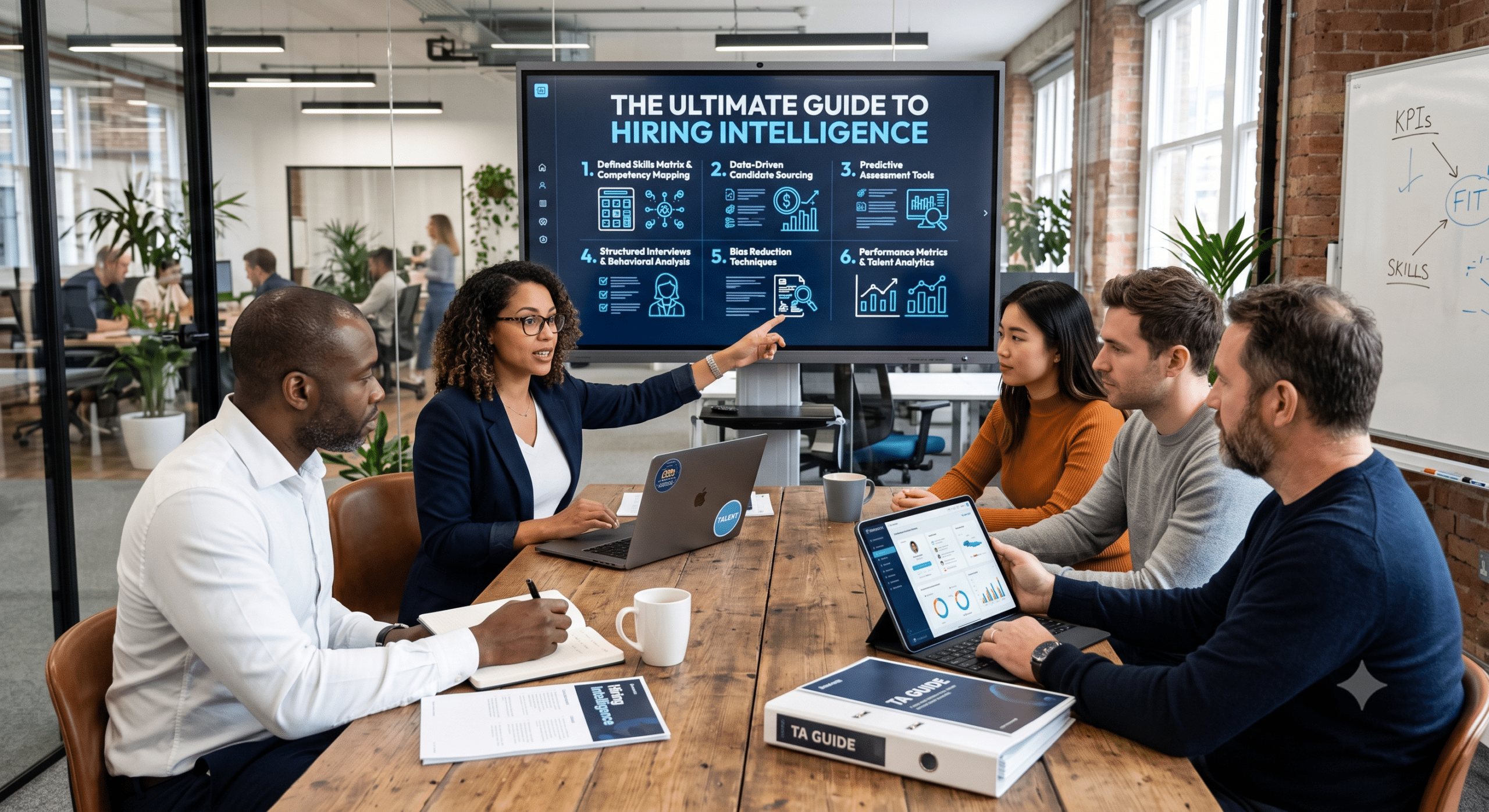
Hiring intelligence is changing how organizations find, evaluate, and hire top talent. Instead of relying only on resumes, interviews, or instinct, businesses now use hiring intelligence for enterprise recruiting to make smarter, data-driven hiring decisions. As hiring becomes more competitive and skill requirements continue to evolve, companies need better ways to identify qualified candidates while reducing recruitment costs and improving long-term employee success.
Hiring the right people has never been more difficult. Companies receive hundreds—or even thousands—of applications for a single position. At the same time, skill shortages, changing workforce expectations, and rapid advances in AI have made recruitment far more competitive than it was just a few years ago.
This is where utilizing hiring intelligence for enterprise recruiting becomes valuable.
Instead of relying on outdated hiring methods, this strategy uses data, workforce insights, market trends, and predictive analytics to help recruiters make better decisions. It gives organizations a clearer picture of who to hire, when to hire, and where to find the best talent.
As part of a broader workforce intelligence strategy, combining internal HR data with external labor market information improves recruitment quality, reduces hiring costs, and shortens time-to-fill. Modern organizations are increasingly adopting skills-based hiring, AI-powered recruiting, and workforce analytics to stay competitive.
This guide explains everything you need to know about implementing data-driven recruitment, including practical strategies, common challenges, key metrics, and future trends that will shape recruitment over the next several years.
What Is Hiring Intelligence?
Simply put, hiring intelligence for enterprise recruiting is the process of collecting, analyzing, and using recruitment data to improve hiring decisions.
Instead of making choices based only on resumes or interviews, organizations evaluate multiple sources of information, including:
-
Candidate skills
-
Previous hiring success
-
Workforce planning data
-
Labor market trends
-
Salary benchmarks
-
Employee performance
-
Candidate assessments
-
Hiring pipeline analytics
The goal is simple: Hire better employees while reducing recruitment risk.
Companies that transition to data-backed recruiting often experience:
-
Better quality hires
-
Faster recruiting cycles
-
Lower overall hiring costs
-
Improved employee retention
-
Better long-term workforce planning
-
Stronger, bias-free diversity initiatives
Hiring Intelligence vs. Workforce Intelligence
To successfully implement hiring intelligence for enterprise recruiting, it is crucial to understand how it differs from broader workforce intelligence.
| Feature | Hiring Intelligence | Workforce Intelligence |
| Primary Focus | Focuses strictly on talent acquisition and recruitment | Covers the entire employee lifecycle (retention, development) |
| Strategic Goal | Helps recruiters identify and hire better talent | Helps executive leaders manage overall workforce strategy |
| Data Sources | Uses recruiting, sourcing, and assessment data | Uses HR, finance, operations, and broad talent data |
| Business Value | Improves hiring efficiency and quality of hire | Improves long-term workforce performance and planning |
Ultimately, hiring intelligence is one of the most critical components of a comprehensive workforce intelligence strategy.
Why Hiring Intelligence Matters Today
Recruitment has changed dramatically over the last decade. Today’s employers face unprecedented talent challenges:
-
Global talent shortages
-
Hybrid and remote work complexities
-
Rapidly evolving AI-assisted recruitment
-
Higher candidate expectations regarding culture and compensation
-
A shift toward skills-first hiring
Traditional hiring methods simply cannot keep pace, forcing organizations to leverage hiring intelligence for enterprise recruiting to stay competitive. Recent workforce research shows that employers are placing greater emphasis on verified skills rather than prestigious job titles, while AI continues to reshape—rather than replace—the human elements of recruitment.
The Main Goals of Hiring Intelligence
While every organization has unique hiring needs, most initiatives around hiring intelligence for enterprise recruiting focus on similar objectives.
Finding Better Candidates
Instead of trying to attract the largest pool of applicants, data-driven systems identify the most qualified individuals. Quality always beats quantity.
Reducing Hiring Costs
Recruitment is expensive. Total costs quickly add up across job advertising, recruiter salaries, interview time, candidate assessments, onboarding, and training. Smarter, data-driven decisions dramatically reduce wasted sourcing spend.
Improving Employee Retention
Poor hiring decisions lead to early resignations, low productivity, and poor cultural fit. Utilizing historic performance and retention data helps mitigate these issues before an offer is even extended.
Shortening Time-to-Hire
Vacant positions directly drain organizational productivity. Predictive analytics identify bottlenecks in the pipeline so recruiters can move qualified candidates through the hiring process faster.
The 12 Core Elements of Hiring Intelligence
Every successful strategy using hiring intelligence for enterprise recruiting includes several essential, interconnected components.
-
Labor Market Intelligence: Understanding external talent markets (e.g., regional availability, salary trends, and growing skill sets) to support smarter sourcing decisions.
-
Skills Intelligence: Evaluating candidates based on technical abilities, soft skills, certifications, and learning potential rather than arbitrary resume keywords.
-
Candidate Analytics: Measuring application completion rates, interview scores, and offer acceptance rates to continuously optimize the candidate journey.
-
Predictive Hiring Analytics: Analyzing historical data to forecast future candidate success, turnover risks, and hiring demand.
-
AI-Assisted Screening: Using AI to responsibly rank resumes and match skills while maintaining human oversight to ensure fairness.
-
Talent Pool Intelligence: Building warm, continuous talent communities to reduce sourcing time when critical positions open up.
-
Interview Intelligence: Standardizing evaluation criteria and structured scoring to ensure consistency across hiring managers.
-
Performance Feedback Loops: Comparing post-hire performance reviews and promotion rates against original recruitment data to refine future hiring profiles.
-
Diversity Analytics: Monitoring recruitment outcomes across candidate groups to identify and eliminate systemic bias.
-
Salary Intelligence: Leveraging real-time market benchmarking to control compensation costs while remaining highly competitive.
-
Employer Brand Insights: Measuring career page conversion rates and social reputation to understand how candidates perceive the organization.
-
Continuous Hiring Optimization: Treating recruitment as an evolving system by reviewing key HR metrics quarterly.
How Hiring Intelligence Works
Transforming raw recruitment data into actionable business decisions follows a structured, five-step process:
[Step 1: Collect Data] ➔ [Step 2: Clean & Organize] ➔ [Step 3: Analyze Patterns] ➔ [Step 4: Decide] ➔ [Step 5: Measure]
Step 1: Collect Recruitment Data
The first step in establishing hiring intelligence for enterprise recruiting is gathering data from multiple sources, including:
-
Applicant Tracking Systems (ATS) and HRIS platforms
-
Candidate assessments and exit interviews
-
Job boards, social recruiting platforms, and labor market reports
Step 2: Clean and Organize the Data
Raw recruitment data is often incomplete. Before running analyses, talent teams must standardize job titles, remove duplicate candidate records, and verify skill categories to ensure high-quality outputs.
Step 3: Analyze Hiring Patterns
Once organized, recruiters look for actionable trends:
“Which sourcing channels yield the longest-tenured employees?”
“At which interview stage do we lose the most highly qualified candidates?”
Step 4: Make Data-Driven Decisions
Instead of relying on personal opinions or gut feelings, hiring managers use concrete insights to decide when to scale headcount, which candidates to advance, and what compensation packages to offer.
Step 5: Measure Hiring Results
Hiring intelligence does not stop once a contract is signed. Organizations continue to monitor long-term retention, manager satisfaction, and employee productivity to continuously train and improve their recruitment algorithms.
Key Metrics to Measure Success
Without measurable results, it is impossible to know if your talent strategies are working. Focus on tracking these essential metrics:
-
Time-to-Fill: The total number of days between opening a requisition and an offer being accepted.
-
Time-to-Hire: The speed at which a candidate moves from application to accepted offer (a vital metric for evaluating candidate experience).
-
Quality of Hire: The ultimate recruitment metric, measuring whether new employees perform well, fit the culture, and stay with the organization.
-
Cost per Hire: The total financial investment required to secure a single hire, including advertising, software, and agency fees.
-
Offer Acceptance Rate: The percentage of extended offers that are accepted (frequent rejections indicate compensation or brand perception issues).
-
Source of Hire: Pinpoints exactly where your highest-performing employees originate so you can optimize your sourcing budget.
The Core Benefits of Modern Hiring Intelligence
Organizations of all sizes unlock massive competitive advantages by adopting these data-driven workflows:
-
Better Hiring Decisions: Recruiters operate with a clear understanding of required skills, market availability, and long-term business needs.
-
Lower Recruitment Costs: Eliminates wasted spending on extended job postings, external agency fees, and the costly process of replacing bad hires.
-
Stronger Workforce Planning: Allows companies to transition from reactive hiring (filling a seat after someone leaves) to proactive planning (building pipelines before shortages occur).
-
Improved Diversity & Inclusion: Uncovers structural bottlenecks in the hiring funnel, ensuring candidates are evaluated strictly on their skills and qualifications.
Common Challenges and How to Avoid Them
While the benefits are undeniable, organizations must prepare to navigate a few common implementation obstacles.
Poor Data Quality
Hiring intelligence is only as reliable as the information fed into it. Outdated resumes, duplicate candidate profiles, and missing assessment scores will skew your analytics. Regular database maintenance is essential.
Disconnected HR Systems
Many companies use separate, isolated tools for their ATS, HRIS, and performance management. Integrating these platforms is essential to build a reliable foundation for hiring intelligence for enterprise recruiting and establish a single source of truth.
AI Bias and Ethical Concerns
While automation dramatically speeds up candidate screening, human oversight must remain central to the process. Organizations should regularly audit their AI recruiting tools to ensure they remain fair, transparent, and compliant with evolving labor laws.
Best Practices for a Successful Strategy
Creating a roadmap for hiring intelligence for enterprise recruiting is more than purchasing new recruiting software. True success comes from combining technology, reliable data, skilled recruiters, and continuous improvement.
-
Define Clear Hiring Goals: Start with highly specific, measurable goals (e.g., “Reduce time-to-fill by 20%” or “Improve first-year retention by 15%”).
-
Focus on Skills Over Job Titles: Structure your evaluation processes around technical and transferable skills rather than prestigious past employers.
-
Standardize Your Recruitment Process: Implement structured interview formats, consistent evaluation rubrics, and standardized skills assessments to ensure every candidate is judged on a level playing field.
-
Train Your Hiring Teams: Ensure recruiters and hiring managers know how to read recruitment dashboards, mitigate personal bias, and use AI tools responsibly.
Technologies That Support the Stack
To build an efficient hiring intelligence ecosystem, organizations rely on a suite of integrated tools:
-
Applicant Tracking Systems (ATS): The central database managing the end-to-end recruitment pipeline.
-
Workforce Analytics Platforms: Analytics dashboards that aggregate internal HR data with external labor market intelligence.
-
Skills Assessment Platforms: Tools that provide objective, standardized proof of a candidate’s practical capabilities.
-
Labor Market Intelligence Tools: Platforms that supply real-time salary benchmarking, talent availability maps, and competitor hiring insights.
Future Trends in Modern Recruitment
As technology and workforce expectations continue to evolve, several key trends will shape the future of talent acquisition:
-
The Dominance of Skills-Based Hiring: Degrees and job titles will continue to lose weight in favor of verified, practical skills.
-
AI as a Collaborative Assistant: AI will handle high-volume administrative tasks (scheduling, initial resume matching), freeing up recruiters to focus entirely on human-centric candidate relationships.
-
Expansion of Internal Talent Marketplaces: Organizations will increasingly look inward first, utilizing skills data to promote, upskill, and mobilize existing employees before sourcing external candidates.
Frequently Asked Questions
What is hiring intelligence?
Hiring intelligence is the practice of using data, workforce analytics, labor market insights, and candidate assessments to make more informed, efficient, and successful hiring decisions.
How does hiring intelligence differ from traditional recruiting?
Traditional recruiting is transactional, focusing primarily on quickly filling open roles. Hiring intelligence supports recruitment by providing deep data, market context, and predictive analytics to ensure those hiring choices align with long-term business strategy.
Can small businesses utilize hiring intelligence?
Absolutely. Small businesses do not need expensive enterprise software to get started. By tracking basic metrics in a spreadsheet, standardizing interview questions, and using simple pre-employment assessments, any business can make highly informed, data-driven hires.
Final Thoughts
Hiring has become far too complex to rely on instinct alone. In a highly competitive, fast-moving labor market where skills evolve rapidly, organizations must adapt to survive.
By combining recruitment analytics, external market insights, skills intelligence, and responsible AI practices, companies can make smarter hiring decisions while driving down overall costs. Embracing hiring intelligence for enterprise recruiting ensures that your talent acquisition team acts as a strategic driver of long-term business growth, positioning your organization to secure the top-tier talent needed to thrive.
References
-
Crosschq Blog (2026). The Definitive Guide to Hiring Intelligence. [https://www.crosschq.com/blog/the-definitive-guide-to-hiring-intelligence]
-
iMocha Tech Insights (2026). Hiring Intelligence for Enterprise Recruiting. [https://www.imocha.io/blog/hiring-intelligence]
-
BrightHire Recruiting Analytics (2026). Hiring Intelligence That Works Wherever You Do. [https://brighthire.com/blog/a-new-level-of-hiring-insights-wherever-you-work/]
-
Eightfold AI Blog (2026). The enterprise case for AI interviewing: scale without sacrificing quality. [https://eightfold.ai/blog/ai-interviewing-tool-enterprise/]