

Event driven recruitment offers a modern, high-conversion solution to a problem that plagues most talent acquisition teams: relying on the same tired pattern of writing a job description, publishing it across several job boards, waiting for applications, and hoping the right candidate appears.
That traditional approach can work for basic roles; however, it costs more every year and ultimately disconnects companies from how candidates make modern decisions. Specifically, a job post tells people what the company needs, but it rarely shows them what daily work feels like, who their teammates will be, how managers behave, or whether organizational promises match reality.
The Foundations of Event Driven Recruitment
The Rise of Live Hiring Events
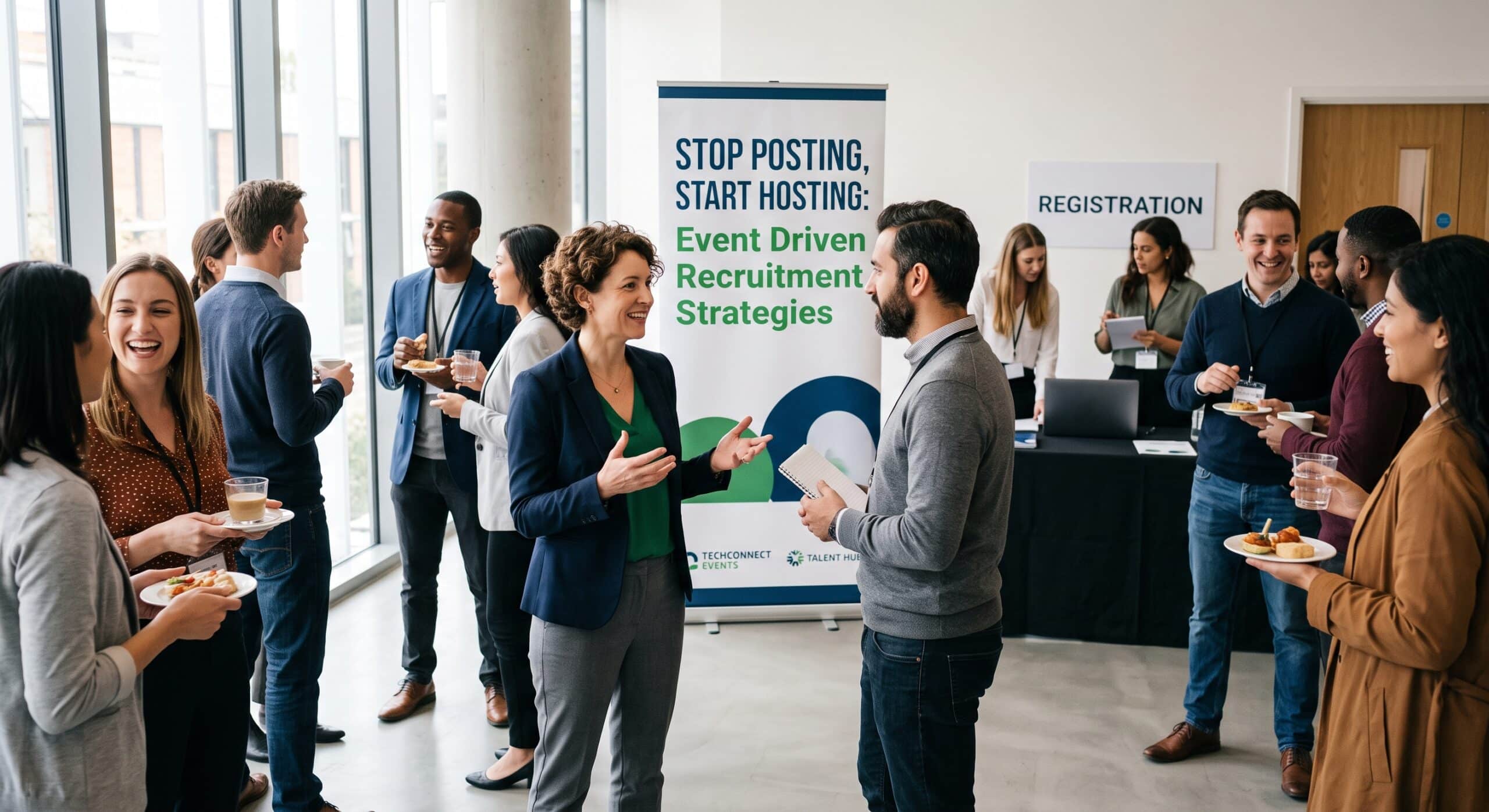
Consequently, live hiring events deserve a central place in modern talent acquisition. After all, a well-designed event turns employer branding from a collection of polished statements into a direct, engaging experience. Through these events, candidates meet employees, ask difficult questions, understand the work clearly, and thereby decide whether the organization fits them.
From the perspective of a Talent Acquisition Systems Architect, the value of an event extends far beyond creating a temporary spike in applications. Indeed, its real value lies in how it connects people, content, recruiting workflows, hiring teams, and measurement into one coordinated experience.
What is Event Driven Recruitment?
Ultimately, that connection forms the foundation of event driven recruitment.
To be clear, an event driven recruitment approach does not mean hosting a broad career fair and simply hoping attendance yields hires. Instead, it means designing a recruiting system in which each event features a clear business purpose, a defined audience, a consistent candidate journey, and measurable outcomes.
Therefore, the goal of event-driven recruitment is not merely more attendees. Rather, the goal is driving more qualified conversations, faster decisions, stronger trust, and a significantly lower cost per hire.
Live Experiences Build Believable Brands
Candidates easily spot employer-brand language that sounds attractive but says very little. For example, words such as “fast-paced,” “inclusive,” “innovative,” and “people-first” appear in thousands of job advertisements. Without concrete evidence, however, these buzzwords fail to differentiate a company.
In contrast, event driven recruitment replaces vague claims with tangible proof:
- For instance, a software engineer can explain directly how the team handles technical disagreements.
- Similarly, a warehouse supervisor can describe the daily realities of shift work.
- Meanwhile, a customer service representative can explain the onboarding process, and a hiring manager can discuss what success looks like during the first 90 days.
Furthermore, these live conversations persuade candidates better than a carefully edited paragraph because they provide rich detail. As a result, candidates can ask follow-up questions and observe whether the answers remain consistent. Additionally, they can see whether employees speak openly and comfortably about the organization.
Of course, authenticity does not require an unscripted or disorganized event. On the contrary, executing successful event driven recruitment requires a clear boundary between preparation and performance. Therefore, prepare employees so they understand the audience, the open roles, and the key topics. Above all, never force them to repeat marketing language that feels unnatural to them.
Generally speaking, the best hiring events share five core qualities:
- Real employees actively participate in the conversation.
- Candidates gain meaningful, structured opportunities to ask questions.
- Employees explain the work honestly, including its most difficult parts.
- In addition, the event reflects the exact employer promise used across other recruitment channels.
- Finally, the recruitment team continues personalized follow-up long after the meeting closes.
Ultimately, an event should leave candidates with an accurate understanding of the company, not merely a positive impression. Because accuracy improves hiring quality, candidates make better-informed decisions before entering the recruitment pipeline.
Design the Infrastructure First for Event Driven Recruitment
Teams often treat a hiring event as a mere marketing project. However, that is a critical mistake. In reality, modern event-driven recruitment serves simultaneously as a marketing experience and an operational recruiting workflow.
Therefore, before selecting a venue, platform, speaker, or promotional channel, define the infrastructure that will support your event driven recruitment strategy.
1. Define the Hiring Objective
Start first with the hiring objective. Specifically, specify the roles, locations, levels, headcount, hiring deadline, and minimum qualification requirements. While a general event for “anyone interested in working here” may generate superficial attention, it usually produces poorly matched leads.
Conversely, focused event driven recruitment attracts the right talent and simplifies promotion. For instance, “Meet the Operations Team: 13 Distribution Roles in the Chicago Area” achieves far more than a vague prompt like “Join Our Virtual Career Event.”
2. Map the Candidate Journey
Next, map out the candidate journey step by step:
- A person discovers the event.
- Then, the person reviews the opportunity and decides whether to register.
- Before the event, the candidate receives reminders and preparation material.
- During the event, the candidate attends a live session.
- Next, the candidate speaks with a recruiter, employee, or hiring manager.
- Afterward, the candidate completes a short qualification step.
- Consequently, the candidate receives a clear next action.
- Finally, the recruiting team records the outcome and follows up promptly.
Crucially, assign a clear owner to every single stage. If nobody owns the transition from attendance to application, valuable candidates will inevitably drop out after the event.
3. Connect Supporting Systems
Furthermore, connect the systems supporting the journey wherever possible:
- Route registration data directly into your recruiting database.
- Simultaneously, capture candidate attendance automatically.
- Record specific candidate interests in your CRM.
- In addition, keep interview availability visible to the recruiting team.
- Lastly, attach all communication history directly to the central candidate record.
Importantly, event-driven recruitment does not require an expensive technology stack—rather, it requires disciplined system design. Indeed, a simple registration form, a reliable scheduling process, a talent database, and clear ownership easily outperform a sophisticated platform that nobody uses consistently.
Build for Conversion, Not Attendance
Attendance is an attractive but incomplete metric. In fact, a large audience can create the illusion of success while yielding very few qualified candidates.
Therefore, high-conversion event driven recruitment begins with a promise that offers genuine value to the candidate. Specifically, design the event to answer pressing questions that matter to your target audience, such as:
- What does a first-year career in this department actually look like?
- How can an experienced technician move into a leadership role?
- Furthermore, what should candidates expect from the interview process?
- In terms of flexibility, how does the company support remote work?
- Lastly, what skills add the most value for entry-level applicants?
Above all, organize content around candidate decisions rather than corporate announcements. Because a long presentation about corporate history rarely converts skilled professionals, focus instead on practical discussions with employees, short demonstrations of daily work, or manager-led explanations of team priorities to keep candidates engaged.
Reduce Registration and Engagement Friction
Additionally, keep registration short. Ask only for information needed to personalize the event or confirm basic fit, since long forms introduce friction before you establish trust.
Where appropriate, create separate paths for different audiences. Although students, experienced professionals, and returning workers may show interest in the same employer, they require distinctly different details. Thus, a single event can feature distinct breakout sessions so each group receives tailored content.
Most importantly, make the final step effortless. Candidates should never have to search for the application page, guess their eligibility, or wait days for instructions.
Create a Clear Path to Action
Instead, provide a direct next step: select an interview slot, submit a short application, join a talent community, or speak privately with a recruiter.
Naturally, match your call to action to the candidate’s readiness. For instance, someone who just discovered the company needs more information, whereas someone who already spoke with an employee is ready for an immediate screening conversation.
This approach turns an event from a simple attendance exercise into a structured recruiting journey. Each interaction should move interested candidates toward a logical next step while giving recruiters enough information to identify genuine hiring potential.
Lower Cost per Hire Through Better Design
Recruiters calculate cost per hire by dividing total recruiting expenditure by the number of hires. Therefore, you must evaluate event spending against actual hiring outcomes—not just registrations or impressions. Indeed, industry providers like iCIMS emphasize that cutting administrative overhead, improving candidate matching, and accelerating scheduling all directly reduce recruitment costs.
To calculate accurately, a complete budget for event driven recruitment must include more than venue or platform fees. Specifically, factor in promotional spending, employee time, recruiter hours, production support, travel, candidate communications, software, and post-event work.
Funnel Metrics to Track
Then, track performance through every stage of the funnel:
- Cost per registration
- Cost per attendee
- Cost per qualified candidate
- Cost per interview
- Cost per offer
- Cost per hire
- Offer acceptance rate
- Finally, new-hire retention after a defined period
Together, these measures reveal exactly where you are losing money. For example, high registration paired with low attendance signals poor reminders or bad timing. On the other hand, strong attendance paired with weak candidate quality points to vague messaging or wrong target channels. Likewise, when candidates complete interviews but reject offers, your event may be generating hype without setting realistic expectations.
Strategic Cost Reduction
Ultimately, precise targeting offers the fastest way to cut costs. Therefore, promote the event through channels that reach people who meet your exact requirements. For instance, employee referrals, professional communities, local partnerships, alumni groups, and hyper-targeted paid campaigns yield far better results than broad advertising.
Recruitics demonstrated this when managing a national hiring event for a restaurant chain: coordinated recruitment marketing generated 13.2 million impressions and over 5,000 hires. However, the key lesson is not that every organization needs massive reach, but rather that event performance peaks when paid, owned, and employee-driven channels work together toward one unified goal.
In addition, reusing content provides another major cost-saving opportunity. Specifically, record key segments, compile candidate questions, and convert those insights into career-site media, recruiter messaging, onboarding resources, or future event agendas. In this way, a single well-produced conversation can support multiple stages of the hiring funnel.
However, content reuse should never turn the event into a passive broadcast. Because live interaction remains your ultimate differentiator, remember that while recorded material educates candidates, real-time conversation builds lasting trust.
Give Hiring Managers a Visible Role
Candidates naturally want to meet the person who will lead their prospective team; yet, many recruiting events rely entirely on recruiters, keeping managers hidden behind the scenes.
Fortunately, hiring managers do not need to deliver a polished keynote. Instead, their most valuable contribution comes from a candid conversation about daily work, team priorities, and what it takes to succeed in the role.
To ensure success, prepare managers with clear guidelines:
- Explain the event’s core goal and target audience.
- Furthermore, agree on the open roles and key requirements beforehand.
- Identify questions that require consistent responses.
- Additionally, clarify which topics they should route to recruiting, legal, or employee relations.
- Practice concise explanations of the role and interview process.
- Finally, set clear expectations for candidate follow-up.
Equally important, select participating employees based on credibility rather than seniority. After all, a candidate often learns more from a peer who joined six months ago than from an executive who rarely interacts with the team.
Above all, represent diverse perspectives across your event team. Because varied tenures, functions, backgrounds, and career paths help candidates visualize their own future within your organization, diversity is essential.
Follow-Up is Part of the Event
The most common failure occurs after the event ends: an organization invests heavily in promotion and production, sends a generic thank-you email, and simply waits.
Unquestionably, that gap destroys your conversion rate.
Therefore, plan your follow-up strategy long before opening registration. Specifically, segment attendees based on their participation and explicit interests:
- Send role-specific information to someone who asked about a specific job.
- In contrast, send a session recording or employee story to an attendee who did not apply.
- Meanwhile, if a candidate completed a screening conversation, ensure a recruiter reaches out immediately.
Granted, speed matters, but relevance matters just as much. For example, blast-sending the same generic message to every attendee feels automated and cold. Conversely, a short, tailored note from a recruiter or team member keeps the relationship warm.
Additionally, always provide closure. If a candidate is not a current fit, explain what happens next and whether you will consider them for future roles. Otherwise, silence damages trust and undermines the employer brand your event worked so hard to build.
Finally, combine quantitative data with qualitative insights in post-event reporting. While hard metrics pinpoint exact conversion rates, candidate feedback explains the sentiment behind them. Therefore, ask attendees if the event clarified the work, answered their key questions, and increased their interest in applying.
A Practical Operating Model
Instead of launching a massive, expensive production right away, start with a repeatable, lightweight operating model:
- First, choose one urgent hiring goal with a firm deadline.
- Next, define the ideal audience and target headcount.
- Build a focused event around authentic employee access and practical role details.
- Keep registration simple and friction-free.
- Simultaneously, reserve interview capacity on hiring managers’ calendars before launching promotion.
- Assign clear owners for marketing, hosting, candidate support, screening, and reporting.
- Finally, review conversion results within 48 hours of event completion.
Through this review, identify which promotional sources delivered qualified talent, which sessions drove the highest engagement, and where candidates dropped off.
Consequently, treat every subsequent event as an upgraded iteration of the last. Adjust one or two variables at a time—such as target audience, event timing, messaging, session length, or follow-up sequence—to build organizational capability over time.
In the end, the strongest recruitment infrastructure is rarely the one with the most software tools. Rather, it is the one that makes the right actions effortless for candidates, recruiters, employees, and hiring managers alike.
Frequently Asked Questions
What is event driven recruitment?
Event driven recruitment is a talent acquisition model that uses live or virtual events as deliberate inflection points in the hiring journey. Instead of treating an event as an isolated promo push, the organization integrates registration, live interaction, screening, interviews, communication, and analytics into one unified recruitment process.
Are live hiring events better than job postings?
They fulfill different roles. Specifically, job postings generate broad reach for active job seekers, whereas live events build deeper relationships and trust. Therefore, the most effective talent strategies leverage job posts to capture demand and live events to drive engagement and conversion.
How can a hiring event reduce cost per hire?
Events lower cost per hire by concentrating recruiting resources on targeted candidate segments, accelerating candidate qualification, speeding up interview scheduling, driving direct applications, and minimizing agency fees. However, to see true cost benefits, you must measure events by completed interviews, offers, and hires rather than headcounts alone.
How many people should attend a hiring event?
No single target fits every scenario. Instead, set target attendance based on open requisitions, team bandwidth, role complexity, and projected conversion rates. In fact, a focused event with 40 highly relevant candidates yields far more value than a crowd of 400 unqualified attendees.
Should the event be virtual, in person, or hybrid?
Match your event format to your audience and work environment. For instance, virtual formats expand geographic reach while eliminating venue overhead. In contrast, in-person events work best when candidates need to tour a physical facility, meet local teams, or assess company culture firsthand. Alternatively, hybrid setups offer accessibility alongside optional in-person touchpoints.
How do we make an event feel authentic?
Feature real employees, encourage open Q&A, showcase actual work conditions, and address challenges honestly. Above all, resist forcing team members to recite corporate scripts, because candidates trust specific, balanced insights far more than generic marketing pitches.
What should happen after the event?
Deliver a clear, relevant next step to every participant. Depending on candidate fit, this could mean an immediate application link, a screening phone call, a direct interview slot, an invite to your talent community, or additional role details. Furthermore, track every follow-up action within your recruiting database.
Which metrics matter most in event driven recruitment?
Focus on cost per qualified candidate, interview rate, offer conversion rate, final cost per hire, time-to-decision, channel source performance, and candidate feedback. Where possible, also track long-term retention and performance of event hires against other sourcing channels.
References
- iCIMS: Cost per Hire: How to Calculate It and How to Reduce It — Breaks down formulas for calculating total talent acquisition spend and highlights practical tactics to lower recruitment overhead.
- Recruitics: Recruitment Marketing Resources & Case Studies — Demonstrates how coordinated multi-channel campaigns drive high candidate conversion rates during large-scale hiring events.
- Talroo: Top Hiring Event Metrics for Talent Acquisition Pros — Outlines crucial performance indicators to track throughout the hiring funnel, from initial registration to offer acceptance.
- Rally Recruitment Marketing: Data-Driven Social Recruiting Strategies — Provides frameworks for evaluating candidate engagement and measuring recruitment marketing ROI.
- SyncMatters: CRM Systems for HR Teams & Talent Pipelines — Explores how recruitment CRMs optimize employer branding and nurture long-term candidate relationships.
- EasyVirtualFair: Recruit at Scale with Branded Hiring Events — Details benchmarks showing how branded hiring events reduce time-to-fill and lower total cost-per-hire.
In conclusion, the future of employer branding will not rely on clever slogans or relentless job postings. Instead, organizations will build authentic brands through credible, real-time experiences that allow candidates to see the work clearly and apply with confidence.
Therefore, stop posting into the void. Start building an event driven recruitment system that makes your work, your culture, and your opportunities real.