
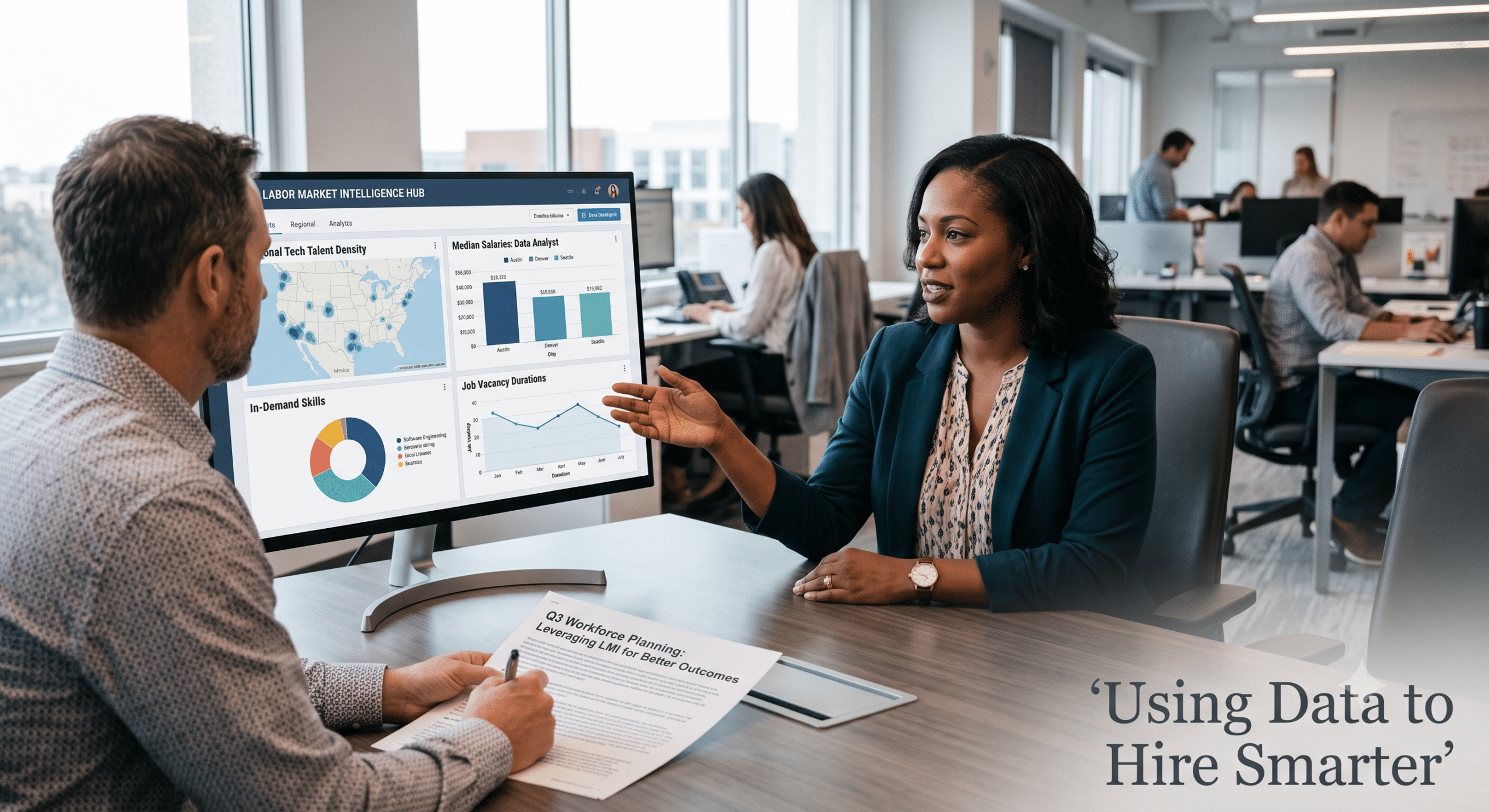
Hiring has changed more in the last few years than it did during the previous decade, making labor market intelligence one of the most valuable tools for modern businesses. Companies are facing changing skill requirements, remote work, artificial intelligence, talent shortages, and rising employee expectations. Instead of relying on guesswork, organizations now use labor market intelligence to understand hiring trends, predict future workforce needs, and make smarter decisions. Combined with Workforce Intelligence, these insights help businesses build stronger teams and stay competitive in a rapidly changing job market.
Companies of every size—from startups to global enterprises—use these insights to answer important questions.
- Are the right skills available?
- Which jobs are becoming harder to fill?
- What salaries remain competitive?
- Which locations have the strongest talent pool?
- What skills will matter over the next few years?
When leaders understand these answers, hiring becomes less risky and far more strategic.
What Is Labor Market Intelligence?
Labor market intelligence is the process of collecting, analyzing, and interpreting employment data to understand how the workforce is changing.
It combines information from multiple sources, including:
- Job postings
- Government employment reports
- Wage and salary data
- Industry hiring trends
- Economic indicators
- Education statistics
- Skills demand
- Workforce demographics
Rather than simply reporting today’s hiring activity, labor market intelligence helps organizations predict future workforce needs.
For example, if software engineering jobs continue growing while qualified candidates remain limited, companies can prepare by expanding recruiting efforts, investing in employee training, or adjusting compensation before hiring becomes even more competitive.
This forward-looking approach allows organizations to stay ahead instead of constantly catching up.
Understanding Workforce Intelligence
Although people often use these terms interchangeably, Workforce Intelligence and labor market intelligence serve different purposes.
Think of Workforce Intelligence as looking inward.
It focuses on information such as:
- Employee performance
- Internal skills
- Productivity
- Turnover
- Promotion readiness
- Learning progress
- Succession planning
- Workforce costs
Labor market intelligence, on the other hand, looks outside the company.
It studies:
- External talent availability
- Industry hiring patterns
- Emerging occupations
- Regional workforce changes
- Salary benchmarks
- Competitor hiring activity
- Skills shortages
- Future employment trends
When organizations combine both perspectives, leaders gain a complete understanding of both current capabilities and future opportunities.
Instead of making hiring decisions based on assumptions, they can make decisions supported by reliable data.
Research from organizations like the OECD continues to show that labor market analysis plays an important role in understanding how technology, artificial intelligence, and automation are reshaping employment and skill requirements. (OECD)
Why Labor Market Intelligence Matters More Than Ever
The workforce no longer changes slowly.
Technology, automation, remote work, and artificial intelligence are constantly reshaping nearly every industry.
Many jobs that existed just five years ago have evolved significantly, while entirely new occupations continue to appear.
Businesses now face challenges such as:
- Rapidly changing technology
- Global competition for skilled workers
- Hybrid and remote work
- Aging workforces
- New employee expectations
- Continuous skill shortages
Without labor market intelligence, organizations often struggle to keep pace.
They may recruit for outdated skills.
They might offer salaries below market rates.
Or they may invest in training programs that no longer match business needs.
By monitoring labor market data continuously, organizations can identify changes much earlier and adjust their workforce strategies before competitors do.
LinkedIn’s Economic Graph regularly highlights how skills-based hiring, internal mobility, and AI adoption are reshaping recruiting across industries, reinforcing the growing importance of labor market intelligence in workforce planning. (LinkedIn)
How Labor Market Intelligence Supports Better Workforce Planning
Planning a workforce isn’t simply deciding how many employees to hire next year.
Modern workforce planning requires understanding where talent is available, what skills are emerging, and how workforce demand is shifting.
For example, imagine a healthcare organization planning to expand into three new cities.
Without labor market intelligence, leadership might estimate staffing needs using historical hiring data alone.
However, labor market intelligence could reveal that one location has a shortage of registered nurses, another city offers stronger healthcare talent, while a third region has rising wage competition.
That information changes hiring strategy entirely.
The company may choose to recruit earlier, adjust salaries, create partnerships with local colleges, or invest in internal development programs.
Instead of reacting to hiring difficulties, leadership prepares before expansion begins.
This proactive planning reduces recruitment delays, lowers hiring costs, and improves long-term workforce stability.
1. It Helps Companies Predict Future Skill Demand
One of the biggest advantages of labor market intelligence is forecasting.
Organizations don’t simply analyze today’s workforce.
They look ahead.
By studying industry hiring patterns, technology adoption, educational trends, and job postings, businesses can identify which skills will become increasingly valuable.
For example, demand has grown rapidly for professionals with expertise in:
- Artificial intelligence
- Cloud computing
- Cybersecurity
- Data analytics
- Machine learning
- Automation engineering
- Digital compliance
- Sustainability reporting
Rather than waiting until these skills become extremely difficult to recruit, organizations can begin:
- Training existing employees
- Building university partnerships
- Creating apprenticeship programs
- Expanding recruitment pipelines
- Updating workforce development plans
This reduces future hiring risks while strengthening organizational resilience.
According to research from the OECD and the International Labour Organization (ILO), advances in AI and digital transformation are accelerating changes in skill demand, making continuous labor market analysis increasingly important for employers and policymakers alike. (OECD)
2. It Helps Organizations Set Competitive Salaries
Finding qualified people is only one part of hiring. Keeping compensation competitive is just as important.
Many companies lose strong candidates because they rely on outdated salary data. A pay range that looked competitive last year may no longer attract skilled professionals today.
This is another area where labor market intelligence provides real value.
Instead of guessing what employees expect to earn, organizations can compare current compensation trends across industries, job titles, experience levels, and geographic regions. They can also monitor how wages are changing as demand increases for certain skills.
For example, a business hiring cybersecurity analysts may discover that salaries have increased significantly because organizations across multiple industries are competing for the same talent. If leadership continues offering last year’s salary range, qualified candidates may accept offers elsewhere before interviews are even completed.
Labor market intelligence also helps employers look beyond base salary. Today’s candidates often compare complete compensation packages, including:
- Health insurance
- Retirement benefits
- Flexible work arrangements
- Paid time off
- Professional development
- Tuition assistance
- Remote work options
- Performance bonuses
Companies that understand these market expectations can create compensation packages that attract high-quality applicants without unnecessarily increasing payroll expenses.
Instead of simply paying more, organizations learn where they can offer greater overall value.
3. It Identifies Talent Shortages Before They Become Hiring Problems
Every industry experiences talent shortages from time to time. The difference is that prepared organizations recognize them early.
Without labor market intelligence, companies often realize there is a shortage only after job openings remain unfilled for months.
By then, projects may already be delayed, workloads increase, and existing employees become overwhelmed.
Labor market intelligence allows organizations to monitor important indicators such as:
- Declining candidate availability
- Rising job posting volume
- Increasing salaries
- Longer hiring cycles
- Graduation rates
- Certification trends
- Workforce retirement patterns
- Regional employment growth
When several of these indicators begin changing together, leaders receive an early warning that hiring conditions are becoming more competitive.
For example, a manufacturing company planning to expand production might discover that experienced industrial maintenance technicians are becoming harder to find in its region. Instead of waiting until expansion begins, the company could:
- Launch apprenticeship programs.
- Cross-train current employees.
- Recruit earlier in the hiring cycle.
- Partner with technical schools.
- Expand recruiting into nearby cities.
Small adjustments made months in advance often prevent major staffing problems later.
That proactive approach reduces recruiting costs while helping operations continue without unnecessary delays.
4. It Supports Better Geographic Hiring Decisions
Location has always influenced hiring, but today it matters even more.
Remote work has expanded recruiting possibilities, while regional differences continue affecting labor availability, salaries, education levels, and competition.
Using labor market intelligence, businesses can compare multiple hiring markets before deciding where to expand operations.
Questions leaders often ask include:
- Which cities have the largest talent pools?
- Where are salaries growing fastest?
- Which regions have lower turnover?
- Are graduates entering this market?
- Is remote hiring more effective than opening another office?
Imagine two cities with similar populations.
City A has several universities producing technology graduates every year.
City B has fewer graduates but much higher demand from competing employers.
Although both markets appear attractive at first, labor market intelligence may reveal that City A offers a much stronger long-term recruiting advantage.
These insights also influence decisions about remote work.
Instead of limiting hiring to one location, organizations can identify regions where qualified professionals are available but competition remains relatively low.
That flexibility often improves recruiting speed while reducing labor costs.
5. It Makes Skills-Based Hiring More Effective
Many organizations have started moving away from hiring based only on degrees or previous job titles.
Instead, they focus on actual skills.
This approach has become increasingly popular because technology changes much faster than traditional education programs.
A candidate who learned cloud computing independently and earned respected certifications may perform just as well as someone with a traditional computer science degree.
Labor market intelligence helps employers understand which skills are becoming more valuable across industries.
Rather than creating job descriptions filled with outdated requirements, hiring teams can focus on capabilities that truly matter.
For example, instead of requiring ten years of experience with one software platform, employers may prioritize skills such as:
- Problem-solving
- Data analysis
- AI literacy
- Project management
- Cloud technologies
- Process improvement
- Automation
- Digital collaboration
This broader perspective increases the available talent pool while improving workforce diversity.
It also supports internal mobility.
Employees who already understand the business can often move into new positions after targeted training rather than requiring organizations to recruit externally.
As industries continue evolving, skills-based hiring has become one of the most effective ways to build a future-ready workforce.
How Artificial Intelligence Is Expanding Labor Market Intelligence
Artificial intelligence has dramatically improved how organizations analyze workforce information.
Years ago, labor market research often involved collecting reports manually, reviewing spreadsheets, and interpreting historical data.
Today, AI can analyze enormous volumes of workforce information in minutes.
Modern workforce intelligence platforms continuously process data from sources such as:
- Online job postings
- Government labor statistics
- Professional networking platforms
- Industry reports
- Economic indicators
- Skills databases
- Compensation surveys
- Education trends
Instead of simply reporting what happened last quarter, AI identifies patterns that humans might overlook.
For example, AI may detect that demand for cloud security specialists has increased across healthcare organizations six months before that trend becomes widely recognized.
This allows employers to prepare earlier by updating recruiting plans, expanding learning programs, or adjusting hiring budgets.
AI also improves forecasting.
Rather than relying only on historical hiring data, predictive models estimate future workforce demand based on changing business conditions, technology adoption, retirement projections, and economic growth.
The result is faster decision-making supported by stronger evidence.
Turning Data Into Better Business Decisions
Collecting information alone does not improve hiring.
The real value comes from turning information into action.
Organizations using labor market intelligence successfully often follow a structured decision-making process.
They begin by identifying their workforce goals.
Perhaps the business plans to launch a new product, expand into another market, or introduce automation across manufacturing facilities.
Next, leaders compare those goals with external labor market conditions.
Do enough qualified workers exist?
How competitive is the hiring market?
Will salaries likely increase?
Should employees be trained instead of hiring externally?
By answering these questions early, organizations reduce uncertainty.
Leadership can allocate recruiting budgets more effectively, prioritize training initiatives, and avoid costly hiring mistakes.
Instead of reacting to labor shortages after they appear, companies prepare while opportunities still exist.
This proactive mindset strengthens workforce planning and supports long-term business growth.
Why Labor Market Intelligence Improves Workforce Intelligence
Although the two concepts are different, they work best together.
Workforce intelligence explains what is happening inside the organization.
Labor market intelligence explains what is happening outside the organization.
When combined, leaders gain a much clearer understanding of their workforce strategy.
For example, workforce intelligence may show that software engineers have a high turnover rate.
Labor market intelligence may reveal that competitors recently increased salaries and expanded remote work opportunities.
Together, these insights explain not only what is happening but also why it is happening.
That deeper understanding allows organizations to create more effective retention strategies, improve hiring plans, and invest in employee development before turnover becomes a larger problem.
The strongest workforce strategies are rarely based on internal data alone. They combine employee insights with external labor market trends to support smarter, more informed decisions.
6. It Strengthens Workforce Planning During Economic Change
Economic conditions rarely stay the same for long. Inflation, new technology, changing consumer demand, and global events can all influence hiring within a short period.
Organizations that depend only on internal reports often struggle to react quickly. However, businesses that use labor market intelligence can recognize changes sooner and adjust their workforce plans before those changes begin affecting operations.
For example, a retail company may notice that consumer spending is slowing. At the same time, labor market data may show that logistics and warehouse jobs continue to grow because of increased online shopping. Instead of freezing all hiring, leadership can shift recruiting efforts toward positions that support long-term business goals.
The same approach helps during periods of rapid growth.
Suppose a healthcare provider plans to open several new clinics. Labor market intelligence can identify which communities have enough qualified nurses, technicians, and administrative staff to support expansion. If talent shortages appear likely, the organization can begin recruiting months in advance or invest in employee development programs.
Planning ahead reduces costly surprises and helps organizations stay flexible, even when economic conditions change quickly.
7. It Improves Employee Development and Retention
Hiring new employees is expensive, but losing experienced workers can cost even more.
Replacing a skilled employee often involves advertising the position, screening applicants, interviewing candidates, onboarding new hires, and allowing time for training before full productivity returns.
Because of these costs, many organizations now focus just as much on retaining talent as recruiting it.
Labor market intelligence supports retention by showing which skills are becoming more valuable and where employees may have opportunities elsewhere.
For example, if market data shows rising demand for cloud engineers or cybersecurity specialists, organizations can respond before employees begin searching for new jobs.
Instead of waiting for resignations, employers can:
- Offer targeted training programs.
- Create clear career advancement opportunities.
- Introduce mentoring initiatives.
- Review compensation packages.
- Expand internal mobility options.
- Support professional certifications.
Employees are more likely to remain with an organization when they see opportunities to grow their skills and advance their careers.
This strategy also benefits employers by building stronger internal talent pipelines.
Rather than hiring externally for every leadership role, organizations can prepare existing employees for future responsibilities.
As a result, labor market intelligence supports both workforce stability and long-term organizational success.
8. It Helps Leaders Make Faster, More Confident Decisions
Business leaders make workforce decisions every day.
Should the company expand into a new region?
Is now the right time to hire?
Should employees be trained instead of recruiting externally?
Is automation likely to reduce future hiring needs?
Without reliable information, these decisions often rely on assumptions or past experience alone.
Labor market intelligence replaces uncertainty with evidence.
Instead of asking, “What do we think will happen?” leaders can ask, “What does the data tell us?”
For example, before launching a new software development center, executives can review labor market information to understand:
- The number of qualified software developers in the region.
- Average salary expectations.
- Competition from other employers.
- Local graduation rates.
- Remote hiring opportunities.
- Long-term workforce availability.
These insights help organizations avoid costly hiring mistakes while improving the speed and quality of workforce planning.
Decision-makers become more confident because their strategies are based on current market conditions rather than outdated assumptions.
Common Mistakes Organizations Make with Labor Market Intelligence
Although labor market intelligence offers valuable insights, organizations do not always use it effectively.
One common mistake is relying on outdated information.
The labor market changes quickly. Data that was accurate a year ago may no longer reflect current hiring conditions, salary expectations, or emerging skills. Reviewing fresh information regularly helps organizations stay aligned with today’s workforce realities.
Another mistake is focusing only on hiring.
Labor market intelligence should influence far more than recruitment. It can improve workforce planning, learning and development, succession planning, compensation strategies, location planning, and long-term business growth.
Some organizations also collect large amounts of workforce data without translating it into action.
Reports alone do not solve hiring challenges.
Leaders need to turn insights into practical decisions by updating recruiting strategies, investing in employee development, and preparing for future workforce needs.
Finally, many companies overlook collaboration.
Human resources, finance, operations, and executive leadership should all contribute to workforce planning. When departments work together, labor market intelligence becomes far more valuable because every decision reflects both business priorities and workforce realities.
Best Practices for Using Labor Market Intelligence
Organizations that gain the most value from labor market intelligence usually follow a consistent process rather than treating it as a one-time project.
Start by defining clear workforce objectives. Whether the goal is expanding into a new market, improving employee retention, or preparing for future growth, having a specific direction makes labor market data much more meaningful.
Next, combine external labor market information with internal workforce intelligence. Looking at both perspectives provides a complete understanding of current capabilities and future workforce requirements.
Regularly review hiring trends instead of waiting until positions become difficult to fill. Monitoring job demand, compensation changes, and emerging skills allows organizations to make adjustments before shortages affect productivity.
Investing in workforce development is equally important. Labor market intelligence often highlights skills that will become more valuable in the future. Training current employees to develop those capabilities can reduce recruiting costs while strengthening employee loyalty.
Finally, measure the results of workforce decisions. Tracking metrics such as time-to-fill, employee retention, hiring quality, internal promotions, and workforce productivity helps organizations evaluate whether their strategies are delivering the expected outcomes.
Continuous improvement keeps workforce planning aligned with changing business needs.
The Future of Workforce Intelligence
The future of Workforce Intelligence will rely even more on real-time data, predictive analytics, and artificial intelligence.
Instead of reviewing workforce reports once or twice a year, organizations are beginning to monitor labor market conditions continuously.
AI-powered platforms can identify changes in hiring demand, emerging occupations, salary trends, and skill shortages almost as they happen.
At the same time, businesses are moving toward skills-first workforce strategies.
Rather than hiring based primarily on degrees or job titles, employers increasingly evaluate candidates based on demonstrated skills, certifications, project experience, and learning potential.
Another important trend is greater collaboration between workforce planning and business strategy.
Workforce decisions are no longer viewed as HR responsibilities alone. Executive leaders, finance teams, operations managers, and department heads all recognize that workforce planning directly affects growth, innovation, customer experience, and long-term competitiveness.
Organizations that combine workforce intelligence with labor market intelligence will be better prepared to adapt to changing economic conditions, emerging technologies, and evolving workforce expectations.
Rather than reacting to change, they will be positioned to lead it.
Conclusion
Organizations can no longer rely on instinct alone when making workforce decisions. The pace of change is simply too fast. New technologies, evolving employee expectations, shifting economic conditions, and increasing competition for skilled professionals all require a smarter approach to workforce planning.
This is why labor market intelligence has become an essential part of modern Workforce Intelligence.
By analyzing external labor market trends alongside internal workforce data, organizations gain a complete picture of their talent landscape. They can identify future skill needs, build competitive compensation strategies, prepare for labor shortages, improve employee development, and make better long-term business decisions.
The most successful organizations don’t wait until hiring becomes difficult. Instead, they continuously monitor labor market conditions and adjust their workforce strategies before challenges become major obstacles.
Whether you’re a small business planning your next hire or a large enterprise developing a multi-year workforce strategy, investing in labor market intelligence provides a significant competitive advantage.
As artificial intelligence, automation, and skills-based hiring continue transforming the workplace, businesses that embrace data-driven workforce planning will be better prepared for whatever comes next.
The future of Workforce Intelligence isn’t just about understanding your employees. It’s about understanding the labor market around you and using that knowledge to build a stronger, more resilient workforce.
Frequently Asked Questions
What is labor market intelligence?
Labor market intelligence is the collection and analysis of employment data, workforce trends, salary information, skill demand, and economic indicators. Organizations use this information to make informed decisions about hiring, workforce planning, compensation, and employee development.
How is labor market intelligence different from workforce intelligence?
Workforce intelligence focuses on data inside an organization, such as employee performance, turnover, productivity, skills, and succession planning.
Labor market intelligence focuses on external factors, including hiring trends, talent availability, compensation benchmarks, emerging occupations, and labor supply. Together, they provide a complete view for workforce planning.
Why is labor market intelligence important?
It helps organizations:
- Predict future hiring needs.
- Understand skill shortages.
- Offer competitive salaries.
- Improve workforce planning.
- Reduce recruitment risks.
- Support employee development.
- Strengthen long-term business strategy.
These insights help organizations make faster and more informed workforce decisions.
Who uses labor market intelligence?
Many professionals rely on labor market intelligence, including:
- Human Resources leaders
- Talent acquisition teams
- Workforce planners
- Business executives
- Government agencies
- Economic development organizations
- Educational institutions
- Workforce development professionals
Each group uses labor market insights to improve planning and decision-making.
What data sources are used for labor market intelligence?
Organizations commonly analyze information from:
- Government employment statistics
- Online job postings
- Salary surveys
- Professional networking platforms
- Industry reports
- Economic indicators
- Education and graduation data
- Workforce demographic statistics
Combining multiple data sources produces a more accurate view of labor market conditions.
How does artificial intelligence improve labor market intelligence?
Artificial intelligence analyzes large volumes of workforce data much faster than manual research. AI can identify hiring trends, predict future skill demand, detect compensation changes, and uncover patterns that help organizations make proactive workforce decisions.
Can small businesses benefit from labor market intelligence?
Absolutely. Small businesses often have limited hiring budgets, making every hiring decision important. Labor market intelligence helps them understand local talent availability, competitive salaries, and emerging workforce trends, allowing them to recruit more effectively while controlling costs.
What industries benefit the most from labor market intelligence?
Nearly every industry can benefit, including:
- Healthcare
- Manufacturing
- Information technology
- Financial services
- Retail
- Construction
- Government
- Education
- Logistics
- Professional services
Any organization that hires employees can use labor market intelligence to improve workforce planning.
Final Thoughts
The organizations that succeed in the years ahead will not simply hire more people—they will hire smarter, develop talent continuously, and adapt quickly to changing workforce conditions. Labor market intelligence provides the insights needed to make those decisions with confidence. When combined with Workforce Intelligence, it becomes a powerful foundation for building an agile, skilled, and future-ready workforce that can support sustainable business growth.
References
The following authoritative resources provide reliable research, labor market data, and workforce insights for organizations, HR professionals, and workforce planners:
- LinkedIn Economic Graph – Workforce Data – Labor market reports, hiring trends, skills insights, and workforce analytics. (LinkedIn Economic Graph)
- International Labour Organization (ILO) – Data and Statistics – Global labor statistics, employment data, and workforce indicators through ILOSTAT. (International Labour Organization)
- Organisation for Economic Co-operation and Development (OECD) – Empowering the Workforce in the Context of a Skills-First Approach (2025), covering skills-first hiring, labor market trends, and workforce policy. (OECD)
- U.S. Bureau of Labor Statistics (BLS) – Research and statistics on employment, occupations, wages, productivity, and the impact of emerging technologies on labor markets. (Bureau of Labor Statistics)
- World Bank Group & LinkedIn – Research on jobs, workforce skills, labor mobility, and labor market analytics using LinkedIn Economic Graph data. (World Bank)
- LinkedIn Economic Graph Research Resources – Publications exploring workforce trends, skills demand, hiring patterns, and labor market analysis. (LinkedIn Economic Graph)