
The way companies find, attract, and hire talent has officially hit a wall, sparking a massive shift toward multi agent AI recruitment architectures. For decades, corporate hiring teams have relied heavily on Applicant Tracking Systems to manage their pipelines. Let’s be entirely honest about these platforms, though. Ultimately, they are just glorified digital filing cabinets. They do not hunt for talent, nor do they understand human nuance. Furthermore, they certainly do not make life easier for busy hiring teams. Instead, human recruiters spend hours clicking through endless menus. Consequently, they must sort through piles of unvetted resumes while they manually move candidates from one pipeline stage to the next.
Similarly, the first wave of artificial intelligence tools did very little to solve this fundamental workflow problem. When generative AI hit the mainstream, people assumed the administrative burdens of hiring would disappear overnight. Instead, however, we simply received faster ways to write generic job descriptions. In addition, we generated massive batches of outbound template emails to spam professionals on LinkedIn. Therefore, these early tools still required a human operator to constantly manage them. Recruiters sat in front of a screen all day typing out perfect prompts. Meanwhile, they fixed errors and manually transferred data across disconnected software programs. As a result, the human recruiter remained the primary bottleneck.
Today, fortunately, we are witnessing a massive structural shift in the industry. This positive change comes from the rise of specialized automation systems. As an AI solutions architect and HR technology architect, I look at hiring through a specific operational lens. Specifically, how can a business maximize its talent pipeline throughput? Likewise, how do we radically slice down overall cycle times? Most importantly, how do we minimize the candidate scrap rate to virtually zero?
When you move away from isolated AI tools and embrace a coordinated network, you do not just automate isolated chores. On the contrary, you actually build an autonomous hiring engine that operates around the clock. These digital specialists work together like a highly trained human team. To achieve this, each agent carries its own specific role, independent memory, and distinct objective. Thus, they cooperate flawlessly to handle a wide-open corporate job opening. Eventually, they turn it into a short list of deeply engaged, perfectly qualified professionals. Let’s break down the core architectural pillars that make this approach the new gold standard.
1. What Is a Multi-Agent AI System Anyway?
To understand this shift, we must look closely at how it differs from traditional automation. First of all, traditional software automation relies entirely on rigid, if-then logic loops. Consequently, it is completely blind to context. For example, a basic automation rule might send a pre-written confirmation email when a candidate clicks apply. However, the software cannot think or adapt to unique situations. Furthermore, it cannot handle unexpected variables. If something goes even slightly off the rails, the automation breaks down completely. Therefore, it requires a human engineer to jump in and fix the code.
With a multi agent AI recruitment architecture, instead, you deploy a dynamic ecosystem of highly specialized digital entities. These agents possess deep situational awareness. Moreover, they do not just follow a rigid line of code. Instead, they possess high-level goals and the autonomy to find the best way to achieve them. For instance, they can read text, analyze data patterns, and weigh different options. Then, they communicate with other agents using advanced language models as their core reasoning engine.
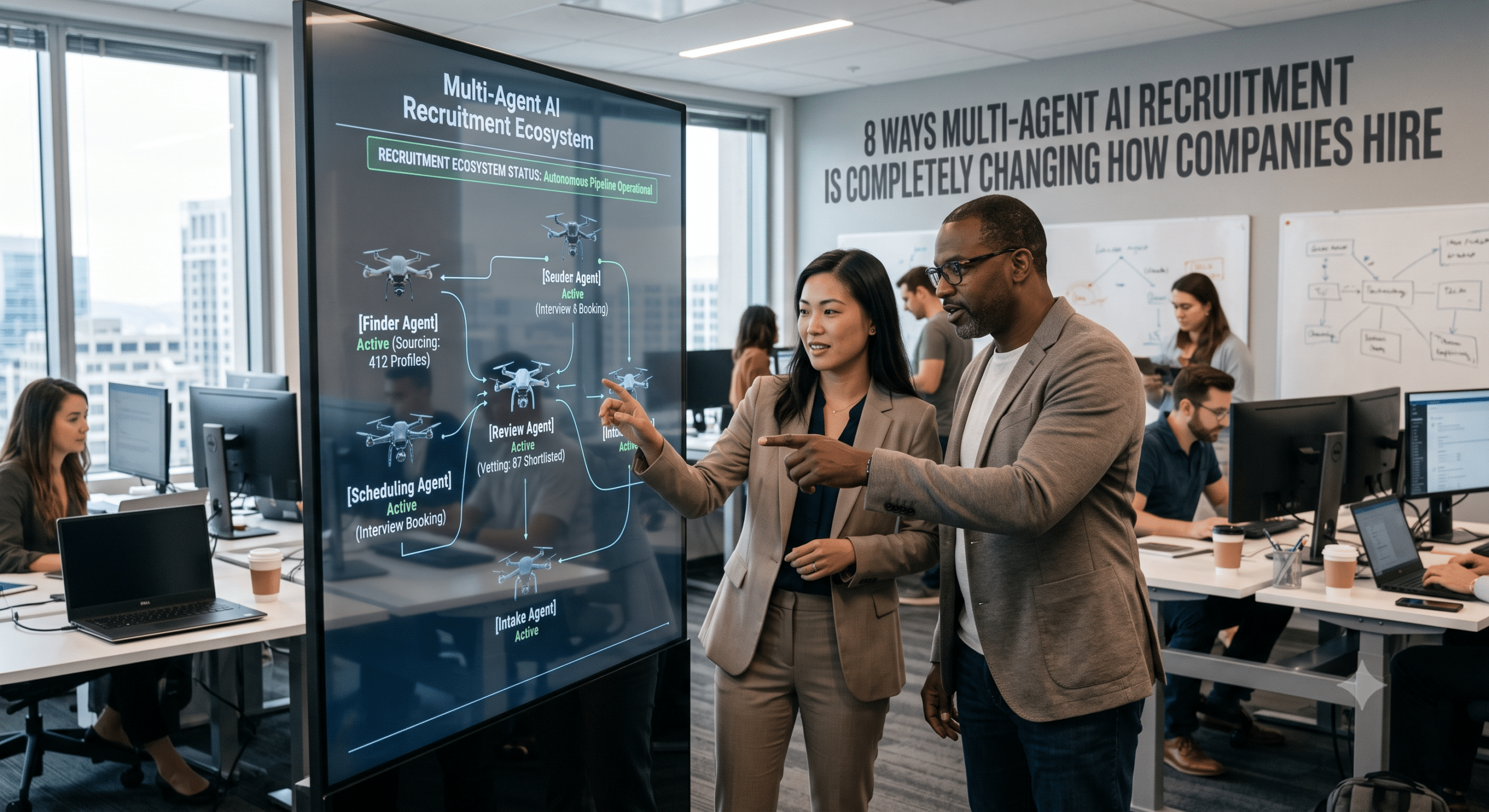
[Job Setup Agent] ──> [Finder Agent] ──> [Review Agent] ──> [Scheduling Agent]
Organizing the Digital Assembly Line
In this advanced ecosystem, digital agents operate exactly like a highly synchronized assembly line. For example, one agent works exclusively to understand the hiring manager’s deepest team needs. It moves far beyond basic keywords to grasp the actual mission of the role. Once it maps out those requirements, it immediately passes a rich packet of conceptual data to the finder agent. Next, this agent spends its cycles scouring public networks and internal databases.
The finder agent then hands its discoveries off to the review agent for deep qualification vetting. Afterward, this step subsequently triggers the scheduling agent to initiate immediate human outreach. These digital specialists constantly pass context back and forth through a unified data layer. Because of this seamless handoff, the candidate moves forward smoothly and instantly. Thus, your team avoids weekly batch processes, data drop-offs, and manual clicks to keep the momentum going. Modern systems leverage this orchestration layer to ensure that the process remains efficient and error-free throughout the day.
2. Finding Great People at Massive Scale
The oldest and most frustrating bottleneck in talent acquisition is the limitation of human bandwidth. Specifically, a human recruiter only has a finite number of hours in their workday. For this reason, a person can only look at a few dozen profiles or resumes before cognitive fatigue sets in. When eyes glaze over, your team misses great talent. Consequently, judgment becomes inconsistent. Ultimately, the overall throughput of the hiring funnel hits a hard operational ceiling.
In contrast, an integrated framework for multi agent AI recruitment completely removes this ceiling from your business model. Finder agents do not sleep, nor do they experience fatigue. Instead, they process immense volumes of data simultaneously across dozens of different platforms. For example, they scan your internal applicant databases. At the same time, they explore your historical candidate relationship platforms. Furthermore, they scour public professional networks all at the exact same time, twenty-four hours a day.
Analyzing Careers with Deeper Context
More importantly, these autonomous agents do not rely on brittle, old-school keyword strings. Traditional keywords often exclude great people who simply used different titles on their resumes. Instead, these agents use deep talent intelligence to read between the lines of a career history. For instance, they analyze the true trajectory of a candidate’s promotions. Likewise, they evaluate the specific scale and scope of past projects. Finally, they contrast this journey against the historical patterns of your company’s best internal hires. By processing thousands of profiles concurrently with this level of care, the architecture ensures your pipeline always holds incredible talent.
3. Cutting Down the Endless Waiting Time
We have all experienced the dreaded corporate hiring black hole. First, you find a position that fits your skillset perfectly. Next, you spend an hour tailoring your application and click submit. Then, unfortunately, weeks go by without a single whisper of feedback. This painful delay does not happen because recruiters are mean or indifferent. Rather, it happens because administrative chaos completely overwhelms them. Consequently, it buries them under an avalanche of emails. It also keeps them stuck playing endless games of calendar tag with busy internal hiring managers.
In the modern business landscape, this long cycle time introduces incredible risk. Indeed, the absolute best talent on the market usually leaves the market within a matter of days. Suppose your organization takes two weeks just to review an initial application and schedule a first phone call. As a result, your competitors will snap up those top-tier professionals before you even have a chance to say hello.
Erasing the Dead Space Between Steps
Fortunately, implementing multi agent AI recruitment networks attacks this operational delay by completely wiping out the dead space between hiring steps. The exact millisecond a review agent determines that an applicant meets the benchmarks for an open role, it instantly pings the outreach and scheduling agent.
This agent immediately connects with the candidate through their preferred communication channel. To do this, it uses email, text, or a modern messaging app. Additionally, it answers the candidate’s immediate questions and checks their availability. Then, it balances this availability against the internal team’s calendar and locks in the interview slot immediately. Consequently, a process that traditionally required multiple weeks of back-and-forth messaging compresses into a seamless, satisfying ten-minute interaction.
4. Making Sure Great Candidates Don’t Drop Out
In the manufacturing world, operations managers keep a hawk-like eye on their scrap rate. This metric tracks the percentage of raw materials that get damaged or thrown away during production. Similarly, in recruitment, your scrap rate is just as critical. It consists of two incredibly expensive problems. First, high-quality candidates drop out of your pipeline out of sheer frustration because your communication lagged. Second, unqualified candidates accidentally slip through loose early screens and waste hours of interview time with your expensive leaders.
Naturally, minimizing this talent scrap rate requires an absolute commitment to two things. First, you need highly precise, multi-layered screening. Second, you must maintain an unbroken, deeply engaging candidate experience. If either of these pieces falls apart, your hiring efficiency plummets. Thus, your cost-per-hire skyrockets.
All Applications
  │
  ├──> [Smart AI Screening] ──> Unqualified Profiles Filtered Out (Saves Time)
  │
  └──> Top Candidates ──> [Instant Chat Agent] ──> 0% Dropouts Due to Long Delays
Balancing Consistency and Communication
To prevent this, structural deployments of multi agent AI recruitment provide a robust safety net that stops these costly system leaks. Review agents evaluate every single applicant using identical, deeply objective criteria rooted in actual skill validation. Because of this standardization, the system completely neutralizes the risk of human bias or a rushed, careless review. Therefore, every candidate gets a fair, thorough look.
Simultaneously, specialized communication agents maintain an open, proactive relationship with every professional in the pipeline. For example, they provide real-time updates. Furthermore, they offer clear transparency about what to expect next. They also answer questions about corporate culture, health benefits, or remote-work policies instantly. Because candidates feel valued and informed from day one, dropout rates caused by corporate neglect disappear entirely.
5. Why One Big AI Tool Is Not Enough
A very common mistake enterprise leadership teams make is assuming they can solve their talent acquisition challenges with a single, large-scale general AI model. Usually, they buy a license for a mainstream corporate chatbot. Then, they instruct their recruiters to use it for everything and expect immediate miracles. However, forcing a single language model to handle intake, sourcing, screening, copywriting, and calendar scheduling all at the same time introduces massive operational fragility into your workflows.
Specifically, when you force a single AI model to switch contexts constantly between completely different tasks, it suffers from context drift. Consequently, it starts to lose track of details. Furthermore, its processing speeds slow down dramatically. It even begins to experience hallucinations or make critical logical errors. Therefore, if that single model runs into a glitch or experiences downtime, your entire hiring workflow grinds to a sudden, painful halt.
Compartmentalizing the Cognitive Workload
In contrast, a multi agent AI recruitment framework completely bypasses this vulnerability. It elegantly distributes the cognitive load across an entire team of digital specialists instead. Each individual agent operates within a clearly defined boundary. Moreover, it uses a highly optimized, single-purpose instruction set. Because of this isolation, it executes its specific task with world-class accuracy.
Suppose a specialized sourcing agent hits a major data formatting issue on an obscure, poorly coded global resume database. That minor hitch remains completely contained within its own process boundary. Thus, it does not disrupt the rest of your operation. Meanwhile, the scheduling agent keeps right on booking interviews. Similarly, the review agent keeps right on vetting candidates. As a result, your overall hiring pipeline keeps moving forward without skipping a single beat.
6. Keeping the Hiring Process Warm and Human
Whenever the topic of autonomous hiring systems comes up in corporate boardrooms, someone inevitably raises a hand to express deep concern. Usually, they worry that incorporating more artificial intelligence will make the application process feel cold, robotic, and entirely corporate. It is a very valid concern on the surface. After all, nobody wants to feel like a faceless, uncaring digital meat grinder is processing them when they look for their next major career step.
The Problem with Human-Centric Chores
But let’s take a realistic, honest look at the traditional human-centric hiring model today. Frankly, it already feels incredibly cold and robotic. Administrative tasks, spreadsheets, and broken software links completely bury human talent acquisition teams. For this reason, recruiters simply do not have the physical time to treat people like human beings. Consequently, they cut corners and ignore messages. Then, they send out automated, boilerplate rejection emails six months after a candidate applies.
Freeing Human Teams for Authentic Connection
This is the great paradox of modern systems. By deploying specialized digital entities to handle all the tedious administrative underpinnings of your pipeline, you finally give your human recruiters the freedom to be truly human again.
Consequently, when a human recruiter steps into a conversation or a phone call with a candidate, they no longer feel stressed or rushed. Furthermore, they do not have to flip desperately through notes to remember who they are talking to. Instead, the multi-agent network has already done the heavy lifting. For instance, it organizes a beautiful, comprehensive digest of the candidate’s core strengths, aspirations, and technical highlights. This allows the human recruiter to spend one hundred percent of their energy doing what humans do best. Specifically, they build authentic relationships. They also share inspiring stories about company culture. Ultimately, they understand personal career motivations and successfully close top-tier talent.
7. Growing and Shrinking with the Business
In the modern corporate world, business needs are highly volatile. Indeed, they change with lightning speed. An enterprise organization might win a massive international contract, for example. Therefore, they suddenly need to hire fifty specialized software developers and product managers across three continents this month. Then, six months later, their market strategy shifts. Consequently, they might completely pause hiring for those roles and pivot to expanding their enterprise sales teams instead.
For a traditional, human-centric human resources department, managing these violent macroeconomic swings is an absolute nightmare. First, scaling a human recruiting team upward to handle a massive hiring spike requires an incredible amount of capital. Second, it takes months of onboarding time and extensive training. Worse yet, when the hiring wave inevitably slows down, companies must execute painful, demoralizing rounds of layoffs to bring their overhead costs back in line with reality.
Activating Elastic Recruiting Power
In contrast, enterprise multi agent AI recruitment architectures provide your business infrastructure with complete, frictionless elasticity. Suppose your executive leadership team decides to ramp up hiring across four new international technical hubs simultaneously. Your tech team does not need to launch an expensive, months-long recruiter search. Instead, they can simply spin up additional instances of your pre-configured sourcing and screening agents within your cloud infrastructure.
These digital specialists will immediately scale up their processing power. Furthermore, they work through the night to map out the new talent landscapes without needing rest, coffee breaks, or onboarding. Later, when your hiring goals are achieved and things naturally quiet down, you can simply wind those digital instances back down instantly. Therefore, your operational overhead aligns perfectly with your real-time business needs. Ultimately, you completely protect your internal staff from burnout and layoffs.
8. Learning and Getting Smarter Every Single Day
The final, and perhaps most powerful, pillar of a sophisticated multi-agent recruitment ecosystem is its unique ability to engage in continuous, self-driven optimization. In a traditional corporate talent acquisition setup, the hiring process is completely fractured. For instance, a recruiter might find a slate of candidates that look great on paper. But when those candidates finally sit down with the actual hiring manager, they fail to pass the interview. This failure often stems from a subtle lack of cultural alignment or specific domain experience.
In a traditional system, unfortunately, that crucial feedback engineering rarely makes its way back to the beginning of the funnel in a structured, actionable way. The recruiter simply shrugs and tries to guess what went wrong. Then, they go back to searching using the exact same flawed parameters. Therefore, the system never learns from its mistakes. This leads to repeated cycles of wasted time, frustrated hiring managers, and extended vacancies.
Building a Closed-Loop Infrastructure
In a mature framework, however, every single interaction, evaluation, and human decision serves as a powerful data signal. This signal instantly updates the entire ecosystem. For example, when a human hiring manager interviews a candidate and inputs their detailed notes into the system, the central coordination agent reads that feedback. Next, it analyzes the specific nuances of the manager’s critiques. Immediately following this, it updates the behavioral and cognitive parameters for the sourcing and screening agents.
Consequently, the finder agent will automatically measure the very next profile it retrieves against this newly refined criteria. This creates a beautifully tight, closed-loop feedback mechanism. Thus, your talent acquisition engine literally gets smarter, sharper, and more aligned with your specific business culture with every single interview. Ultimately, it steadily drives your hiring success rate to maximum heights.
Frequently Asked Questions
What is the main difference between basic hiring tools and multi-agent AI?
Basic recruitment tools can only perform simple, repetitive tasks that follow strict rules. For example, they send an automated email notification when a human recruiter clicks a specific checkbox in an ATS. On the other hand, a multi agent AI recruitment system utilizes a network of independent, highly intelligent digital entities. These agents use advanced language models to reason, adapt to changing information, and solve complex problems. Furthermore, they pass rich contextual insights to one another without requiring a human to manually prompt them at every turn.
Will these AI agents take away human recruiting jobs?
Absolutely not. On the contrary, these systems are explicitly designed to eliminate heavy, soul-crushing administrative burdens. This tedious work currently consumes up to seventy percent of a human recruiter’s typical workweek. Therefore, by handling global sourcing, initial data validation, and multi-party calendar coordination completely automatically, the AI agents free up human HR professionals. Consequently, recruiters can then focus entirely on strategic workforce planning, deep candidate relationship building, and high-impact interview closing.
How do multi-agent systems keep things fair for applicants?
First and foremost, modern systems evaluate every single candidate application using identical, highly objective structural frameworks. These frameworks root themselves purely in proven skills, past performance, and verified competencies. Unlike human reviewers, digital agents do not experience physical fatigue. Moreover, they do not rush through resumes because they are running late for a meeting. Most importantly, they are completely immune to the unconscious biases that frequently distort human judgment. This ensures a remarkably fair top-of-funnel evaluation for everyone.
Can these digital agents work with our current software?
Yes, they can. Modern architectures sit directly on top of the enterprise platforms that major companies already have in place. For instance, they integrate with standard Applicant Tracking Systems and Candidate Relationship Management software. To do this, they connect smoothly via secure, robust APIs. Consequently, this connection ensures that all candidate interactions, profile updates, evaluation notes, and scheduling milestones flow directly into your central system of record in real time.
Further Reading
-
For a deep dive into the underlying technology and tools shaping autonomous hiring workflows, check out the comprehensive overview on AIHR – AI Agents for Recruiting: How They Work + Top 9 Tools.
-
To see how recruitment agencies and search firms are deploying these systems to scale operations, read the tactical breakdown over at Recruiterflow.
-
To understand the functional benefits of modern semantic matching over traditional keyword filtering, explore the architecture insights featured on Findem.