

To begin with, modern organizations no longer compete only with better products or lower prices. Instead, they compete with better people, stronger capabilities, and the ability to map and develop talent faster than everyone else using a strategic skills ontology.
Furthermore, as a Jobs and Skills Architecture Consultant, I’ve seen companies spend millions on hiring while overlooking one of their greatest assets—the skills they already have. Although many organizations know employee job titles, departments, and years of experience, very few truly understand the skills behind those titles.
Consequently, this is where skills intelligence becomes undeniably valuable.
Ultimately, at the center of every successful skills intelligence strategy is a well-built skills ontology. Admittedly, while the term may sound technical, the idea is actually simple. In essence, it gives organizations a smarter way to organize, connect, understand, and use workforce skills.
Rather than viewing skills as isolated checkboxes, a skills ontology specifically shows how skills relate to jobs, learning paths, certifications, projects, and future career opportunities. As a result, this creates a living map of workforce capability that helps leaders make better hiring, learning, workforce planning, and talent decisions.
In this guide, I will explain what a skills ontology is, why it matters, and the first steps organizations should take to build one that supports long-term business growth.
What Is Skills Intelligence?
Fundamentally, skills intelligence is the practice of collecting, organizing, analyzing, and using workforce skills data to make smarter talent decisions.
Rather than relying only on resumes or job titles, organizations instead evaluate what employees actually know and what they are capable of doing.
To illustrate, skills intelligence helps answer questions like:
-
What skills already exist inside the company?
-
Which critical skills are missing?
-
Who can move into new roles?
-
Which employees are ready for promotion?
-
Where should training investments go?
-
Which future skills will become important?
Therefore, instead of making assumptions, leaders gain evidence. Undeniably, that changes everything.
Why Traditional Job Descriptions Are No Longer Enough
Historically, for decades, organizations managed talent around job titles. For instance, examples include:
-
Marketing Manager
-
HR Specialist
-
Sales Director
-
Software Engineer
However, job titles don’t explain capability. In fact, two Software Engineers may have completely different expertise.
For example, one may specialize in:
-
Python
-
Cloud Architecture
-
Kubernetes
Meanwhile, another may focus on:
-
Mobile Development
-
Swift
-
UI Design
Despite having the same title, they possess completely different skills. Because of this, organizations are moving from job-based management toward skills-based organizations. Naturally, that shift begins with building a skills ontology (360Learning).
What Is a Skills Ontology?
By definition, a skills ontology is a structured framework that organizes skills while also showing how they relate to one another, to job roles, learning content, certifications, projects, and career paths.
Unlike a simple spreadsheet, it captures relationships. In other words, think of it as a living knowledge map for workforce capability.
Instead of simply saying “SQL is a database skill,” a skills ontology might conversely show that SQL connects to:
-
Data Analytics
-
Business Intelligence
-
Data Engineering
-
Reporting
-
Data Visualization
-
Machine Learning preparation
-
Database Administration
As a result, those relationships create context. Moreover, as business needs change, the ontology evolves too, thus making it far more useful than static lists of competencies (360Learning).
Think of It Like Google Maps
To clarify, here’s a simple comparison I often use with executives. Initially, a traditional skills list is like having a phone book. Granted, you know what exists, but you don’t know how everything connects.
On the other hand, a skills ontology works like Google Maps. Specifically, it shows:
-
Connections
-
Routes
-
Relationships
-
Alternatives
-
Shortest paths
-
Neighboring skills
Undoubtedly, that’s exactly what HR leaders need. Therefore, instead of seeing isolated skills, they see an interconnected workforce.
Skills Ontology vs Skills Taxonomy
Frequently, many organizations confuse these two terms. Although related, they serve different purposes.
| Skills Taxonomy | Skills Ontology |
| Organizes skills into categories | Maps relationships between skills |
| Static structure | Dynamic structure |
| Focuses on classification | Focuses on intelligence |
| Simple hierarchy | Connected network |
| Easier to build | More valuable over time |
Therefore, imagine a taxonomy as a filing cabinet. Meanwhile, an ontology is an interactive city map. Certainly, both are useful; however, only one helps you discover new pathways between people, jobs, and opportunities (360Learning).
The Building Blocks of a Skills Ontology
Generally, every successful skills ontology usually includes several connected elements.
First, Skills. For instance, examples include:
-
Python
-
Public Speaking
-
Strategic Planning
-
Data Analysis
-
Financial Modeling
Second, Job Roles. Specifically, examples include:
-
Product Manager
-
Cybersecurity Analyst
-
HR Business Partner
-
AI Engineer
Consequently, each role links to multiple required skills.
Third, Skill Levels. Typically, organizations define proficiency levels such as Beginner, Intermediate, Advanced, and Expert. Additionally, some companies use five or even seven maturity levels.
Fourth, Certifications. To demonstrate, examples include PMP, AWS Solutions Architect, SHRM-CP, and CompTIA Security+. Ultimately, certifications validate skills within the ontology.
Fifth, Learning Content. Here, training courses connect directly to required skills. Thus, employees know exactly which learning activities improve specific capabilities.
Finally, Career Paths. Consequently, employees can visualize their progression (Current Role → Required Skills → Future Role). Ultimately, that creates transparency for career development.
Why Skills Intelligence Depends on a Skills Ontology
Without a doubt, lacking structure makes skills intelligence messy. For instance, imagine collecting millions of employee skills without defining relationships. Inevitably, you would end up with duplicate skills, inconsistent naming, outdated information, and conflicting definitions.
As an illustration, consider:
-
Python
-
Python Programming
-
Python Development
-
Programming in Python
-
Python Coding
Obviously, these all describe nearly the same capability. Therefore, a skills ontology standardizes these terms while preserving meaningful relationships, thereby improving reporting and analytics (360Learning).
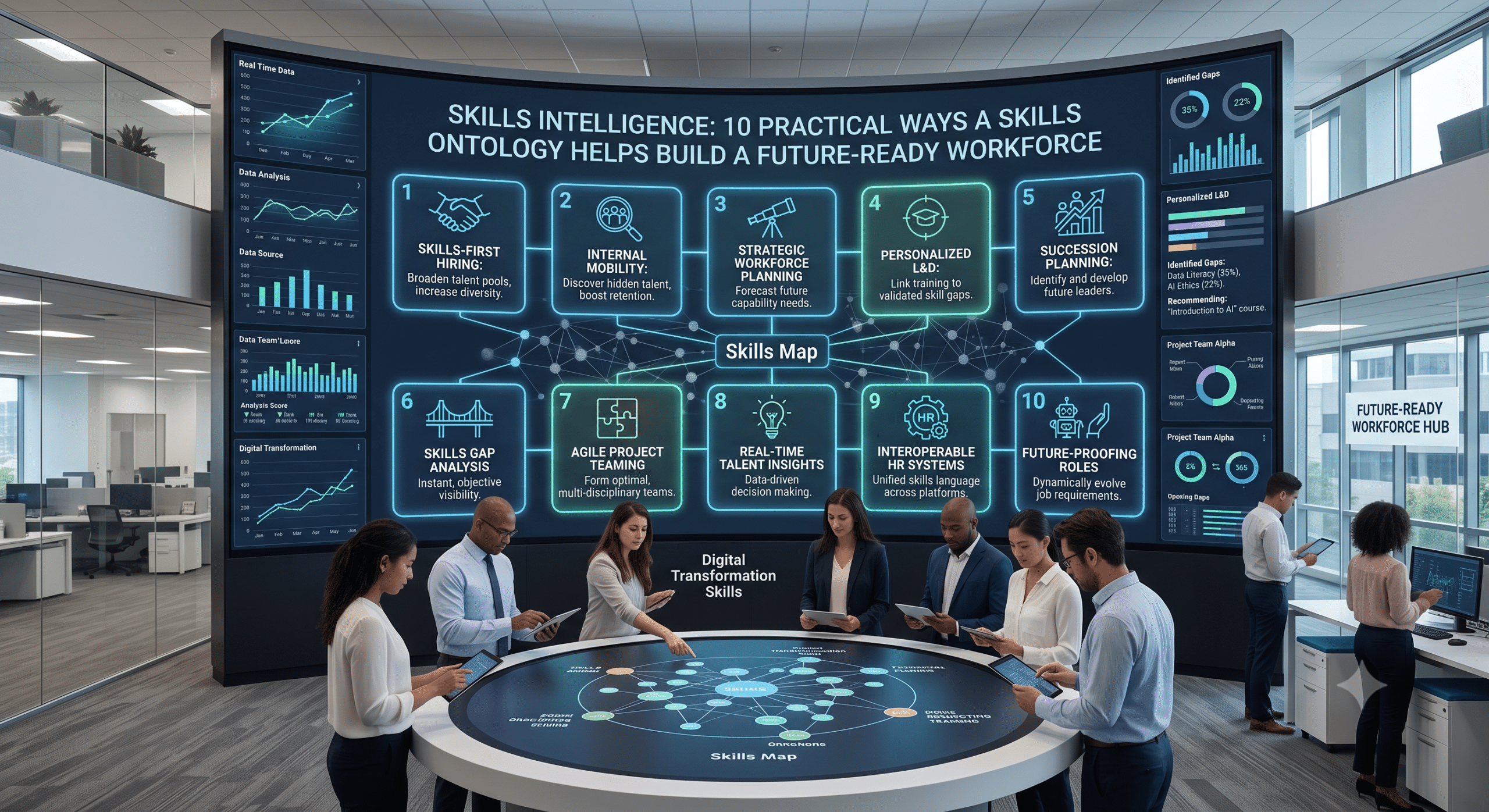
10 Benefits of Building a Skills Ontology
Based on my consulting experience, organizations that invest in a strong skills ontology usually improve talent decisions across every HR function. Specifically, they experience the following benefits:
-
Better Hiring Decisions: Initially, recruiters stop relying solely on job titles. Instead, they search for precise capabilities. Consequently, that produces better candidate matches.
-
Improved Internal Mobility: For example, employees discover opportunities they never knew existed. As a result, hidden talent becomes visible, and internal hiring increases.
-
More Accurate Skills Gap Analysis: Rather than guessing training needs, organizations identify exact capability shortages. Thus, learning budgets become more effective.
-
Personalized Learning: Consequently, employees receive recommendations based on their unique skill profiles instead of generic training catalogs.
-
Smarter Workforce Planning: Specifically, executives understand whether future business goals align with available workforce capabilities. Therefore, planning becomes proactive rather than reactive.
-
Faster Reskilling: As technology changes, employees can transition into emerging roles more efficiently because related skills are already mapped.
-
Better Succession Planning: Accordingly, future leaders are identified based on demonstrated capabilities instead of tenure alone.
-
Stronger Performance Conversations: Consequently, managers discuss measurable skills growth rather than vague performance opinions. Thus, employees appreciate clearer expectations.
-
Data-Driven Talent Strategy: Ultimately, leadership gains reliable workforce intelligence for hiring, promotions, workforce planning, and organizational design.
-
Continuous Organizational Learning: Perhaps the greatest benefit is adaptability. Because a skills ontology evolves alongside changing technologies and business priorities, consequently, organizations can continuously update their understanding of workforce capability instead of rebuilding skill frameworks every few years (360Learning).
Common Challenges Organizations Face
Despite the benefits, many companies struggle during the early stages of implementation. Particularly, the most common issues include:
-
Inconsistent Skill Names: For instance, different departments describe the same skill differently. Therefore, standardization becomes difficult.
-
Outdated Competency Libraries: Historically, many competency models haven’t been updated in years. Consequently, modern AI, cloud, cybersecurity, and digital skills may be missing.
-
Too Much Manual Work: Typically, large organizations often maintain thousands of job profiles. Consequently, updating them manually consumes enormous time and effort. Fortunately, modern AI-assisted platforms can automate much of the initial mapping process while experts validate the final structure (360Learning).
-
Poor Data Quality: If employee profiles are incomplete or inaccurate, thus, the ontology produces weak insights. Therefore, regular validation is essential.
-
Lack of Business Ownership: Importantly, a skills ontology should not belong only to HR. Instead, successful programs involve HR, Learning & Development, Business Leaders, IT, Workforce Planning, and Talent Acquisition. Ultimately, when everyone contributes, the ontology reflects real business needs instead of theoretical models.
How to Build a Skills Ontology That Actually Works
After understanding why a skills ontology matters, the next question is always the same: “Where do we start?” Fortunately, you don’t need to catalog every skill in the company on day one. In fact, trying to build a massive framework all at once is one of the biggest reasons these initiatives fail. Instead, begin with a practical, business-focused approach. Accordingly, I typically recommend building the ontology in phases.
Step 1: Define Your Business Goals
Initially, a skills ontology should solve business problems. Specifically, ask questions such as:
-
Are we trying to reduce hiring costs?
-
Do we need better internal mobility?
-
Are we preparing for AI adoption?
Subsequently, your answers determine how the ontology should be designed. For example, a healthcare organization may prioritize clinical certifications, while a software company focuses on cloud computing. Ultimately, business strategy should always come first.
Step 2: Create a Standard Skills Library
Next, create a standard skills library. To illustrate, consider Excel, Microsoft Excel, MS Excel, and Advanced Excel. Obviously, they all describe the same capability. Without standardization, reporting becomes unreliable. Therefore, a strong skills ontology creates one approved skill name while allowing synonyms behind the scenes. As a result, this improves reporting, analytics, and search results. Ultimately, consistency creates trustworthy data.
Step 3: Connect Skills to Jobs
Furthermore, the next step is mapping each role to the skills required for success. For example, a Data Analyst needs core skills like SQL and Excel, supporting skills like Presentation, and optional skills like Python. Importantly, notice that not every skill carries the same importance. Thus, prioritization matters.
Step 4: Define Skill Proficiency Levels
Additionally, simply knowing someone has a skill isn’t enough. Therefore, organizations should also understand proficiency.
| Level | Description |
| Level 1 | Basic awareness |
| Level 2 | Beginner |
| Level 3 | Working knowledge |
| Level 4 | Advanced practitioner |
| Level 5 | Subject matter expert |
Consequently, this helps managers identify development needs without making subjective judgments.
Step 5: Link Skills to Learning
Moreover, a modern skills ontology should connect every important skill to learning opportunities. To illustrate, examples include online courses, certifications, and mentoring. As a result, employees immediately understand how to develop missing skills. Thus, learning becomes intentional instead of random.
Step 6: Update the Ontology Regularly
Finally, update the framework regularly. Undeniably, skills evolve quickly. For example, think about how emerging capabilities like Generative AI and Prompt Engineering have become valuable recently. Consequently, if your ontology isn’t updated regularly, it quickly loses value. Therefore, treat it as a living system rather than a one-time project.
The Role of AI in Skills Intelligence
Currently, artificial intelligence has transformed how organizations build and maintain a skills ontology. Rather than manually reviewing thousands of resumes and job descriptions, instead, AI can analyze large volumes of workforce data in minutes. Specifically, modern skills intelligence platforms can automatically identify related skills, emerging skills, transferable skills, and learning recommendations. Nevertheless, AI speeds up the work, but human experts should still review and validate the results. Ultimately, technology supports good decisions—it shouldn’t replace them.
How Skills Ontology Supports Internal Mobility
Significantly, one of the biggest benefits of skills intelligence is helping employees move into new roles without leaving the company. Historically, traditional career paths were often rigid (e.g., Marketing Coordinator → Marketing Manager). Conversely, today, careers are much more flexible.
For instance, someone working in customer support may already possess many of the skills needed for Customer Success or Sales Operations. Consequently, a skills ontology uncovers these hidden opportunities by identifying transferable skills. As a result, employees gain more career options, while employers retain valuable talent.
Skills Ontology and Workforce Planning
Meanwhile, workforce planning has become increasingly difficult. Specifically, organizations face labor shortages, rapid technology changes, and economic uncertainty. Instead of guessing future staffing needs, therefore, organizations can use a skills ontology to compare current capabilities with future business requirements.
For example, comparing current cloud engineers to projected needs highlights where hiring or upskilling should begin today. Thus, planning becomes evidence-based instead of reactive.
Why Employees Benefit Too
Often, many organizations think a skills ontology only helps HR. However, that’s not true. On the contrary, employees benefit just as much. Specifically, they gain clearer career paths, personalized learning, and better promotion opportunities. Therefore, instead of asking, “What job can I apply for?” rather, employees begin asking, “What skills should I build next?” Ultimately, that’s a healthier career mindset.
Common Mistakes When Building a Skills Ontology
Throughout my career, I’ve seen several organizations make the same mistakes repeatedly. Fortunately, avoiding them can save months of effort.
-
Mistake 1: Creating Too Many Skills. First, some companies try to capture every possible skill. Consequently, the result is thousands of overlapping entries that are impossible to maintain. Therefore, focus on meaningful business skills first.
-
Mistake 2: Ignoring Soft Skills. Second, technical skills matter, but so do communication, leadership, and adaptability. Because these skills often determine long-term success, therefore, a balanced ontology includes both technical and behavioral capabilities.
-
Mistake 3: Treating the Project as HR-Only. Furthermore, business leaders understand their teams better than anyone. Therefore, their input is essential when defining role-specific skills. Without cross-functional collaboration, the ontology becomes disconnected from reality.
-
Mistake 4: Never Updating the Framework. Additionally, an outdated ontology is almost as bad as having no ontology at all. Therefore, review it regularly. Specifically, retire obsolete skills, while adding emerging capabilities.
-
Mistake 5: Measuring Completion Instead of Adoption. Finally, building the framework is only the beginning. Instead, success should be measured by whether managers are using it and if mobility is increasing. Ultimately, real value comes from adoption, not documentation.
Best Practices for Long-Term Success
Generally, organizations that succeed with skills ontology initiatives often share these habits:
-
First, start with high-impact business roles.
-
Second, use consistent naming conventions.
-
Furthermore, involve HR, business leaders, IT, and learning teams.
-
Additionally, review the ontology at least twice a year.
-
Moreover, integrate it with HRIS, LMS, and talent platforms.
-
Likewise, encourage employees to validate and update their skill profiles.
-
Importantly, keep the framework simple enough for people to understand.
-
Finally, treat the ontology as a strategic business asset rather than an HR document.
Ultimately, these practices help ensure the ontology remains relevant and valuable as the organization grows.
Measuring the Success of Your Skills Intelligence Program
Importantly, a skills ontology should produce measurable business outcomes. Therefore, consider tracking metrics such as:
| KPI | Why It Matters |
| Internal mobility rate | Shows whether employees are moving into new roles |
| Time-to-fill open positions | Indicates hiring efficiency |
| Skills gap reduction | Measures progress in closing capability gaps |
| Training completion | Demonstrates learning impact tied to priority skills |
Consequently, monitoring these indicators helps leaders refine their skills intelligence strategy over time instead of relying on assumptions.
The Future of Skills Intelligence Is Skills-First
Undeniably, the workplace is changing faster than ever. For instance, artificial intelligence is reshaping jobs. Additionally, automation is eliminating repetitive work. Meanwhile, many organizations still rely on job descriptions that were written five or even ten years ago. Consequently, that approach no longer works. Therefore, a modern workforce needs a modern way of understanding talent. As a result, more organizations are investing in skills intelligence. Ultimately, a well-designed ontology evolves over time, helping organizations respond to changing business needs instead of constantly rebuilding workforce frameworks (360Learning).
Emerging Trends in Skills Intelligence
Looking ahead, the next generation of workforce management will be built around skills. Specifically, here are some trends every HR leader should watch:
-
AI-Powered Skills Discovery: Clearly, artificial intelligence is making skills identification much faster. Instead of manually reviewing resumes, therefore, AI can analyze employee profiles and learning history. Consequently, this helps organizations build frameworks with far less manual effort (360Learning).
-
Skills-Based Hiring: Moreover, recruiters are beginning to hire for capabilities instead of credentials alone. Rather than asking for five years of experience, instead, organizations ask if a candidate can perform the work. Consequently, this widens the talent pool.
-
Personalized Career Development: Furthermore, employees increasingly expect personalized career guidance. Specifically, a connected skills ontology can recommend learning paths and stretch assignments. Thus, development becomes tailored.
-
Continuous Workforce Planning: Finally, organizations are moving away from annual exercises. Instead, skills data is updated continuously. As a result, leaders gain real-time visibility into critical shortages. Consequently, this supports faster and more informed decisions.
How to Choose the Right Skills Intelligence Platform
Importantly, technology should support your strategy—not define it. Therefore, when evaluating solutions, look for platforms that provide more than a simple database. Specifically, a strong platform should include:
-
Flexible Skills Ontology: Because your business will change, therefore, your ontology should be able to change with it. Thus, look for configurable frameworks.
-
AI-Assisted Skills Mapping: Granted, automation reduces manual work. However, the platform should also allow HR experts to validate AI recommendations.
-
Integration Capabilities: Furthermore, the platform should connect with systems you already use (e.g., HRIS, LMS, ATS). Ultimately, integrated data creates a more complete picture.
-
Analytics and Dashboards: Moreover, executives need insights. For example, useful dashboards should answer which critical skills are declining. Ultimately, actionable analytics are where skills intelligence delivers value.
-
Employee-Friendly Experience: Finally, employees should be able to easily update skills and explore opportunities. Consequently, the easier the experience, the higher the adoption rate.
Final Thoughts from a Jobs and Skills Architecture Consultant
In conclusion, over the past decade, I’ve watched organizations invest heavily in recruiting and workforce planning tools. Nevertheless, many still struggle to answer a simple question: “What skills do we actually have?”
Consequently, without that answer, hiring becomes reactive. Similarly, training becomes generic. Furthermore, career development becomes unclear. As a result, workforce planning becomes guesswork.
However, a well-designed skills ontology changes that. Specifically, it creates a common language for the organization. Instead of relying on assumptions, leaders gain reliable data. Ultimately, the organizations that succeed over the next decade won’t simply have the largest workforce; rather, they’ll have the clearest understanding of workforce capability. Undeniably, that journey begins with building a skills ontology that grows alongside the business.
Frequently Asked Questions (FAQ)
1. What is a skills ontology?
By definition, a skills ontology is a structured framework that organizes skills and shows how they relate to job roles, learning content, and career paths. Unlike a static list, it continuously evolves as workforce needs change (360Learning).
2. How is a skills ontology different from a skills taxonomy?
Generally, a taxonomy organizes skills into categories. Conversely, a skills ontology goes further by mapping the relationships between skills and business functions, thus making it more dynamic (360Learning).
3. Why is a skills ontology important?
Primarily, it helps organizations identify skills gaps, improve hiring, support internal mobility, and make better talent decisions.
4. Who should own a skills ontology?
Although HR often leads the initiative, nevertheless, successful organizations involve HR, Learning & Development, Business Leaders, IT, and Workforce Planning. Ultimately, shared ownership ensures the framework reflects real business needs.
5. Can AI create a skills ontology?
Certainly, AI can accelerate the process by analyzing workforce data. However, subject matter experts should strictly review and validate the results to ensure alignment with organizational goals (360Learning).
6. How often should a skills ontology be updated?
Typically, review it at least twice a year. Furthermore, organizations in rapidly changing industries may update it quarterly.
7. Which industries benefit the most from skills intelligence?
Essentially, nearly every industry can benefit. Ultimately, any organization investing in workforce development can gain value from it.
8. Does a skills ontology help employees?
Undeniably, yes. Specifically, employees benefit from clear career paths, better learning recommendations, and increased internal mobility.
References
The following high-authority resources and industry guides provide excellent, up-to-date insights into building and leveraging dynamic talent networks for a modern workforce strategy:
-
Cornerstone OnDemand’s strategic HR guide: This resource explains how putting workforce capabilities front and center empowers both leaders and individuals to take charge of their career progression. It details how actioning these insights helps close capability gaps and enables internal talent mobility.
-
Gloat’s insights on dynamic talent mapping: This comprehensive post explores how a connected capability network functions as a dynamic knowledge graph. It highlights how HR can use this approach to inventory internal talent, identify transferable capabilities for internal redeployment, and predict future workforce requirements.
-
TestGorilla’s resource on objective hiring: This article breaks down the fundamental differences between a simple taxonomy and a relational network. It highlights how dynamic mapping is crucial for precise talent acquisition, evaluating candidates objectively, and supporting a broader capability-based hiring approach.
-
Bryq’s implementation manual: A deep dive into the elements that make an organizational capability map adaptive and dynamic. It provides practical steps for building a connected ecosystem—from data collection and trend analysis to integrating it into existing HR, LMS, and ATS systems.
-
360Learning’s L&D best practices: An actionable, L&D-focused guide that outlines how a living map of capabilities acts like a “neural network” for your workforce. It covers the essential best practices for creating a connected ecosystem, emphasizing how AI-powered tools can automatically update relationships between roles and capabilities.