

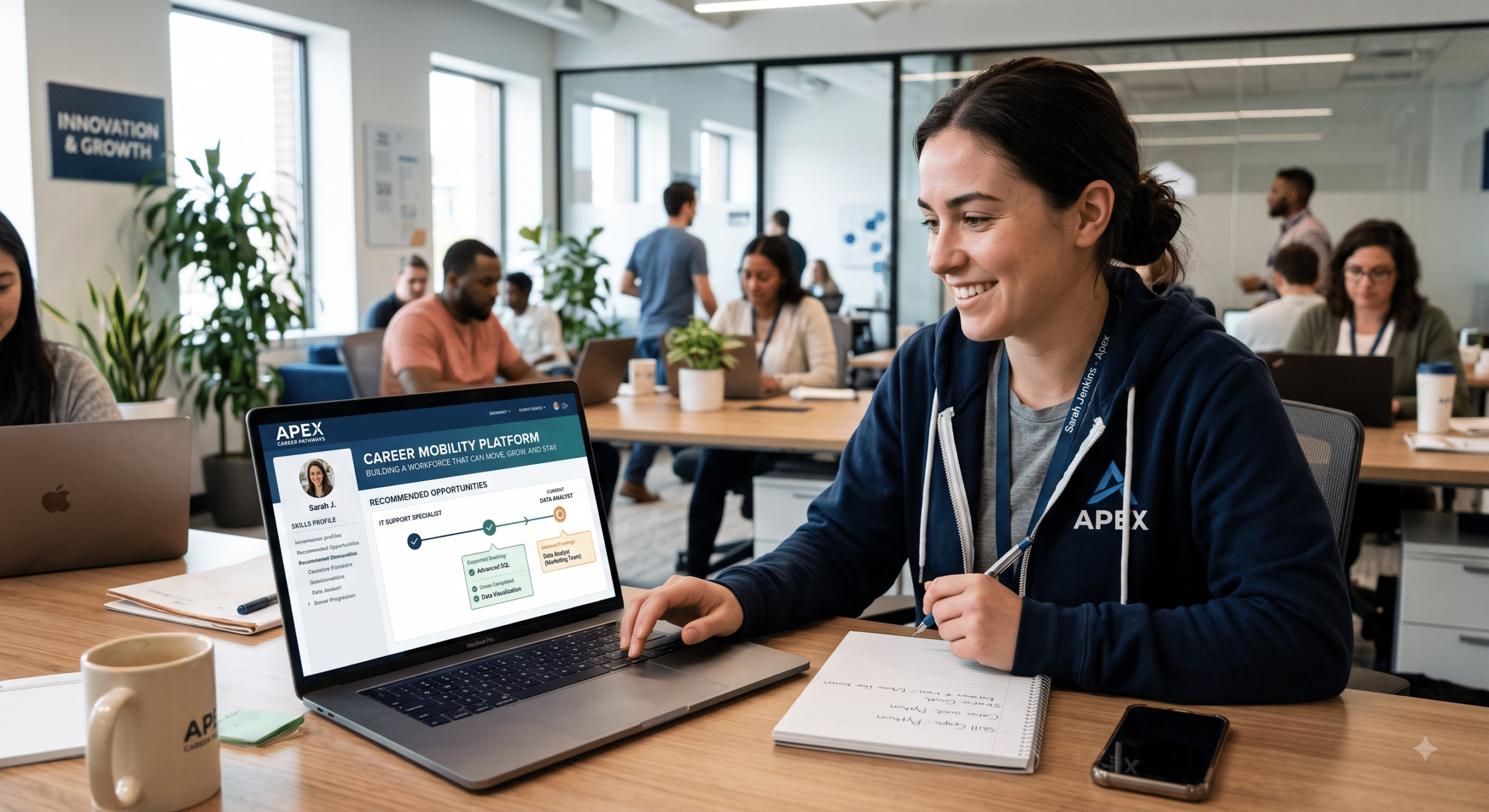
Implementing a career mobility platform is becoming essential as the traditional career ladder loses its usefulness. In a large global organization, employees rarely move from one clearly defined rung to the next. Instead, they move sideways into new functions, take temporary assignments, develop new skills, join international teams, step into leadership roles, or discover that their strongest career opportunity is somewhere they had never considered before.
That reality is changing how workforce leaders think about internal mobility.
To address this shift, a career mobility platform can give employees and managers a practical way to navigate this increasingly complex environment. Rather than treating career development as an annual conversation between an employee and a manager, the platform can connect skills, aspirations, jobs, projects, learning opportunities, mentoring, and workforce demand in one experience.
From a global HR strategy perspective, however, technology is only part of the answer. In fact, the strongest organizations do not implement a platform simply because it is fashionable. Rather, they use it to solve a workforce problem: critical skills are difficult to find, employees cannot see opportunities outside their immediate teams, managers hold onto talent, and external recruitment is often used when capable people already exist inside the business.
Recent research reinforces that direction. For instance, LinkedIn’s 2026 Top Companies research describes internal mobility as an increasingly important route to career growth, while SHRM reports that 35% of organizations surveyed in 2025 used an internal talent marketplace, up from 25% in 2024.
The strategic question, therefore, is not simply whether an organization should buy a platform. Ultimately, it is how to build an internal mobility system that actually changes the way talent moves.
What Is a Career Mobility Platform?
A career mobility platform is a technology-enabled environment that helps employees discover and pursue career opportunities within their organization while helping employers identify, develop, and redeploy internal talent.
Depending on the platform and operating model, those opportunities can include:
- Full-time internal positions
- Promotions
- Lateral moves
- Cross-functional assignments
- Short-term projects
- Mentoring
- Job shadowing
- Rotational programs
- Learning experiences
- Stretch assignments
- International opportunities
- Leadership pathways
That broader definition matters because internal mobility is not synonymous with promotion. SHRM describes it as movement into new or expanded roles, including promotions, lateral transfers, cross-functional changes, rotational assignments, and project-based work.
This distinction is particularly important for multinational companies. For example, an employee may not be ready for a senior leadership role today, but they may be ready for a six-month project in another business unit. As a result, that experience could develop precisely the skills needed for the employee’s next permanent position.
In other words, mobility can be a journey rather than a single transaction.
Why Career Mobility Has Become a Strategic Issue
For years, many organizations approached internal career development through job postings, succession planning, performance reviews, and manager recommendations. Although those tools remain useful, they can create a fragmented view of the workforce.
Specifically, an employee may know about opportunities within their department but have little visibility into another country or business unit. Similarly, a hiring manager may know exactly what skills are needed but have no efficient way to discover someone elsewhere in the organization who already possesses them.
That creates an expensive paradox: companies can simultaneously have a talent shortage and an abundance of unused internal capability.
Deloitte’s research has highlighted this problem for years. Specifically, its internal mobility research found that only 6% of respondents considered their organizations excellent at moving people from role to role, while 49% identified the lack of processes to identify and move employees as a major barrier.
A modern career mobility platform attempts to reduce that friction.
Consequently, instead of asking, “Who do I already know who could fill this position?” the organization can begin asking, “Which people have the skills, experience, potential, and aspirations that align with this opportunity?”
That is a significant shift in workforce strategy.
7 Strategic Capabilities Every Career Mobility Platform Should Support
Technology specifications vary between vendors, yet from a workforce consulting perspective, there are 7 capabilities that deserve particular attention.
1. Skills-Based Talent Discovery
The foundation is a reliable understanding of what people can actually do. While traditional HR systems tend to emphasize job titles, grades, departments, education, and employment history, those fields do not necessarily reveal the full capability of an employee.
For instance, a marketing manager may have strong data-analysis skills. Likewise, an operations specialist may have project-management experience, or an engineer may have commercial skills developed through customer-facing projects.
Therefore, a sophisticated platform should help surface those capabilities. The World Economic Forum has argued that skills-first approaches can expand access to talent by focusing on capabilities rather than relying primarily on degrees, job histories, or titles. For global employers, this can be especially valuable because skills often transfer across organizational boundaries more easily than job titles do.
2. Personalized Career Pathways
Employees often know they want to progress, but they do not know what their next move should be. Thus, a good platform should turn career development into something more tangible.
For example, an employee interested in becoming a senior commercial leader might see a traditional route:
Account Manager → Senior Account Manager → Regional Sales Lead → Country Commercial Director
However, the platform could also show less obvious routes:
Account Manager → Product Strategy → Business Development → Commercial Director
The second path might be particularly valuable for someone whose strengths do not fit the conventional promotion ladder. Ultimately, the objective is not to prescribe a career, but rather to make possibilities visible.
3. Opportunity Matching
This is where the platform begins to operate more like a marketplace. On one hand, employees should be able to discover opportunities based on their current skills, interests, experience, location, career objectives, and development needs. On the other hand, hiring managers should be able to identify internal candidates without relying entirely on personal networks.
Deloitte describes internal talent marketplaces as technology-enabled platforms that can connect employees with roles as well as projects, mentoring, rotations, stretch assignments, and skill-building opportunities. That broader opportunity model is important because not every career move should require a new permanent job; sometimes, the best development opportunity is a project.
4. Learning Connected to Mobility
Learning and mobility should not operate as separate HR processes. If an employee is interested in a particular role but lacks two important capabilities, the platform should ideally help identify the gap and recommend relevant learning or experience.
For example:
- Target role: Digital Product Manager
- Current capabilities: Stakeholder management, business analysis, customer research
- Development needs: Product discovery, agile delivery
- Recommended actions: Product-management course + six-week product project + mentor relationship
Because of this approach, learning now has a distinct purpose. The World Economic Forum similarly emphasizes connecting skills data with workforce planning, development, and internal mobility so organizations can make better decisions about building, buying, or borrowing talent.
5. Manager Enablement
This is where many mobility strategies succeed or fail. Although employees may want to move, managers sometimes hesitate to release strong performers. That is understandable, since a manager who loses a high-performing employee has an immediate capacity problem, whereas the organization receives the long-term benefit of mobility.
However, a career mobility platform cannot solve that cultural issue by itself. Leadership must establish a clear principle: developing people for the wider enterprise is part of managerial performance. Specifically, managers should be measured not only by team stability, but also by whether they develop people who can succeed elsewhere.
That changes the psychology of mobility:
- From: “I’m losing my best employee.”
- To: “I’m helping create the organization’s next generation of talent.”
6. Internal Talent Analytics
The platform should not be treated only as an employee-facing career portal; furthermore, the underlying data can become strategically valuable for workforce leaders.
HR executives can examine questions such as:
- Where are critical skills concentrated?
- Which business units have unused capacity?
- Which roles are difficult to fill externally?
- Where are employees moving successfully?
- Which skills are emerging?
- Which career pathways produce stronger retention?
- Where are internal candidates being overlooked?
- Which learning programs lead to actual movement?
SHRM notes that talent marketplaces can provide data useful for workforce planning while giving employees visibility into opportunities and managers greater visibility into available talent. As a result, this turns mobility technology into part of the workforce intelligence architecture.
7. Equity and Transparency
Internal opportunities should not depend entirely on who an employee knows. If roles are quietly discussed among senior leaders or circulated through informal networks, employees with less organizational visibility can be disadvantaged.
A properly designed mobility system can make opportunities more visible and establish consistent criteria for matching people with work. However, that does not automatically guarantee fairness. Because algorithms can reproduce poor data or biased assumptions if the underlying systems are weak, HR leaders should regularly examine who receives recommendations, who applies, who gets selected, and who actually moves. In short, technology should increase transparency—not simply automate old decisions.
Career Mobility Platform vs. Internal Job Board
It is tempting to think of a mobility platform as an upgraded internal job board, but that comparison misses the point.
An internal job board generally answers:
“What jobs are available?”
In contrast, a career mobility platform should help answer:
“Where could I go next, what could I learn, and what opportunities would help me get there?”
The difference is substantial. While a job board is primarily vacancy-centric, a mobility platform is employee-, skills-, and opportunity-centric. Moreover, it can connect current capability to future capability, expose temporary assignments before permanent vacancies appear, and connect learning with career movement. That is why the most mature internal mobility models resemble an opportunity marketplace rather than a recruitment portal.
The Business Case for Internal Mobility
From a consulting perspective, the business case should extend beyond employee satisfaction. In fact, there are at least four strategic benefits:
- Lower External Hiring Dependence: When qualified talent can be identified internally, organizations can reduce some dependence on external recruiting. Additionally, Deloitte has reported evidence that internally promoted employees can deliver stronger hiring outcomes, while external hires have historically shown higher early attrition in certain comparisons.
- Faster Workforce Deployment: When business priorities change, internal talent can sometimes be deployed faster than external candidates can be sourced, interviewed, hired, and onboarded.
- Stronger Retention: Career stagnation is a common reason employees look elsewhere. However, LinkedIn’s research has associated internal mobility with stronger employee retention, and the World Economic Forum has highlighted internal movement as an important mechanism for keeping employees engaged.
- Better Use of Existing Skills: Perhaps the biggest opportunity is hidden capability. Organizations frequently know what job someone holds, yet they have a weaker understanding of everything that person can contribute. Therefore, a skills-centered career mobility platform makes that hidden capability more visible.
What a Global Implementation Should Look Like
For a multinational organization, implementation should not begin with technology procurement. Instead, start with the workforce strategy.
- Step 1: Define the Business Problem — Identify whether the priority is retention, critical skills, succession, redeployment, leadership development, hiring costs, workforce agility, or several of these.
- Step 2: Establish a Skills Architecture — Create a practical common language for skills across functions and regions.
- Step 3: Map Career Families — Employees need understandable pathways, rather than thousands of disconnected job descriptions.
- Step 4: Remove Policy Barriers — Review eligibility rules, manager approvals, geographic restrictions, compensation practices, and internal hiring procedures.
- Step 5: Pilot the Model — Begin with a strategically important population instead of attempting an enterprise-wide transformation overnight.
- Step 6: Connect Learning and Opportunities — Make development actions relevant to actual career destinations.
- Step 7: Measure Movement — Track applications, placements, lateral moves, promotions, skill development, retention, time-to-fill, and business outcomes.
Ultimately, the goal should be to create a repeatable mobility system—not simply launch another HR application.
The Role of AI in Career Mobility
AI is becoming increasingly relevant to workforce mobility because organizations are dealing with enormous volumes of skills and career data. For instance, a platform can potentially analyze employee profiles, job requirements, learning histories, project experience, and expressed interests to identify possible matches.
However, AI should support judgment rather than replace it. The most useful question is not:
“What job does this employee qualify for?”
Rather, it is:
“What opportunities could this employee realistically succeed in, and what development would make the transition successful?”
That requires context. Because a skills match alone cannot understand motivation, leadership potential, cultural considerations, location constraints, or the quality of an employee’s actual performance, human judgment remains essential.
Measuring Career Mobility Success
A platform should have a scorecard from day one.
| Metric | What It Tells Leaders |
| Internal fill rate | How often roles are filled from within |
| Internal application rate | Whether employees are engaging |
| Mobility rate | How frequently employees move |
| Lateral movement | Whether careers extend beyond promotion |
| Promotion rate | Whether advancement is occurring |
| Time to fill | Whether mobility improves workforce speed |
| Retention after movement | Whether moves produce sustainable outcomes |
| Skills-gap closure | Whether mobility supports future capability |
| Manager participation | Whether leaders support the model |
| Employee satisfaction | Whether employees trust the experience |
The important point is to avoid measuring platform activity alone. For example, ten thousand profile views do not necessarily mean the strategy is working. Instead, the real measure is movement that creates value for both the employee and the business.
Common Mistakes to Avoid
- Buying technology first: The first mistake is buying technology before defining the operating model.
- Isolating the initiative: The second is treating mobility as an HR-only initiative, whereas business leaders, managers, learning teams, talent acquisition, workforce planning, and employees all have roles to play.
- Overcomplicating the experience: The third is making the system overly complicated. Since employees should not need to understand HR terminology to use it, the experience should feel intuitive.
- Focusing solely on advancement: The fourth is focusing only on promotions, even though lateral and project-based movement can be equally valuable.
- Ignoring managers: The fifth is ignoring managers. Indeed, without managerial support, even the best platform can become an attractive interface sitting on top of an immobile organization.
- Over-relying on automation: Finally, organizations should not assume AI automatically creates fairness. Therefore, skills data must be maintained, algorithms should be monitored, and outcomes should be reviewed.
The Future of Internal Mobility Systems
The next generation of internal mobility will likely be less about finding another job and more about continuously matching people with work.
That distinction matters. For instance, employees may spend part of a year in their core role, contribute to a strategic project, work with a different geographic team, complete targeted learning, receive mentoring, and eventually move into a new permanent position. Thus, the career becomes a series of experiences rather than a straight line.
This is particularly important as AI changes job content and skill requirements. Indeed, the World Economic Forum’s 2026 Chief People Officers’ Outlook identifies skills mismatches, organizational redesign, upskilling, reskilling, and responsible AI adoption as central workforce challenges.
A mature career mobility platform can become the connective tissue between those priorities. Specifically, it can help organizations understand what skills they have, what skills they need, and which employees could make the transition. That is much more strategic than simply publishing internal vacancies.
Final Perspective: Make Mobility a Workforce Strategy
A career mobility platform should never be viewed as just another HR technology purchase. Instead, its real value comes from changing how an organization thinks about talent.
- The old model says employees belong to departments; the emerging model says employees belong to the enterprise.
- The old model asks whether someone is qualified for today’s vacancy; the emerging model asks what capability someone has today, what they could develop next, and where that capability could create value.
For global organizations, that shift can be transformative. In conclusion, the strongest internal mobility systems will combine skills intelligence, career transparency, learning, opportunity matching, manager accountability, workforce planning, and human judgment. Technology provides the infrastructure, but leadership creates the culture that makes movement possible.
Ultimately, employees rarely expect their careers to remain unchanged; rather, they want evidence that their employer can provide a future. An organization that can make that future visible—and give people practical ways to move toward it—has a much stronger proposition for retaining talent, developing leaders, closing skills gaps, and adapting to changing business conditions.
That is the real strategic promise of a modern career mobility platform.
Frequently Asked Questions
What is a career mobility platform?
A career mobility platform is a digital system that helps employees discover internal jobs, projects, mentoring, learning, rotations, and other development opportunities while helping organizations identify and deploy internal talent.
How is a career mobility platform different from an internal job board?
An internal job board primarily displays vacancies. In contrast, a mobility platform can connect employee skills, aspirations, learning, projects, and career pathways with current and future opportunities.
Does internal mobility only mean promotions?
No. Internal mobility includes promotions as well as lateral transfers, cross-functional moves, rotations, project assignments, temporary gigs, and other forms of movement.
Can a career mobility platform improve employee retention?
Yes, it can support retention by making career development and internal opportunities more visible. Furthermore, research from LinkedIn and SHRM indicates that organizations with stronger internal mobility and growth opportunities can achieve better retention outcomes.
Should companies use AI for internal mobility?
AI can be useful for skills matching, opportunity recommendations, career-path suggestions, and workforce analysis. However, organizations should maintain human oversight and regularly evaluate data quality, fairness, and outcomes.
What should companies measure?
Organizations should measure internal fill rates, applications, mobility rates, promotions, lateral moves, retention after movement, time-to-fill, skills development, manager participation, and employee experience.
What is the biggest barrier to internal mobility?
Technology is rarely the only obstacle. In fact, manager behavior, organizational silos, unclear career pathways, weak skills data, restrictive policies, and a culture that discourages employees from leaving their current teams can all limit mobility. Deloitte has specifically identified process and organizational barriers as major challenges.
References and Further Reading
- Deloitte Insights — Activating the Internal Talent Marketplace – A foundational strategic framework exploring how AI-driven talent marketplaces drive organizational agility, skill visibility, and cross-functional mobility.
- Deloitte Insights — The Internal Talent Marketplace: Evolution and Future – Examines the shift from traditional job posting boards to dynamic opportunity ecosystems that match employees with projects, gigs, and mentorship.
- McKinsey & Company — Stave Off Attrition With an Internal Talent Marketplace – Analyzes the direct impact of talent marketplaces on curbing voluntary turnover, closing critical skill gaps, and maximizing existing enterprise capability.
- World Economic Forum — Putting Skills First: A Framework for Action – Demonstrates how transitioning to a skills-first approach expands internal candidate pools, breaks down formal degree constraints, and boosts overall workforce resilience.
- Workday Blog — Does Your Talent Marketplace Foster Internal Mobility? –Provides actionable benchmarks and insights into leveraging skills data to transform traditional career ladders into flexible, multi-directional “jungle gyms.”