

Building an effective workforce planning model should never begin with a narrow question: “How many people do we need?” Instead, in strategic talent management, a far better question is: What capabilities will the business need to execute its strategy, and how do we design an effective workforce planning model to achieve that realistically? Ultimately, that distinction changes everything.
A strong workforce planning model connects key business drivers. It links strategy, financial expectations, workforce supply, and future demand. It also incorporates skills, attrition, productivity, mobility, and talent decisions. Consequently, it gives leaders a structured framework to look beyond today’s headcount. They can clearly understand needs two, three, or five years down the road.
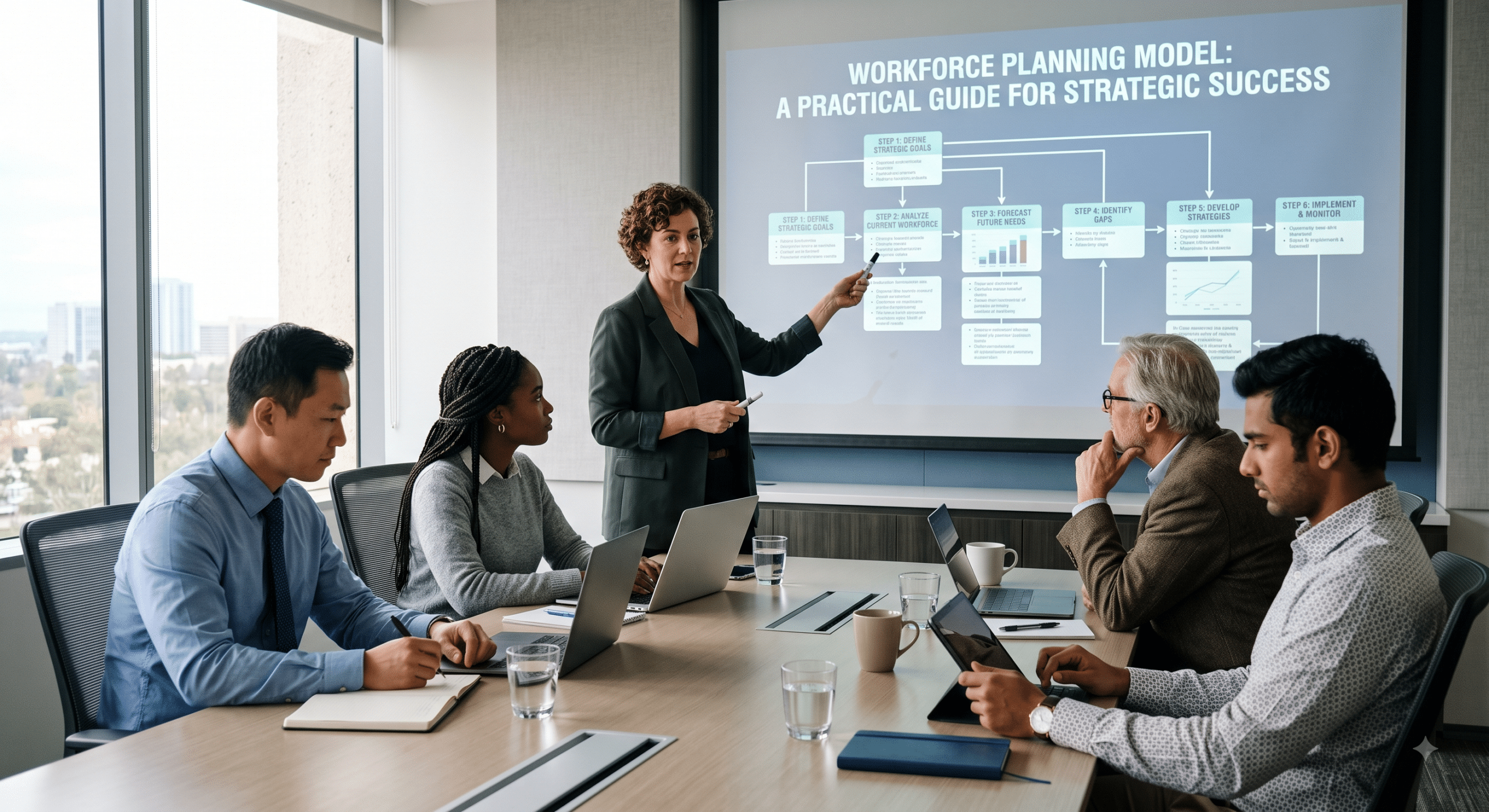
For instance, the CIPD describes workforce planning as a systematic process to balance supply and demand. Moreover, its framework outlines a practical six-stage approach. This process covers the baseline, supply, demand, gap analysis, action planning, and implementation.
From a People Analytics perspective, this holistic alignment adds true value. A robust workforce planning model is not a static spreadsheet. Rather, it serves as an active decision-making framework.
Furthermore, the best models are not necessarily the most complicated. On the contrary, an effective talent framework makes underlying assumptions visible. It connects talent decisions directly to business outcomes. Finally, it gives leaders timely insight to act before a talent shortage causes a crisis.
Here are 13 practical principles to apply when building or improving your talent strategy
1. Start With Business Strategy, Not HR Data
Opening the HR database first is a common mistake when designing a workforce framework.
Instead, start directly with the overarching business plan.
Specifically, ask: What is the organization trying to achieve? Is it entering new markets or opening locations? Are you aiming to reduce costs or increase production output?
Does the roadmap include launching products, automating, expanding service, or consolidating operations?
Indeed, every strategic decision creates immediate talent implications.
For example, a company entering three new markets needs sales, operations, support, compliance, and leadership capabilities. However, your workforce planning model should show that hiring hundreds of external employees is rarely the best path.
A better approach is combining internal mobility, targeted recruitment, continuous reskilling, selective automation, and external partnerships.
Therefore, a well-structured workforce planning model translates business strategy into concrete workforce requirements. It prevents talent planning from becoming an isolated HR exercise.
Similarly, McKinsey frames strategic workforce planning around linking talent needs directly to strategy. This approach helps identify capability gaps as business needs evolve.
2. Establish a Reliable Workforce Baseline
Before forecasting future requirements in your workforce planning model, thoroughly understand the present landscape.
Consequently, establish a baseline with a crystal-clear view of the current workforce. Include total headcount, specific roles, physical locations, and employment types. Track skills inventories, tenure, turnover patterns, compensation structures, and organizational design.
However, an effective talent architecture requires much more than just counting employees.
For instance, two separate departments may each have 100 employees, yet carry completely different operational risks. One department might feature a young workforce with robust internal mobility. The other might depend heavily on a few highly experienced specialists who are hard to replace.
Because of this contrast, your baseline must combine raw workforce numbers with qualitative workforce characteristics.
In addition, data quality is paramount. Inconsistent job titles, incomplete records, or outdated org charts destroy accuracy. Your resulting forecast may look precise while remaining fundamentally unreliable.
3. Separate Workforce Supply From Workforce Demand
This separation represents a core foundation of a useful workforce planning model.
On one hand, workforce supply asks: Who are we realistically likely to have?
On the other hand, workforce demand asks: Who will we actually need?
Specifically, supply considers ongoing factors like current staff, anticipated attrition, retirement rates, and promotions. It also accounts for internal movement, lateral transfers, and skill development.
In contrast, demand considers the exact capabilities required to deliver the future business plan.
By keeping these questions distinct, your planning framework makes talent gaps easier to pinpoint and solve.
For example, imagine a business expects to need 500 cybersecurity professionals within three years. Its current workforce contains only 350 relevant employees. At first glance,
The gap appears to be 150 external hires.
However, that total is not necessarily the true hiring requirement.
Suppose 50 existing employees are reskilled, and 30 move internally from adjacent technical roles. Furthermore, targeted automation eliminates the need for another 20 positions. As a result, the external hiring requirement shrinks dramatically.
This is precisely where a modern workforce planning model proves far more valuable than simple headcount forecasting.
4. Forecast Demand Using Business Drivers
A robust talent framework should feature a clear business reason behind every single demand assumption.
Rather than vaguely stating, “We expect headcount to increase by 8%,” interrogate what drives that growth.
- Revenue growth may drive sales staffing needs.
- Production volume may dictate manufacturing capacity.
- Customer transaction volume may directly drive service team staffing.
- Physical store openings may determine retail hiring schedules.
- Upcoming projects may govern engineering or consulting capacity needs.
Consequently, this focus creates a dynamic, driver-based planning tool.
For instance, if customer transactions rise by 20%, link required workforce expansion directly to transaction throughput and productivity metrics.
As a result, explaining and justifying the forecast to finance and executive leadership becomes much easier. Additionally, it makes scenario planning fluid and accurate.
5. Model Attrition Realistically
Attrition is easily one of the most underestimated variables in any workforce planning model.
As a rule, assuming every current employee stays will overstate future workforce supply.
At the same time, applying a single attrition rate across the entire organization is equally misleading.
Indeed, turnover differs substantially by geographic location, job family, seniority level, tenure, and labor market dynamics.
Therefore, leverage a People Analytics team to enhance your framework. They can analyze historical departure trends to identify where turnover is consistently higher or lower.
Ultimately, the goal is not to predict every individual departure with absolute certainty. Rather, establish realistic, actionable planning assumptions within your workforce planning model.
That distinction is vital. Workforce planning is fundamentally about preparing for plausible futures—not pretending the future can be perfectly foretold.
6. Put Skills at the Center of the Model
Headcount tells you how many bodies are in seats. Skills reveal what your workforce can actually execute.
Today, integrating skills mapping into your workforce planning model is vital as job roles evolve, technology advances, and organizations restructure work.
In fact, a department may appear fully staffed on paper while suffering from a severe
capability shortage.
For example, an organization might possess plenty of software engineers overall. Yet, it may lack individuals with specialized experience in cloud security, data engineering, or artificial intelligence.
As a result, a mature planning approach deliberately shifts its central inquiry. It moves from “How many employees do we need?” toward “Which specific capabilities will we require?”
Furthermore, this pivot establishes stronger alignment between your talent strategy, learning programs, career pathways, and internal mobility initiatives.
7. Use Scenario Planning Instead of One Static Forecast
In business, there is rarely only one inevitable future.
Therefore, a truly effective workforce planning model should routinely incorporate multiple potential scenarios.
For instance, account for:
- Base scenario: The current business plan proceeds as planned.
- Growth scenario: Market demand expands faster than anticipated.
- Efficiency scenario: Internal productivity improves, reducing overall labor requirements.
- Downside scenario: Market demand or revenue streams fall below expectations.
Crucially, scenario modeling gives executives a structured platform to deliberate workforce decisions before external market shifts force a reaction.
This adaptability is particularly invaluable for companies operating in volatile or fast-moving industries.
Ultimately, the primary objective of a workforce planning model is not to pick one scenario and declare it correct. Instead, clearly understand how talent requirements fluctuate as core assumptions change.
8. Make the Workforce Gap Visible
Once supply and demand are projected in the workforce planning model, conduct a thorough gap analysis.
However, recognize that talent gaps manifest in several distinct forms within your analysis:
- Headcount gap: The organization lacks sufficient total headcount.
- Skills gap: Existing employees are present, but lack required modern capabilities.
- Location gap: Qualified talent exists, but not where work needs to happen.
- Cost gap: The required workforce structure is financially unsustainable under current operational budgets.
Because of these variations, a well-designed planning framework must never generate a single isolated metric and call it a complete solution.
Instead, explicitly highlight what is missing, where the deficit exists, why it matters strategically, and precisely when the gap becomes operationally critical.
9. Treat Internal Mobility as a Workforce Supply Lever
External talent acquisition is only one piece of the puzzle.
Consequently, a strategic workforce planning model must incorporate internal talent mobility as a primary supply lever.
For instance, an employee in one division may possess foundational skills required for an emerging role in another. With targeted development, that individual can transition into the new role seamlessly, eliminating an expensive external search.
As a result, your talent architecture links directly into career development, succession planning, and internal talent marketplaces.
Moreover, this approach significantly alleviates pressure on talent acquisition teams.
Instead of constantly asking, “How many people must recruitment hire?”, leaders using a complete workforce planning model evaluate: “How much demand can we fulfill through our existing talent pool?”
Without question, that is a far more strategic conversation.
10. Connect the Model to Financial Planning
A workforce planning model operating in isolation from financial realities will fail to gain executive support.
After all, labor expenses frequently constitute the single largest operating cost in an organization. Therefore, workforce choices inside the model must align tightly with budgets, compensation projections, hiring overhead, productivity targets, and financial metrics.
To achieve this, finance and HR must avoid operating separate, conflicting forecasts.
Instead, the optimal framework establishes a unified, shared source of truth between HR and Finance.
For example, suppose the business plan calls for 200 new hires, but financial budgets accommodate only 100 positions. The workforce planning model must make that trade-off immediately visible.
Subsequently, the resolution might involve driving productivity gains, introducing automation, outsourcing non-core tasks, increasing internal mobility, or adjusting business priorities.
Through this alignment, the workforce planning model evolves from a passive HR reporting exercise into a core financial and business discipline.
11. Build Clear Ownership
A workforce planning model frequently fails when everyone is vaguely involved, but nobody is held accountable.
To prevent this, define responsibilities across HR, finance, business leaders, People Analytics, talent acquisition, L&D, and HR business partners.
In fact, Gartner’s research on strategic workforce planning teams emphasizes establishing a clear operating structure. Define definitive ownership and structure dedicated teams properly.
In practice, the Strategic Workforce Planning (SWP) specialist facilitates and coordinates the process. However, operational business leaders must retain final accountability for the workforce choices tied to their strategies.
Ultimately, a workforce planning model cannot succeed if it remains just “an HR document”—it requires direct business ownership.
12. Keep Assumptions Fully Visible
Every forecast within a workforce planning model relies heavily on baseline assumptions.
Severe problems arise when those assumptions remain hidden or implicit.
Therefore, a resilient forecasting framework must explicitly document key variables:
- Expected revenue growth rates
- Operational productivity shifts
- Segmented attrition rates
- Projected retirement timelines
- Standard time-to-fill hiring timelines
- Internal mobility rates
- Annual compensation escalation
- Technology and automation impact
- Geographic location changes
- Expansion or contraction across business units
When these assumptions are transparent inside the workforce planning model, leaders can constructively test and challenge them.
In fact, that debate is healthy.
If a business leader argues that turnover will fall below historical averages, the workforce planning model instantly demonstrates the downstream impact if that assumption proves incorrect.
Consequently, executive dialogue shifts away from subjective opinions and toward objective evidence.
13. Turn the Model Into an Actionable Plan
Ultimately, even the most sophisticated workforce planning model offers little value if no one acts upon its insights.
Therefore, the final stage of any planning exercise involves converting identified gaps into concrete strategic decisions.
Specifically, for every major workforce gap identified by your planning process, evaluate the 5 Bs framework:
- Build: Can we reskill or upskill existing employees to meet future demand?
- Buy: Do we need to recruit permanent talent from the external market?
- Borrow: Would contractors, consultants, or gig partners provide required flexibility?
- Bound (Move): Can we redeploy existing employees from declining business areas?
- Bot (Redesign): Can automation, process redesign, or AI reduce total headcount requirements?
By applying these options, organizations create a comprehensive, multi-faceted strategy rather than relying solely on a generic hiring plan.
What Should a Workforce Planning Model Contain?
In practice, a functional framework does not require hundreds of complex spreadsheet tabs.
Instead, an effective workforce planning model should incorporate core components:
- Business strategy objectives and core planning assumptions
- Current workforce baseline metrics
- Forward-looking workforce supply forecasts
- Business-driven workforce demand forecasts
- Detailed attrition and turnover assumptions
- Skills inventory and capability maps
- Comprehensive workforce gap analyses
- Multi-scenario models
- Internal mobility pipeline metrics
- External recruitment forecasts
- Upskilling and reskilling implementation plans
- Financial and budget implications
- Action plans with clear assigned ownership
While exact configurations vary across industries, these components offer a dependable foundation for any organizational framework.
Similarly, CIPD guidance emphasizes establishing a robust baseline, evaluating supply and demand, conducting gap analysis, crafting an actionable plan, and executing that plan through broad stakeholder engagement.
Common Mistakes to Avoid
Even highly mature organizations fall into predictable traps when implementing a workforce planning model.
- Mistake 1: Treating the framework as an annual headcount review. Strategic planning must remain an ongoing, dynamic discipline to adjust whenever business conditions shift.
- Mistake 2: Relying exclusively on historical data. While past trends offer context, a workforce planning model cannot rely solely on the past to account for future technological or market transformations.
- Mistake 3: Over-indexing on external hiring. Recruitment is only one tool in the talent toolkit, not the entire output of your planning process.
- Mistake 4: Overcomplicating the system. If business leaders cannot easily interpret the logic behind the workforce planning model, they will not trust or use the outputs.
- Mistake 5: Striving for false precision. If a planning forecast claims an organization will need exactly 1,437 employees three years from now, leaders may place unearned trust in that figure. Projected ranges are often far more realistic and useful.
How People Analytics Elevates the Workforce Planning Model
People Analytics plays a pivotal role in grounding your workforce planning model in objective evidence.
Specifically, analytics teams uncover turnover patterns, employee movement, productivity curves, skill densities, recruitment efficiency, and demographic transitions.
These insights feed directly into the overarching framework.
However, analytics must serve to clarify decision-making rather than overwhelm business leaders with raw data.
Therefore, instead of asking, “What data can we dump into this framework?”, ask a better question: “Which specific insights would materially alter a key workforce decision?”
That focused mindset maintains the practical utility of the model.
As the CIPD highlights, raw numerical metrics alone are rarely sufficient. Data within a workforce planning model must always be interpreted within its broader operational context.
The Future of the Workforce Planning Model
Looking ahead, the scope of strategic talent forecasting continues to expand rapidly.
Today, organizations navigate rapid skills inflation, artificial intelligence integration, evolving operating models, demographic shifts, and heightened demands for internal agility.
Consequently, the traditional question—“How many employees do we need?”—is becoming obsolete.
Instead, the modern strategic question driving any workforce planning model is: What work needs to be accomplished, what specific capabilities are required, and how can we best structure people and technology together to deliver it?
Undoubtedly, that represents a much richer workforce conversation.
Ultimately, the most successful organizations will not be those that predict headcount with pinpoint accuracy. Rather, they will be agile organizations that leverage a flexible workforce planning model to identify emerging risks early and adapt their talent strategy quickly.
FAQ: Workforce Planning Model
What is a workforce planning model?
A workforce planning model is a structured framework used to forecast future workforce supply and demand. It outlines targeted actions to align the two by integrating headcount, skill maps, attrition trends, productivity factors, internal mobility, talent acquisition, financial constraints, and overall strategy.
What is the difference between operational workforce planning and a strategic workforce planning model?
Operational workforce planning focuses on short-term staffing, scheduling, and immediate capacity needs. In contrast, a strategic workforce planning model takes a multi-year view. It directly aligns future talent requirements with overarching business growth strategies. Indeed, professional bodies define strategic workforce planning as a comprehensive approach bridging broader business drivers and long-term talent strategy.
How far ahead should a workforce planning model look?
While there is no single rule, a 1-to-3-year planning horizon works effectively for most organizations using a workforce planning model. However, companies undergoing dramatic digital transformations or long-cycle infrastructure projects often benefit from a 3-to-5-year view. Ultimately, the planning horizon should reflect the speed of change within your specific industry.
What data inputs are required for a workforce planning model?
Key inputs include current headcount, job family classifications, skill inventories, physical locations, historical turnover rates, time-to-fill metrics, promotion/retirement trends, compensation structures, productivity benchmarks, and revenue forecasts. Crucially, prioritize inputs that directly impact strategic decision-making.
Should a workforce planning model focus primarily on headcount or skills?
Both matter, but modern planning is shifting heavily toward skills. While headcount provides a broad view of overall capacity, mapping skills within your workforce planning model reveals whether your workforce actually possesses the capabilities required to execute future business objectives.
Can a workforce planning model predict the future accurately?
No workforce planning model can predict the future with 100% accuracy. Instead, its primary function is to make assumptions explicit, highlight prospective talent shortages, and equip executives to prepare for various potential scenarios.
Who should own the workforce planning model?
A strategic workforce planning model should be co-owned by executive business leadership and HR, with active support from Finance, People Analytics, Talent Acquisition, and L&D. While a dedicated SWP team usually facilitates the process and manages the data model, business leaders must ultimately own the final operational choices.
Final Thoughts
Ultimately, a well-designed workforce planning model accomplishes something practical: it transforms market uncertainty into a clear set of strategic choices.
It enables leaders to evaluate where the workforce stands today, where the business needs to go, and what potential obstacles lie in between.
From my perspective as a practitioner, the most impactful models are rarely those with the most complex algorithms. Rather, they foster meaningful, transparent dialogue around tough organizational choices.
Ultimately, the true output of a talent architecture is not a static headcount number.
Instead, it provides decisive answers to five fundamental questions:
- What workforce do we currently have?
- What workforce will we actually need?
- Where are our critical gaps?
- Which strategic levers can close those gaps?
- What immediate actions must we take today?
When leadership teams consistently answer these five questions using a structured workforce planning model, talent management stops being a routine HR compliance exercise. It becomes an indispensable engine for driving business strategy.
References and Further Reading
- CIPD — Strategic Workforce Planning: Guide for People Professionals – A comprehensive professional guide covering the core stages of strategic workforce planning, supply and demand balancing, and practical execution methodologies.
- CIPD — Workforce Planning Factsheet – An essential background resource detailing workforce baseline reviews, supply vs. demand dynamics, and aligning talent insights directly with business strategy.
- AIHR — Strategic Workforce Planning: The Ultimate Practical Guide – A practical HR industry guide breaking down the step-by-step framework for constructing actionable workforce planning models and dynamic scenario forecasts.