

Implementing talent mobility software is no longer just an HR initiative—it is becoming a core business strategy. For years, organizations viewed internal mobility as a simple employee benefit: provide career opportunities, advertise internal vacancies, encourage people to develop new skills, and hope they stay longer.
That view is becoming too narrow.
From a global HR strategy and workforce advisory perspective, internal mobility is increasingly an operating capability. Companies need to know where critical skills sit today, where they will need those skills tomorrow, and how quickly capable employees can move toward those opportunities. The challenge is that founders did not design most large organizations for that level of workforce visibility.
Employees may have useful skills that never appear in their formal job descriptions. Managers may know about talent that HR systems cannot easily identify. Teams may advertise open positions through one channel while hosting learning opportunities somewhere else. Meanwhile, leadership often runs succession plans, workforce planning, recruiting, and employee development as separate processes.
This is where talent mobility software becomes strategically interesting.
The right platform does more than display internal jobs. It can connect employee skills, career aspirations, learning, projects, vacancies, and workforce demand in a single environment. Workday, for example, describes its Talent Marketplace as connecting workers with opportunities according to skills, experience, and interests—including jobs, projects, teams, and learning opportunities.
For organizations operating across multiple countries, business units, and talent markets, that connection can become a major competitive advantage.
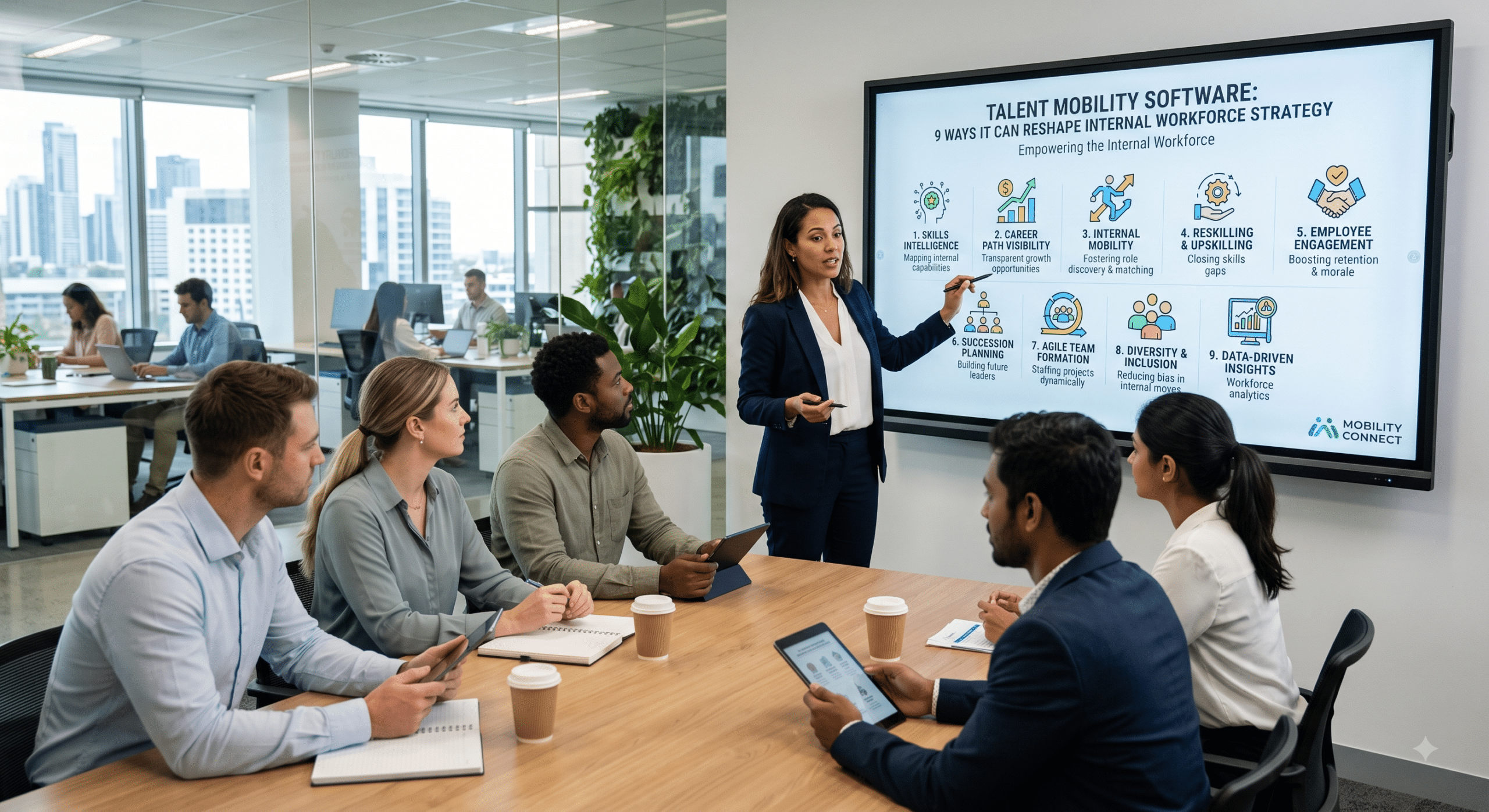
Here are 9 ways talent mobility software can reshape an organization’s internal workforce strategy.
1. It Makes Hidden Talent More Visible
One of the most persistent problems in workforce management is not necessarily a shortage of talent. It is a shortage of talent visibility.
A company may employ thousands of people who have developed valuable capabilities outside their current roles. Someone working in finance may have strong data analytics skills. A project manager may have developed commercial expertise. An engineer may possess leadership capabilities that managers have never formally recorded.
Traditional HR systems tend to emphasize the position someone occupies rather than the broader capability they possess. That distinction matters.
Talent mobility software can create a more detailed view of the workforce by combining information such as skills, experience, career interests, learning activity, previous roles, and employee aspirations. Instead of asking, “Who currently has this job title?” organizations can begin asking, “Who has the capabilities to perform this work?”
That shift is fundamental to a skills-based workforce strategy. It also gives executives a better understanding of the organization’s existing talent supply before they immediately turn to external recruitment.
2. It Connects Employees With More Than Permanent Jobs
Leaders often reduce internal mobility to internal recruitment. That is a mistake.
A modern mobility strategy can include permanent transfers, promotions, lateral moves, short-term projects, mentoring, stretch assignments, rotations, temporary teams, and development experiences. LinkedIn’s research describes internal mobility as movement into new career and development opportunities, while its data also highlights the importance of skills employees develop before making internal moves.
This broader perspective changes how organizations think about opportunity.
An employee may not be ready to move into a new executive role tomorrow. However, they might be ready to lead a six-month project, participate in a cross-functional assignment, or complete targeted learning that prepares them for the position later.
Talent mobility software brings those opportunities into the same employee experience. For workforce consultants, this is particularly valuable because mobility becomes a development journey rather than a single job transaction.
3. It Strengthens Succession Planning
Traditionally, executives have focused succession planning on identifying a small group of high-potential employees for critical leadership positions. While that approach remains important, it can leave a large portion of the workforce outside the conversation.
A stronger model combines succession planning with broader mobility.
Imagine an organization has identified nine strategically important leadership and specialist roles. Rather than maintaining a static list of successors, HR can examine the capabilities each position requires and identify employees who are developing toward those capabilities. The organization can then create pathways involving coaching, mentoring, leadership assignments, international exposure, and project experience.
This creates a living succession pipeline. It also reduces dependence on the assumption that the ideal successor is already sitting in the obvious feeder role.
From an executive advisory standpoint, that is one of the most valuable applications of mobility technology: expanding how the organization defines potential.
4. It Helps HR Move From Job-Based to Skills-Based Workforce Planning
The language of workforce planning is changing. Instead of planning exclusively around headcount and job titles, many organizations are focusing on capabilities. That makes sense in industries where technology, regulation, customer expectations, and business models change faster than organizational structures.
Gartner’s research on internal talent marketplaces notes that these systems can support use cases including internal mobility, career pathing, and succession planning, while emphasizing the importance of cross-functional collaboration and skills-based talent management. Talent mobility software can become the connection point between those activities.
For example, an executive team may determine that the organization needs significantly more AI, cybersecurity, digital product, or advanced analytics capability over the next three years. Rather than immediately translating every capability gap into external hiring requirements, HR can ask:
- What relevant skills already exist?
- Which employees could we reskill?
- Which roles are adjacent?
- Where are the strongest internal talent pools?
- Which learning experiences could close the gap?
- Which employees have expressed interest in those career areas?
That is a considerably more strategic conversation than simply asking how many people the company needs to hire.
5. It Can Reduce Unnecessary External Hiring
External recruitment will always have an important place in workforce strategy. However, organizations often create unnecessary hiring costs when they overlook internal candidates.
LinkedIn reports that internal mobility can improve retention and agility while reducing the time and cost associated with hiring. Its research has also found substantially longer employee tenure among companies with high internal mobility rates.
The financial logic is straightforward. An existing employee already understands the organization’s systems, culture, customers, processes, and operating environment. They may still require development, but the organization is not starting from zero.
Talent mobility software helps HR identify potential internal matches before opening every opportunity to the external market. That does not mean leadership should automatically fill every position internally. Instead, organizations gain another option.
The strategic question becomes:
“Should we buy this capability, build it internally, or move existing capability to where we need it most?”
That is a much stronger workforce planning question.
6. It Gives Employees More Ownership of Their Careers
Organizations cannot run a successful internal mobility program if they design it entirely around enterprise needs. Employees need visibility, choice, and confidence.
A common problem is that workers do not know what opportunities exist beyond their immediate department. They may also assume that changing functions is unrealistic because they do not meet every requirement listed in an internal job posting.
A good mobility platform transforms that experience by showing employees potential career directions based on their skills, interests, and development goals. The employee begins to see a path rather than simply seeing a vacancy.
That distinction matters. LinkedIn’s research found that only a minority of surveyed employees felt their organization encouraged them to move into new roles, despite growing attention to internal recruiting and mobility.
Organizations must therefore pair technology with a clear cultural message:
- Career movement is not disloyalty. Career movement is workforce development.
- Organizations that communicate that principle clearly are far more likely to build genuine mobility.
7. It Can Break Down Organizational Silos
One of the hardest internal mobility problems is managerial ownership. A manager may support career development in theory, but hesitate when a high-performing employee wants to transfer to another department.
This creates what workforce consultants sometimes describe as a “talent hoarding” problem. The organization technically offers mobility opportunities, but employees cannot access them easily because managers trap talent inside organizational boundaries.
Technology cannot solve that cultural problem by itself. However, it can make movement more visible and measurable.
HR leaders can examine:
- Which functions produce the most internal movers?
- Where do employees tend to move?
- Which business units rarely release talent?
- Which managers actively support development?
- Where do teams overlook internal candidates?
- Which skills are moving across the organization?
Executives can integrate those insights directly into leadership accountability. Leadership should therefore treat mobility as a shared enterprise responsibility rather than simply an HR program.
8. It Creates Better Workforce Intelligence for Executives
For a global workforce, the value of mobility software goes beyond the employee interface. The bigger opportunity lies in workforce intelligence.
Senior executives increasingly need to understand how they can redeploy talent as strategic priorities change, and a mobility platform provides another layer of information for those decisions.
Consider a multinational organization preparing for expansion into a new market. Instead of asking only how many people local teams must recruit, leadership could examine whether existing employees have the language skills, commercial knowledge, technical expertise, or regional experience required to support the expansion.
The organization might discover that 9 employees in different business units already possess pieces of the required capability. That changes the conversation. The company may still need external hiring, but it can combine external recruitment with internal movement and development.
This is where talent mobility software becomes more than an HR application. Properly integrated, it becomes part of the organization’s broader workforce intelligence architecture.
9. It Turns Internal Mobility Into a Measurable Business System
The final advantage is measurement. Leaders should not evaluate a mobility initiative simply by asking whether employees like the platform. Executives need evidence that mobility is producing business value.
Useful metrics include:
- Internal fill rate
- Internal application rate
- Internal promotion rate
- Time to fill internal positions
- Retention of internal movers
- Critical-role succession coverage
- Skills-gap reduction
- Employee participation in development opportunities
- Recruitment costs saved through internal placement
The ninth metric is particularly compelling because it connects mobility directly to financial outcomes. If HR can demonstrate that internal movement reduced external recruitment requirements, shortened vacancy periods, or improved retention in strategically important roles, board members will find mobility much easier to defend as a core business investment.
Gartner’s research highlights fragmented systems and poor visibility of opportunities as obstacles to scaling internal mobility, reinforcing the need to approach technology implementation as an organizational transformation rather than a routine software deployment.
What Should Organizations Look For in Talent Mobility Software?
Selecting a platform should begin with the workforce strategy, not a vendor feature list. A strong solution should ideally support several connected capabilities:
- Skills intelligence: Helps organizations understand employee capabilities beyond formal job titles.
- Opportunity matching: Enables employees to discover roles, projects, and development opportunities aligned with their capabilities and aspirations.
- Career pathways: Shows employees how to move from their current positions toward future goals.
- Learning integration: Connects employees with relevant learning resources wherever skills gaps exist.
- Manager participation: Gives managers visibility into mobility without creating unnecessary administrative barriers.
- Workforce analytics: Delivers meaningful data about movement, skills, vacancies, and organizational capability to HR and executives.
- Integration: Works seamlessly with existing HR, learning, recruiting, and workforce systems rather than creating another isolated database.
Most importantly, the technology must be intuitive enough for employees to use without requiring constant HR intervention.
The Implementation Question Most Organizations Miss
Buying talent mobility software is relatively easy. Creating an environment in which employees actually use it is much harder.
Gartner’s implementation guidance emphasizes the challenges organizations face around ownership, cross-functional requirements, and ongoing adoption practices. In advisory work, consultants best approach mobility as a transformation across four connected layers:
- Establish the business case: Determine what specific problem leadership expects mobility to solve—retention, skills shortages, succession risk, hiring costs, workforce agility, or a combination.
- Establish the talent architecture: Define the skills, roles, career families, and critical capabilities that matter to the organization.
- Redesign the employee experience: Make opportunities visible and give employees practical ways to move toward them.
- Change leadership behavior: Ensure managers understand that developing and releasing talent strengthens the enterprise rather than weakening their individual teams.
Without that fourth component, even the most sophisticated technology risks becoming another underused HR system.
Final Thoughts
The strongest organizations are beginning to rethink the idea of talent ownership.
Employees are not simply resources that leaders assign permanently to organizational boxes. Instead, their skills can move, while their careers evolve and leadership redeploys their experience. The business itself ultimately benefits when leadership manages that movement intelligently.
That is the strategic promise of talent mobility software.
The goal is neither to encourage employees to constantly change jobs nor to eliminate external recruitment. Instead, the focus is on creating a workforce capable of moving toward the organization’s changing needs while giving employees clearer opportunities to build meaningful careers.
For global organizations, this capability becomes particularly important as skills evolve, business models shift, and workforce expectations continue to change.
The organizations that get internal mobility right will not necessarily be those with the most sophisticated software. They will be the ones that connect technology, skills, leadership behavior, career development, and workforce strategy into one coherent system.
Technology provides the infrastructure.
Leadership creates the permission.
And mobility turns existing talent into a more adaptable source of competitive advantage.
Frequently Asked Questions
What is talent mobility software?
Talent mobility software is technology that helps organizations identify, develop, and move employees toward internal career opportunities. Depending on the platform, it can support internal jobs, projects, career paths, skills matching, learning, mentoring, and workforce planning.
How is talent mobility software different from an internal job board?
An internal job board primarily publishes vacancies. Talent mobility software provides a broader experience by connecting employees with jobs, projects, skills, learning, and career-development opportunities. Workday, for example, describes its Talent Marketplace as connecting employees with jobs, projects, flexible teams, and learning opportunities.
Can talent mobility software support succession planning?
Yes. Mobility technology helps organizations identify employees with relevant skills and development potential for critical positions. It also connects succession planning with active career development and learning, rather than leaving succession as a static annual exercise.
Does talent mobility software replace recruiters?
No. External recruiting remains important, particularly when organizations require capabilities that do not exist internally. Mobility software simply gives recruiters and HR leaders another rich source of talent by making internal candidates easier to identify.
Which organizations benefit most from talent mobility software?
Large and complex organizations benefit significantly because they often have substantial internal talent coupled with limited visibility across business units, geographies, and functions. However, smaller organizations with high career movement and complex skill requirements can benefit just as much.
What are the biggest implementation risks?
Common risks include poor skills data, unclear ownership, weak manager adoption, fragmented HR systems, limited employee engagement, and implementing technology before defining the underlying mobility strategy.
How should leadership measure success?
Organizations should track metrics such as internal fill rates, internal movement, promotion rates, retention of internal movers, time to fill, succession coverage, skills development, and recruitment costs saved through internal placement.
Is talent mobility the same as career mobility?
The concepts overlap, but they take different angles. Career mobility generally focuses on an individual’s movement and personal development, while talent mobility encompasses the broader organizational system for moving people, skills, and capabilities to where they create the greatest value.
Here is the updated References and Further Reading section featuring top-tier, high-authority publications and industry-leading research on internal mobility and talent marketplaces.
Here is the updated References and Further Reading section featuring top-tier, high-authority publications and direct resources on internal mobility and talent marketplaces:
References and Further Reading
- Deloitte Insights — Global Human Capital Trends: Explores how leading organizations orchestrate internal talent pools, AI-driven skill mapping, and agile workforce deployment to drive organizational adaptability.
- Gartner — Best Internal Talent Marketplaces Reviews & Ratings: Provides peer reviews, vendor analyses, and research-backed implementation criteria for enterprise internal mobility platforms.
- Workday Blog — Shaping Our Future: Trends We’re Seeing in Hiring and Developing Internal Talent: Analyzes internal workforce data, gig creation trends, and strategies for connecting employees with cross-functional projects and development opportunities.
- LinkedIn Talent Solutions — What Is Internal Mobility and How to Get It Right: Breaks down benchmark global data on employee retention, career movement patterns, and strategies for fostering an internal mobility culture.