

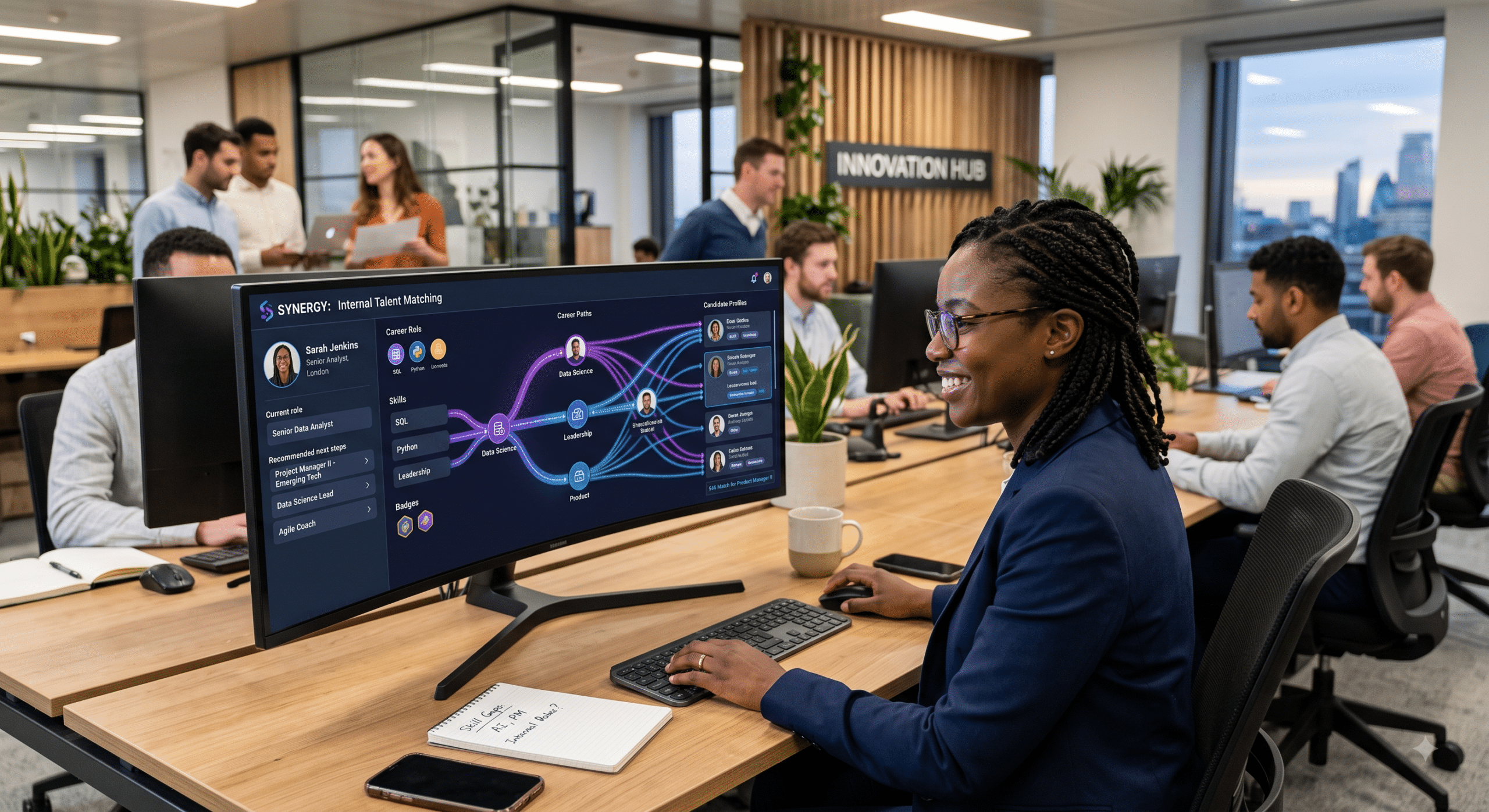
For years, internal mobility was treated as a simple HR process, but the rise of AI career matching is completely transforming how organizations view employee growth. Traditionally, an employee saw an internal vacancy, submitted an application, waited for a manager or recruiter to review it, and hoped the move worked out. That model made sense when organizations were smaller, job descriptions were stable, and career progression generally followed predictable ladders.
However, those conditions no longer hold.
Today, skills are changing rapidly, business models are being redesigned, and employees increasingly expect their employers to help them understand what comes next. Consequently, the World Economic Forum’s Future of Jobs Report estimates that 39 percent of workers’ core skills could change by 2030, while employers identify skills gaps as one of their biggest barriers to transformation. Furthermore, almost half of employers surveyed expect to transition employees from roles disrupted by AI into other positions.
This is precisely why smart career matching technology becomes strategically important.
From a global HR strategy and workforce advisory perspective, the opportunity is not simply to automate internal recruitment. Instead, the larger opportunity is to build an intelligent system that understands what employees can do, what they want to learn, what the organization needs next, and which experiences could connect those points.
A mature internal mobility platform should therefore answer a much more useful question than, “Which employee matches this vacancy?”
Rather, it should ask: “Which people could realistically grow into this opportunity, what skills do they already have, what are they missing, and what pathway would make the transition successful?”
Ultimately, that distinction changes everything.
What Is AI Career Matching?
AI career matching uses artificial intelligence, skills data, employee profiles, job information, learning data, and organizational workforce requirements to identify potential career opportunities for employees.
Traditional internal recruitment tends to depend heavily on job titles, previous roles, and manager recommendations. In contrast, AI-enabled matching can look far beyond those traditional signals.
For example, imagine a financial analyst who has experience with forecasting, stakeholder management, Excel, reporting, and data interpretation. A conventional system may see “financial analyst” and strictly recommend other finance roles. However, a skills-oriented platform might identify meaningful overlap with business intelligence, commercial analytics, operations strategy, or data analysis positions.
LinkedIn has highlighted a similar shift through real-world examples, such as Schneider Electric’s internal talent marketplace. By moving toward skills-based matching, Schneider Electric discovered that their financial analysts actually possessed a substantial portion of the skills needed for data analyst roles.
Therefore, the main value is not the algorithm alone. Rather, the value comes from revealing internal opportunities that traditional organizational structures tend to hide.
Why Internal Mobility Platforms Need AI
A modern enterprise may have thousands of employees, thousands of roles, constantly changing skills, and a significant amount of informal knowledge that never appears in an HR system.
Employees continuously gain capabilities through projects, customer interactions, certifications, mentoring, temporary assignments, and day-to-day experience. Yet, conventional HR technology often records only a fraction of that information.
As a result, an AI-enabled internal mobility platform can create a much more dynamic picture.
Deloitte’s research on internal talent marketplaces describes the evolution from simple job matching toward broader opportunity marketplaces involving full-time roles, gigs, mentorships, rotations, stretch assignments, and skill-building opportunities. Additionally, Deloitte notes that AI-enabled platforms can match people with opportunities at scale and support more personalized career pathways.
For HR leaders, this matters because internal mobility is no longer only a talent-retention initiative. Instead, it can become a core part of strategic workforce planning.
When business strategy changes, the organization can proactively ask:
- Which skills do we already have?
- Where are those skills located?
- Which employees could move into emerging roles?
- What skills are missing?
- What learning would close those gaps?
- Which employees are ready now?
- Which employees could become ready within six or twelve months?
Consequently, that creates a much more strategic use of HR technology.
12 Capabilities of a Strong AI Career Matching Strategy
Technology alone does not create effective internal mobility. Therefore, the platform needs the right capabilities, governance, and operating model.
1. Skills-Based Employee Profiles
The foundation is a living skills profile. Instead of relying exclusively on an employee’s job title, the platform should capture technical skills, functional expertise, certifications, experiences, projects, behavioral capabilities, and career interests. Furthermore, the profile should continuously evolve as the employee learns and takes on new assignments.
2. Transferable Skills Detection
Employees rarely possess every single requirement for their next role. However, that should not automatically eliminate them. A good matching engine identifies transferable capabilities and distinguishes between critical gaps and learnable gaps. As Gartner’s research emphasizes, there is immense value in hiring and developing people based on potential rather than demanding complete proficiency across every requirement.
3. Career Pathway Recommendations
The best platform does more than recommend a vacant position. In fact, it can show an employee a structured, possible pathway:
Current Role -> Adjacent Role -> Development Experience -> Target Role
For instance:
- Financial Analyst -> Business Analyst -> Data Analytics Project -> Data Analyst
This allows the employee to see what is realistic, what needs development, and what specific experiences would improve readiness.
4. Personalized Learning Recommendations
If an employee is a strong match for a role but lacks two important capabilities, the platform should immediately identify appropriate development options. That could include:
- Short courses
- Internal training
- Mentoring
- Job shadowing
- Certifications
- Stretch assignments
- Project-based work
- Temporary rotations
As a result, this creates a direct connection between active learning and career progression.
5. Opportunity Matching Beyond Vacancies
Internal mobility should not be restricted strictly to permanent jobs. On the contrary, an employee may benefit from a six-week project, a mentoring relationship, or a cross-functional assignment before making a permanent move. Deloitte describes this broader concept as an opportunity marketplace, where employees can seamlessly access experiences beyond conventional job openings.
6. Skills Gap Analysis
The organization should be able to compare current workforce capabilities with future strategic requirements. This transforms AI career matching from an employee-facing tool into a macro-level workforce planning capability. For example, if a company expects demand for AI, data governance, or cybersecurity capabilities to increase, the platform can identify internal employees with adjacent skills who could potentially be developed.
7. Manager Visibility
Managers are essential to internal mobility, but they can also unintentionally become gatekeepers. Therefore, a strong platform gives managers visibility into internal talent while establishing clear rules around employee development and movement. Ultimately, the objective is not to bypass managers, but rather to reduce reliance on informal networks.
8. Explainable Recommendations
Employees should clearly understand why a particular opportunity has been recommended. A recommendation such as “You are a 78 percent match” is not particularly useful without context. Conversely, a better explanation might state:
- Strong Match: Stakeholder management, financial modeling, and reporting.
- Development Area: SQL and dashboard development.
- Suggested Action: Complete the internal analytics program and participate in one data project.
Indeed, transparency builds trust.
9. Fairness and Bias Controls
AI does not automatically eliminate bias. In fact, if historical promotion, hiring, or performance data contains implicit bias, an algorithm may reproduce it. Organizations therefore need strong governance around data quality, protected characteristics, model testing, recommendation logic, human review, and auditability. The goal should be to use AI to widen opportunity—not to create a new invisible gatekeeper.
10. Workforce Demand Forecasting
The next stage is predictive. Instead of waiting for jobs to open, organizations can forecast emerging skill requirements and identify potential internal pipelines before the demand becomes urgent. Consequently, this aligns directly with the broader shift toward proactive workforce planning.
11. Internal Talent Marketplace Integration
AI career matching becomes considerably more useful when integrated into an all-in-one internal talent marketplace. Employees should be able to discover jobs, projects, mentors, and learning opportunities from one unified environment. As McKinsey notes, AI-enabled internal talent marketplaces excel at matching open roles with existing employees who might otherwise be overlooked.
12. Measurable Mobility Outcomes
Finally, the platform needs meaningful metrics to track effectiveness. HR leaders should track:
- Internal fill rate
- Employee participation
- Time to internal placement
- Skill-gap closure
- Internal promotion rates
- Lateral mobility
- Retention after internal movement
- Diversity of opportunity access
- Learning-to-mobility conversion
- Manager participation
- Critical-role pipeline strength
- Cost avoided through internal hiring
Without rigorous measurement, AI career matching risks becoming another HR technology project rather than a strategic business capability.
AI Career Matching and the Future of Work
The business case for AI career matching is becoming stronger because work itself is becoming far less predictable.
The World Economic Forum projects 170 million new jobs and 92 million displaced jobs globally, resulting in a net increase of 78 million roles. Meanwhile, the same research highlights the growing importance of both technology skills and human capabilities such as creative thinking, resilience, flexibility, leadership, and collaboration.
This means organizations cannot simply recruit their way through every skills transition. Instead, there will be frequent situations where the right talent already exists inside the company; the core challenge is simply finding it.
Consider a global organization with 50,000 employees. Somewhere within that workforce, there may be hundreds of people with adjacent skills for emerging positions. Yet, those employees often sit in different business units, countries, or functions. Consequently, they may not know the roles exist, and hiring managers may not know those employees exist.
AI career matching creates a systematic mechanism for discovering that hidden capability. As a result, it can turn internal mobility from a routine administrative process into an agile workforce strategy.
The Human Element Still Matters
Despite technological advances, there is a temptation to assume that AI should make career decisions automatically. However, that is the wrong model.
Career decisions deeply involve personal motivation, life circumstances, aspirations, confidence, and organizational context. While an algorithm can identify a strong skills match, it cannot fully understand why an employee may or may not want a particular career path.
Therefore, the best approach is a human-plus-machine model:
- AI identifies opportunities and underlying patterns.
- Employees make personal choices.
- Managers provide context and mentorship.
- HR governs the system.
- Leaders determine workforce priorities.
This balance is particularly important when recommending employees for high-impact or leadership positions. Ultimately, AI should support better conversations, not replace them.
Building the Business Case for Internal Mobility Platforms
For CHROs and workforce leaders, the business case should directly connect internal mobility to measurable organizational priorities:
- Retention: Employees who can see credible opportunities inside an organization have fewer reasons to assume that leaving is the only way to progress. Indeed, LinkedIn reports that employees at organizations with high internal mobility stay significantly longer than those at organizations with low mobility.
- Workforce Agility: When business priorities shift, organizations with clear visibility into internal skills can redeploy talent much more quickly.
- Skills Investment: Rather than training employees broadly and hoping the investment pays off, organizations can connect development directly to anticipated roles.
- Talent Acquisition Efficiency: Every role filled internally reduces dependency on external recruiting, thereby lowering recruitment costs and shortening ramp-up times.
- Employee Experience: Employees increasingly expect organizations to provide visibility into career possibilities. For example, Siemens has successfully used an internal talent portal connecting employees directly with jobs, learning, and career-development resources.
A Practical Implementation Roadmap
Organizations do not need to launch a massive enterprise marketplace on day one. On the contrary, a more practical approach is to start with a defined business problem through a structured, phased rollout:
- Phase 1: Establish the skills foundation. Create a common skills language and clean existing employee and job data.
- Phase 2: Identify priority roles. Select critical or difficult-to-fill roles where internal mobility could make a measurable difference.
- Phase 3: Launch matching. Introduce AI career matching for selected functions or employee populations.
- Phase 4: Connect learning. Link identified skill gaps to relevant development experiences.
- Phase 5: Expand opportunities. Add projects, gigs, mentoring, and rotations.
- Phase 6: Measure outcomes. Track mobility, retention, readiness, skills development, and business impact.
- Phase 7: Scale globally. Expand only after establishing governance, employee trust, and reliable data.
This phased approach aligns with practical lessons from organizations that have successfully implemented talent marketplaces. For instance, Schneider Electric evolved gradually from title-based matching toward a more sophisticated skills-based model rather than waiting for perfect infrastructure before starting.
What HR Leaders Should Avoid
To ensure success, there are several common mistakes that leaders should actively avoid:
- First, do not treat AI career matching as a total replacement for career conversations.
- Second, do not build the system around job titles alone, as titles vary significantly across organizations and regions.
- Third, do not assume that an employee must possess every single skill before being considered for a role.
- Fourth, do not launch the platform without a clear explanation of how recommendations work.
- Fifth, do not ignore managers, because manager incentives and behavior can determine whether internal mobility becomes a genuine organizational practice.
- Finally, do not measure success only by platform logins. The real question is whether people are moving into valuable opportunities and developing capabilities the business needs.
The Strategic Outlook
Internal mobility platforms are moving toward a more sophisticated model in which career development, workforce planning, learning, and talent deployment become interconnected.
The strongest systems will not simply tell employees which jobs they qualify for today. Instead, they will illuminate what could become possible tomorrow.
That distinction is important. A qualification-based system says:
“You are not ready.”
A developmental system says:
“You are 70 percent of the way there. Here is what would close the gap.”
That is where AI career matching creates meaningful value. It helps organizations see skills that were previously hidden, create realistic career pathways, accelerate redeployment, and make learning more relevant. Simultaneously, it gives employees greater ownership over their own careers.
For global HR strategy and workforce leaders, the opportunity is ultimately larger than technology alone. It is about redesigning how organizations think about talent. While the traditional career ladder assumed that progression happened vertically and predictably, the modern workforce is more likely to move sideways, diagonally, temporarily, and across completely different disciplines.
AI helps make those flexible pathways visible. Consequently, the organizations that act on that insight will be far better positioned to build talent internally, respond to changing skills, and retain people whose capabilities might otherwise remain hidden.
Frequently Asked Questions
What is AI career matching?
AI career matching uses artificial intelligence, skills data, employee profiles, and organizational job information to recommend relevant career opportunities, development experiences, and internal roles to employees.
How does AI career matching improve internal mobility?
It can identify transferable skills and potential career pathways that traditional job-title-based systems may overlook. Consequently, this makes it easier for employees to discover opportunities outside their immediate department or current role.
Can AI career matching replace HR recruiters?
No. It is better viewed as an augmentation tool. While AI can analyze large amounts of workforce data and identify potential matches, recruiters, HR leaders, managers, and employees provide essential judgment and context.
Is AI career matching suitable for large global organizations?
Yes, particularly where organizations have thousands of employees across multiple functions, countries, and business units. However, successful implementation requires strong skills data, governance, privacy controls, and change management.
Does AI career matching require employees to have every skill listed in a job description?
No. One of its major advantages is identifying transferable skills and development opportunities. Thus, employees may be suitable for a role even when they have gaps that can reasonably be addressed through learning or experience.
How does AI career matching support succession planning?
It can identify employees with capabilities adjacent to future-critical roles, highlight development gaps, and help organizations build broader internal talent pipelines instead of relying on a small group of known successors.
What data does an AI career matching system need?
Common inputs include employee skills, work history, projects, certifications, learning activity, job requirements, career interests, and organizational workforce demand. Data quality and governance are critical.
Can AI career matching reduce bias?
It can potentially reduce certain forms of bias by making skills and transferable capabilities more visible. However, AI can also reproduce historical bias, so organizations need model testing, governance, transparency, and human oversight.
How should organizations measure success?
Useful measures include internal fill rates, internal mobility, retention after movement, time to placement, skills-gap closure, employee participation, development completion, and the strength of internal pipelines for critical roles.
Conclusion
AI career matching should not be viewed as merely another feature added to an HR platform. Done properly, it becomes the core of an organization’s internal mobility system—a mechanism for connecting people, skills, opportunities, and future business requirements.
The strongest strategy is not to automate every career decision, but rather to give employees and leaders better information. When employees can see the roles they might grow into, the skills they already possess, the capabilities they need to develop, and the experiences that can help them get there, career development becomes much more tangible.
For employers, the payoff is equally significant. Instead of repeatedly looking outside the organization for scarce skills, leaders can identify, develop, and redeploy capabilities already present inside the workforce.
That is the real promise of the next generation of internal mobility platforms: not simply finding people for jobs, but helping organizations and employees find the next opportunity together.
References and Further Reading
- Academy to Innovate HR (AIHR) — AI for Internal Mobility: A Practical Guide to Talent Growth from Within. Provides actionable guidance on skills inference, predictive matching, personalized career pathing, and managing risks around data governance and bias. Source: Read the AIHR Guide
- Deloitte Insights — Global Human Capital Trends & Internal Talent Research. A foundational analysis of internal talent marketplaces, opportunity platforms, dynamic skills mapping, and workforce mobility trends. Source: Explore Deloitte Insights Talent Research
- McKinsey & Company — Stave Off Attrition With an Internal Talent Marketplace. Demonstrates how AI-enabled internal talent marketplaces improve retention by surfacing hidden potential across enterprise workforces. Source: Read the McKinsey Article
- World Economic Forum — Future of Jobs Report. Delivers global evidence on skill evolution, role disruption, reskilling imperatives, and long-term workforce transition strategy through 2030. Source: View the WEF Future of Jobs Report
- Gartner — Hiring for Promise Instead of Proficiency to Close Skills Gaps. Highlights why focusing on transferable skills and employee potential is nearly twice as effective at building critical capabilities internally. Source: Read the Gartner Research Release
- The Josh Bersin Company — Talent, Recruiting, and Career Mobility. Offers leading industry research on AI-driven talent acquisition, skill-based internal growth models, and talent intelligence platforms. Source: Explore Josh Bersin Research
- Eightfold AI — AI-Powered Talent Management & Internal Mobility. Details enterprise talent intelligence, skills-based mobility strategies, and real-world deployment across global organizations. Source: Learn More on Eightfold AI
- Sapia.ai — How AI-Powered Internal Mobility Software Is Changing the Way HR Works. Details how verified assessment data, objective talent matching, and explainable AI recommendations transform internal hiring processes. Source: Read the Sapia.ai Article