

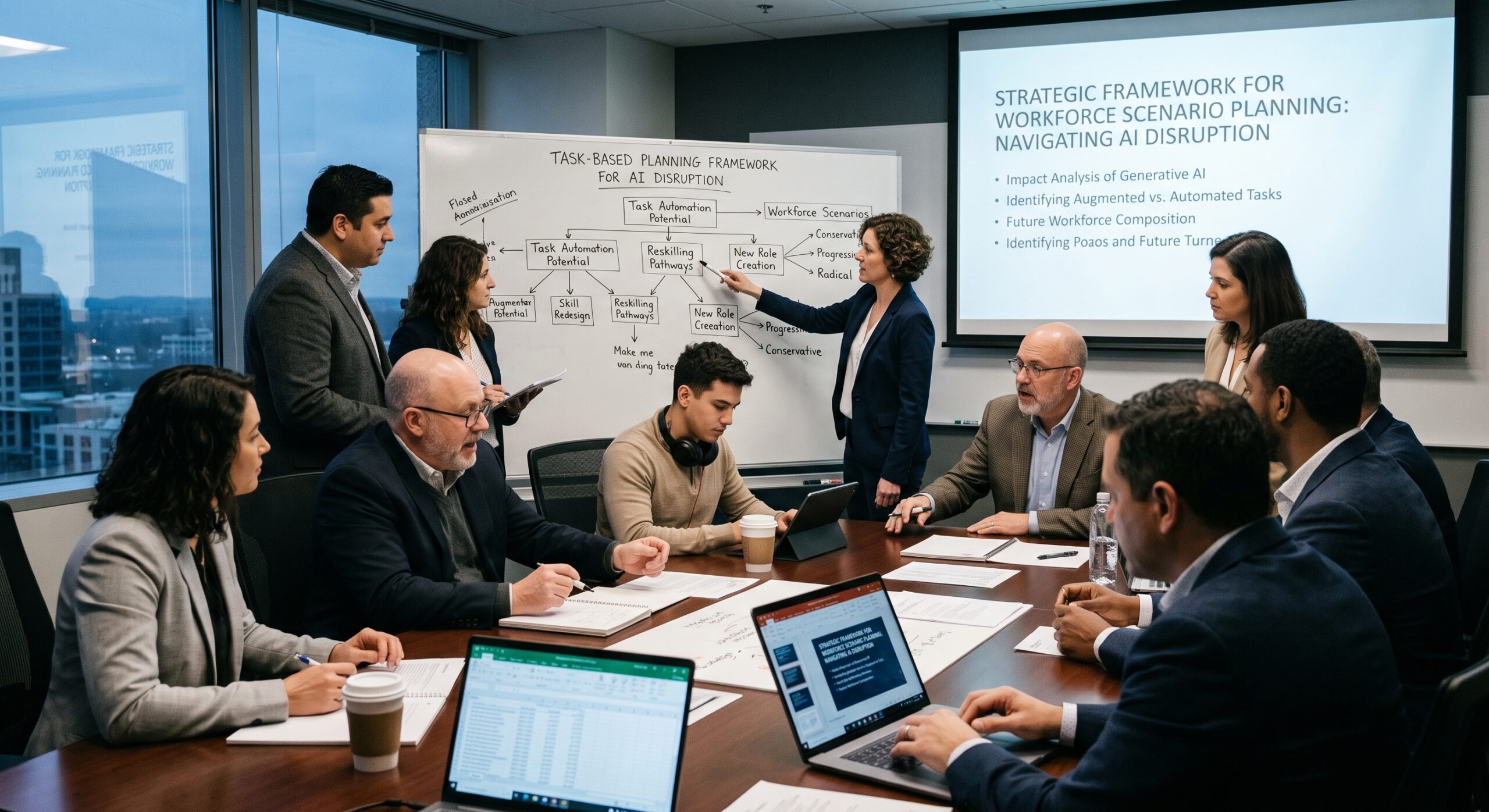
Artificial intelligence is rapidly transforming talent management, making workforce scenario planning an essential tool for organizations navigating digital transformation. However, the most critical evolution does not necessarily require the wholesale elimination of jobs. Instead, across most organizations, AI first alters the individual tasks embedded within those roles. Consequently, a service representative may spend significantly less time searching for information and far more time resolving sensitive customer issues. Similarly, a financial analyst might spend less time generating static reports and more time analyzing underlying business risks. As a result, a manager can supervise fewer administrative activities while taking on greater responsibility for coaching, quality control, and strategic decision-making.
Ultimately, this shift demands a far more practical, task-based approach to workforce management. Rather than merely asking how many headcount slots the business will require, workforce leaders must evaluate what specific work employees must perform, how individual tasks will evolve, which core skills will remain critical, and precisely how people and technology will share accountability.
This is the exact objective of modern workforce scenario planning. Indeed, it empowers executive leaders to prepare for multiple plausible futures rather than locking the organization into a single forecast that could quickly become obsolete.
Why Traditional Workforce Planning Is Changing
Historically, traditional workforce planning begins with headcount. Leaders typically examine existing roles, project future demand, and subsequently calculate how many employees they must hire, retain, or redeploy. Naturally, this traditional model functions effectively when business conditions, organizational structures, and baseline productivity levels remain stable.
However, AI disruption renders those baseline assumptions far less reliable. For example, a team might maintain the exact same number of employees yet deliver vastly higher output simply because AI reduces the hours required for routine labor. Conversely, another team may require fewer headcount for administrative support, but significantly more high-level specialists who can audit automated decisions, handle exceptions, or cultivate deeper client relationships.
Furthermore, a standardized job title alone fails to expose these shifting dynamics. Indeed, two employees holding the exact same title may perform drastically different tasks, rely on different systems, and face entirely different levels of exposure to automation. Consequently, a task-based analysis provides a far more accurate starting point for workforce scenario planning.
In fact, recent workforce planning research heavily emphasizes the value of linking tasks, skills, roles, capacity, productivity, and costs together. Ultimately, this integration yields a far more adaptable view of organizational work than any static model built strictly on job titles or historical staffing ratios.
Moreover, a task-based framework prevents a ubiquitous planning error: assuming that automation exposure impacts every individual within a role equally. In practice, AI will often automate one segment of a job, augment another, and leave the remaining responsibilities entirely untouched.
For instance, consider a workforce management analyst who performs the following weekly activities:
- Preparing daily staffing reports.
- Reviewing forecast accuracy.
- Explaining service-level variances to operational leaders.
- Adjusting agent schedules.
- Investigating recurring absence patterns.
- Advising frontline managers during unexpected demand surges.
- Supporting long-term capacity planning.
Undoubtedly, AI can drastically accelerate report generation and rapidly isolate absence patterns. Furthermore, algorithms can automatically generate optimized schedule adjustments. Nevertheless, explaining strategic trade-offs to senior executives, interpreting nuanced operational anomalies, and determining acceptable organizational risk still strictly demand human judgment. Thus, the future of any given role hinges directly on its specific task mix rather than its nominal title.
Start With the Work: The Task Inventory Baseline
Therefore, workforce leaders take the foundational step in workforce scenario planning by documenting what employees actually do on a day-to-day basis. While formal job descriptions offer a baseline, they rarely provide enough granularity for a proper AI impact analysis, as they typically summarize high-level responsibilities rather than time-consuming micro-activities.
To bridge this gap, a practical task inventory systematically evaluates:
- Task Name & Time Commitment: The specific activity and the overall percentage of weekly working time it consumes.
- Operational Dependency: The underlying systems, tools, and data sources the task requires.
- Criticality & Risk: The degree of human judgment involved alongside the real-world consequences of an operational error.
- Human-Tech Dynamics: The core skills required, the degree of interpersonal interaction involved, and whether the task yields a repeatable or highly variable output.
Importantly, leadership does not aim to construct an overwhelming administrative burden. Instead, planners begin strategically by targeting six high-impact roles or functions where AI adoption will most immediately influence productivity, service quality, cost structures, or employee experience.
For each designated role, workforce planners answer four key questions:
- What specific work involves repetitive, rules-based activities?
- What specific work strictly requires context, judgment, or human trust?
- What specific work currently suffers bottlenecks from poor data or disconnected systems?
- Which specific tasks can AI meaningfully support, redesign, or execute?
Inevitably, this balanced diagnostic yields far more actionable insight than sweeping generalizations about whether a role is simply “safe” or “at risk.”
For example, rigid logic and clean data make a repetitive task a prime candidate for complete automation. Conversely, sensitive personnel data, nuanced negotiations, safety compliance, or emotional support inherently require direct human oversight—even when AI assists in synthesizing background data. As a result, planners must weigh technical feasibility alongside operational risk, quality standards, regulatory mandates, and overall organizational readiness.
How to Build Meaningful Frameworks for Workforce Scenario Planning
Leaders must not treat workforce scenario planning as a dramatic exercise in speculative prediction. Rather, they must use scenarios as a structured framework of stress-tested assumptions designed to guide capital and talent decisions.
Consequently, most enterprise organizations establish at least three distinct operating scenarios:
Accelerated Adoption Scenario
In this environment, organizations deploy AI tools rapidly, overcome data foundation barriers swiftly, drive manager adoption of new workflows, and scale productivity faster than anticipated. As a result, routine manual tasks decline sharply, while demand spikes for employees who can supervise AI outputs, manage edge cases, and drive continuous process improvements.
Measured Adoption Scenario
Here, technology adoption proceeds steadily, but implementation moves at a deliberate pace because teams require upskilling, workflow redesigns, system integrations, or improved managerial readiness. Therefore, the workforce evolves incrementally, offering HR leaders adequate time to systematically reskill and redeploy talent.
Constrained Adoption Scenario
Under this condition, strict regulatory hurdles, heightened cybersecurity risks, internal pushback, poor data health, or unproven ROI constrain widespread AI usage. Consequently, employees continue to lead the majority of core work, keeping hiring and retention targets aligned with traditional historical projections.
Importantly, leaders should never treat these scenarios as static labels. Instead, their true value lies in revealing the specific dependencies beneath them. Thus, executive teams must clearly articulate what conditions must hold true for each scenario to manifest. Key operational assumptions to track across these variables include:
- Automation Potential: Evaluating the exact percentage of routine tasks suitable for complete AI automation versus digital assistance.
- Execution Velocity: Monitoring the estimated timeline for full technical integration and manager adoption.
- Capacity & Cost: Balancing projected productivity gains against software licensing, training, and governance costs.
- Talent & Risk: Assessing the internal availability of specialized skills, error tolerance, and regulatory compliance constraints.
Ultimately, workforce scenario planning becomes actionable when leadership explicitly links it to decision-making. For instance, if AI successfully reduces schedule-creation labor by 40%, executive leadership must deliberately decide whether to reduce overall headcount, expand operational coverage, or reallocate that saved time toward proactive employee coaching. Strategic workforce planning exists to illuminate these distinct choices.
Classify Tasks Carefully Across Scenarios
Furthermore, leadership should not manage all AI-impacted tasks in the same manner. Applying a simple, standardized taxonomy allows leaders to cleanly map out operational interventions during workforce scenario planning.
Automated Tasks
Structured, repetitive, and rules-based processes driven by standardized data. Examples include routine data entry, basic report layout, automated customer appointment reminders, and preliminary information retrieval.
AI-Assisted Tasks
Complex workflows where AI generates recommendations, drafts initial content, analyzes large datasets, or completes routine sub-tasks. Crucially, a human professional evaluates the output, applies domain judgment, and retains overall accountability.
Human-Led Tasks
High-stakes activities depending heavily on empathy, strategic negotiation, ethical discernment, physical presence, or executive relationship management. Although AI may surface supportive context, human responsibility fundamentally grounds the work.
However, leaders must recognize that task classification remains dynamic rather than permanent. Over time, a task may transition from human-led to AI-assisted as algorithms mature and teams strengthen governance frameworks. Conversely, if an automated process yields unacceptable error rates, leadership must immediately shift the task back toward human oversight.
Therefore, Workforce Management Specialists must continuously track operational performance post-deployment. The core metric never focuses on vendor claims regarding automation, but on whether teams execute the task consistently to standard regarding quality, speed, security, and accountability.
Translate Tasks Into Skills
Once planners accurately categorize tasks, workforce leaders can cleanly map out the specific skill profiles required across each future scenario.
At this stage, many traditional workforce plans fail due to vagueness. Generic assertions such as “employees must become digitally fluent” offer little actionable utility. Instead, leaders must isolate the precise capabilities demanded by redesigned workflows.
For example, a modern workforce scheduling team will increasingly require expertise in:
- Data interpretation and statistical reasoning
- Operational exception handling
- Predictive workforce forecasting
- Advanced AI prompt engineering and output auditing
- Process re-engineering and technical documentation
- Data privacy and governance protocol compliance
- Cross-functional stakeholder communication
- Change management and team coaching
Fortunately, many of these requisite capabilities already exist within the current workforce; however, standard skills inventories often fail to capture them, leaving them hidden. Employees frequently acquire advanced capabilities through ad-hoc projects, prior career paths, personal technical pursuits, or informal operational roles.
Consequently, robust workforce scenario planning leverages internal talent mobility before defaulting to expensive external hiring. Indeed, employees whose routine administrative tasks AI automates can frequently transition into quality assurance, workforce analytics, or high-tier escalation management with targeted, modular training.
Once planners identify task changes, decision-makers apply a four-part framework—Build, Buy, Borrow, or Bot—when addressing skill gaps:
- Build: Reskill and upskill the internal talent pool through targeted learning pathways.
- Buy: Source specialized external capabilities through targeted recruiting.
- Borrow: Leverage contractors, consulting partners, or specialized agency support for temporary flexibility.
- Bot Support: Implement task automation or AI assistance for suitable, rules-based activities.
In most enterprise cases, the optimal strategy blends these approaches: hiring a targeted group of senior technical experts while upskilling existing staff to manage AI-augmented workflows.
Connect Planning to Operations
Strategic workforce scenario planning achieves maximum ROI when it directly interfaces with operational key performance indicators (KPIs). A plan disconnected from daily scheduling, service level management, finance, and enterprise learning will inevitably fail to drive executive action.
Within a Workforce Management (WFM) ecosystem, critical operational metrics include:
- Forecast accuracy & Schedule adherence
- Service level agreements (SLAs) & Average handling time (AHT)
- Operational shrinkage, overtime, and absenteeism
- Employee occupancy & Quality assurance (QA) scores
- Escalation rates & Customer resolution metrics
- Time-to-proficiency for newly onboarded talent
It is vital to note that while AI may optimize one specific metric, it can simultaneously introduce stress elsewhere in the system. For instance, an automated customer service tool might dramatically reduce average handling time, but substantially increase repeat contact rates if customers receive incomplete information. Similarly, an automated scheduling algorithm might optimize labor coverage while eroding employee trust if workers find its underlying logic opaque.
For this reason, leadership cannot measure productivity solely through labor hour reductions. Instead, a comprehensive evaluation encompasses output volume, solution quality, customer satisfaction, team sentiment, and long-term operating risk.
Furthermore, leadership must define clear operational triggers—quantitative threshold events that signal when teams must adapt a workforce plan.
- AI tool adoption exceeds 50% across a target workflow.
- Team productivity improves by 15% across three consecutive reporting cycles.
- Process error rates exceed established governance risk thresholds.
- Critical skill shortages begin negatively impacting service delivery SLAs.
- Voluntary turnover spikes within roles undergoing aggressive redesign.
By establishing these empirical triggers, leaders transform workforce planning from a static, annual budgeting exercise into an agile, continuous management function.
Protect the Human Workforce During Transformation
Simultaneously, effective workforce scenario planning prioritizes a comprehensive talent transition plan. Because technological disruption naturally creates workplace anxiety, employees will inevitably question what operational changes mean for their job security, compensation, and career growth.
Consequently, executive communication must remain transparent, empathetic, and specific. Leaders should clearly articulate which tasks AI automates, which responsibilities remain human-led, what reskilling pathways the organization provides, and precisely how managers will evaluate performance. While executive teams should avoid making false promises that roles will never change, they must equally avoid framing automation as a simplistic mechanism for headcount reduction.
A high-integrity workforce transition framework encompasses:
- Objective, task-based skills assessments for impacted teams.
- Customized learning pathways designed around emerging operational tasks.
- Dedicated, low-risk sandbox environments for employees to master new tools.
- Clear internal mobility pathways and redeployment protocols.
- Focused manager training to lead teams through structural change.
- Transparent governance protocols regarding how algorithms support performance evaluation and scheduling.
In this context, middle managers play a pivotal role. Because frontline staff naturally bring concerns to their direct supervisors first, leadership must equip managers with granular visibility into workflow changes, updated performance expectations, and available support systems. Ultimately, maintaining organizational trust depends on robust governance: human judgment must always retain final authority in high-stakes decisions impacting an employee’s career trajectory, status, or compensation.
A Practical Six-Step Starting Point for Workforce Scenario Planning
Rather than attempting to overhaul the entire enterprise simultaneously, executive teams build immediate momentum in workforce scenario planning by executing a focused, six-step implementation plan:
- Select Target Functions: Identify six high-impact roles or operational workflows featuring high business value and significant AI exposure.
- Audit Current Tasks: Document existing task inventories, capturing precise time allocations, supporting software systems, required skill levels, and risk thresholds.
- Classify AI Exposure: Categorize every identified task as primary for Automation, AI-Assisted, or strictly Human-Led.
- Model Plausible Scenarios: Construct three distinct workforce scenarios based on varying adoption rates, productivity gains, talent availability, and regulatory factors.
- Map Skills & Action Plans: Align future task requirements to underlying skills, deploying a balanced Build, Buy, Borrow, or Bot strategy for talent acquisition and reskilling.
- Establish Operational Triggers: Define quantifiable performance thresholds, clear executive ownership, and regular review cadences to update plans dynamically.
Crucially, this planning process engages the frontline employees and managers who execute the work daily. While executive leadership sets overarching strategy, frontline input proves indispensable for identifying hidden procedural nuances, operational workarounds, and systemic risks that traditional HR data fails to capture.
Frequently Asked Questions
What is workforce scenario planning?
Workforce scenario planning is an agile management methodology that prepares organizations for multiple plausible talent futures rather than relying on a single, rigid forecast. By testing varying assumptions regarding business demand, technological maturity, labor costs, and productivity, leaders proactively identify optimal talent strategies across multiple operating environments.
How does task-based planning differ from traditional workforce planning?
Traditional workforce planning focuses almost exclusively on macro-level metrics like job titles, department headcounts, and historical staffing ratios. In contrast, task-based planning deconstructs roles into specific, underlying activities. This granular perspective allows organizations to determine precisely which tasks AI can automate, which tasks technology can augment, and which tasks humans must lead directly.
Does AI disruption automatically lead to workforce reductions?
No. While AI significantly reduces the hours required for routine administrative tasks, it simultaneously creates demand for high-value human capabilities such as exception management, AI auditing, complex advisory, and strategic oversight. Depending on organizational growth objectives, AI adoption often leads to talent redeployment and capacity expansion rather than structural layoffs.
Which metrics should CHROs prioritize when evaluating AI workforce impacts?
CHROs should track a balanced scorecard that moves beyond simple labor cost savings. Essential metrics include overall productivity output, quality control and error rates, customer resolution outcomes, employee trust and sentiment, internal mobility rates, skill acquisition velocity, and the percentage of enterprise workflows that AI successfully supports.
How frequently should workforce scenario planning be conducted?
Scenario cadences should directly reflect the velocity of change within a given domain. For business units undergoing rapid AI deployment, leadership should conduct quarterly strategic reviews. Conversely, for slower-moving operational functions, semiannual or annual reviews are typically sufficient—provided leadership triggers immediate reviews whenever major technological, regulatory, or market shifts occur.
What is the most critical mistake enterprise leaders make during this transition?
The most frequent error occurs when leaders manage workforce transformations purely through static job titles rather than granular task structures. A close second occurs when executives assume that vendor claims regarding technical automation feasibility directly translate into safe, reliable, and culturally accepted business operations without robust human oversight and change management.
The most resilient workforce strategies will not attempt to predict every micro-impact of artificial intelligence. Instead, they will establish a disciplined, repeatable operational framework to observe evolving work patterns, model potential scenarios, upskill employees, and adapt proactively. For CHROs, Chief People Officers, and Workforce Analytics Leads, the core challenge no longer centers simply on determining how many people to hire, but on optimizing how human intellect and advanced technology operate in tandem to drive sustainable enterprise performance.
References
- Deloitte Insights. (2025). Reinventing workforce planning for an AI-powered, uncertain world. Deloitte. https://www.deloitte.com/us/en/insights/topics/talent/future-of-workforce-planning/reinventing-workforce-planning.html
- Deloitte Insights. (2025). Autonomous workforce planning: Moving beyond headcount forecasting. Deloitte. https://www.deloitte.com/us/en/insights/topics/talent/future-of-workforce-planning/autonomous-workforce-planning.html
- Gloat Blog. (2026). AI workforce planning: Transforming talent strategy through predictive analytics and task-based skills approaches. Gloat. https://gloat.com/blog/ai-workforce-planning/
- PwC. (2026). AI and the future of work: Reimagining your workforce and business. PwC. https://www.pwc.com/us/en/services/ai/ai-and-the-future-of-work.html
- PwC Australia. (2026). Strategic workforce planning & AI workforce transformation. PwC. https://www.pwc.com/au/en/services/consulting/workforce/strategic-workforce-planning.html