


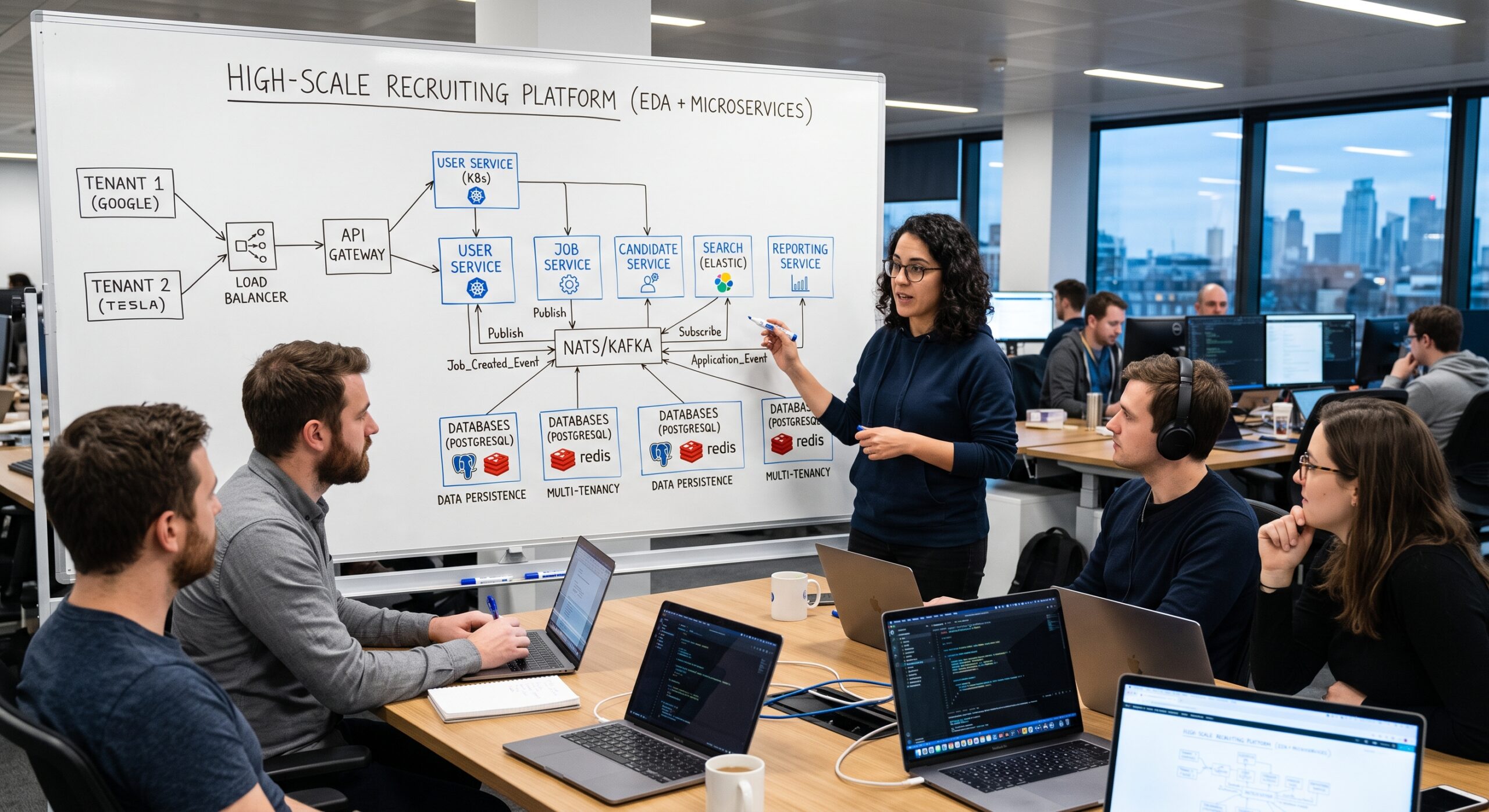
Designing a high-scale recruiting platform architecture requires far more than selecting a framework or deploying a few cloud services; it demands an integrated system built to handle millions of candidates, complex workflows, and enterprise multi-tenancy seamlessly. A modern Applicant Tracking System (ATS) no longer serves as a simple database of resumes and job applications. Instead, it acts as the operating system for talent acquisition: a platform that connects recruiters, hiring managers, candidates, job boards, assessment providers, interview tools, background-check services, HR systems, and compliance processes. Ultimately, the central challenge lies in creating a robust recruiting platform architecture that supports rapid hiring activity, tenant-specific configuration, sensitive personal data, and constant integration changes without becoming fragile.
From the perspective of a Talent Acquisition Systems Architect, engineering teams design the most successful platforms around business capabilities rather than screens. Specifically, a resilient recruiting platform architecture treats candidate information as a strategic business asset, keeps workflow states visible and auditable, and separates core recruiting transactions from high-volume background operations.
Furthermore, a scalable recruiting platform architecture should remain practical. Not every organization needs dozens of independently deployed services on the first day. Rather, the right recruiting platform architecture allows the platform to grow from a well-structured modular foundation into a distributed system when scale, team ownership, and operational maturity justify that transition.
Start With the Recruiting Domain
An ATS represents a connected set of recruiting processes, and architects must thoroughly understand those processes before defining technical services. At a minimum, a modern platform usually includes the following core capabilities:
- Organization and tenant management.
- User identity, roles, and permissions.
- Job requisition and approval management.
- Job description and publishing management.
- Candidate and talent-pool management.
- Application intake and document management.
- Resume parsing and profile enrichment.
- Recruiting workflow and stage management.
- Interview planning and feedback collection.
- Offer preparation and approval.
- Communication and notification management.
- Reporting, analytics, and compliance auditing.
An ATS typically manages the recruiting journey from identifying a vacancy through candidate evaluation, selection, and onboarding preparation. Consequently, it serves as the central system for job requisitions, postings, applications, candidate profiles, and hiring decisions.
Map Capabilities to Technical Behavior
These capabilities relate to one another; however, they do not all share the same technical behavior. For instance, requisition approval usually focuses on transactions, whereas resume parsing demands asynchronous computation. Similarly, candidate search generates heavy read traffic, while email delivery depends on external providers. Finally, analytics requires historical data rather than the latest operational state.
That distinction forms the foundation of a sound recruiting platform architecture.
Instead of building one large application where every function shares the same database tables and deployment cycle, architects should identify clear business boundaries. For example, a requisition service should own requisition rules, while an application service owns application state. Likewise, a scheduling service should manage interview events and availability, whereas a reporting service consumes relevant data without taking ownership of operational transactions.
This separation does not mean that team members must convert every capability into a separate microservice immediately. In fact, early in the product lifecycle, a modular monolith can provide stronger consistency and lower operational overhead. Nevertheless, the vital requirement remains that modules maintain defined ownership, interfaces, and responsibilities within the recruiting platform architecture.
Use Microservices With Discipline
Microservices can help an ATS scale; however, they do not automatically signal a mature recruiting platform architecture. Indeed, poorly designed microservices can create more problems than a monolith: distributed transactions, difficult debugging, duplicated data, inconsistent permissions, and a heavy operational burden.
Therefore, the strongest approach divides services according to business capability and scaling behavior.
Service Landscape Overview
To construct a practical service landscape, teams must assign clear domain responsibilities to each component and tailor each component to its specific technical behaviors:
- Identity and Access Service: Handles authentication, role assignments, and permission policies. It operates with high security standards and requires a low-latency read path.
- Tenant Service: Manages organization settings, feature entitlements, and localization settings. It handles global metadata and relies heavily on caching.
- Requisition Service: Owns job requests, approval routes, budgets, and department mappings. It runs transaction-heavy workflows and demands strict data consistency.
- Job Publishing Service: Handles job syndication to career sites, external job boards, and internal mobility portals. It relies heavily on asynchronous, outbound integrations.
- Candidate Service: Maintains durable candidate profiles, contact details, consent logs, and skills history. It experiences high read volume and requires specialized data indexing.
- Application Service: Tracks stage transitions, ownership, and timestamps. It functions as the core state machine of the system and requires intensive audit logging.
- Document Service: Manages secure storage for resumes, cover letters, and offer letters. Cloud object storage backs this service to handle binary payloads efficiently.
- Workflow Service: Controls stage transitions, automation rules, and recruiter actions. It acts as an event-driven rule evaluation engine.
- Interview Service: Coordinates interview panels, availability schedules, scorecards, and reminders. It relies on deep calendar integrations and notification pipelines.
- Communication Service: Dispatches outbound and inbound emails and text messages, and tracks delivery status. Message queues back this service, which relies on external communication providers.
- Analytics and Audit Service: Builds reporting views, tracks performance metrics, and maintains immutable logs. Append-only historical data optimizes this service for read queries.
Defining Practical Service Boundaries
This breakdown does not represent a mandatory blueprint. For instance, some organizations might combine candidate and application management, whereas others might isolate search into its own service. Ultimately, hiring volume, integration requirements, engineering team structure, and compliance obligations determine the correct boundaries for a recruiting platform architecture.
The most critical rule centers on single ownership. Specifically, each service should have a clear answer to the question: “Which system holds authority for this information?” Otherwise, if both the workflow service and application service can independently change application status, data conflicts become inevitable.
In addition, teams should avoid letting microservices share the same database schema as a shortcut. Shared infrastructure works acceptably; however, shared ownership does not. Thus, a service can publish information for other services to use while retaining exclusive control over its own records.
tion for other services to use while retaining exclusive control over its own records.
Make Events the Backbone
Recruiting inherently creates many events. A candidate applies. An applicant uploads a resume. A recruiter moves an application to a new stage. A coordinator schedules an interview. An interviewer submits feedback. A manager approves an offer. A system updates a consent record.
As a result, these events provide an ideal communication model between services in an event-driven recruiting platform architecture.
In an event-driven architecture, a service publishes a message when a meaningful action occurs, and other services subscribe only when they need to react. Indeed, research on event-based customization describes this model as an effective way to support independent microservices and tenant-specific behavior without embedding every variation directly into the core application.
Application Events in Practice
For example, when a candidate submits an application, the interaction flows through the system in a decoupled sequence:
First, the candidate submits the application, which the Application Service receives. The Application Service stores the initial record and immediately publishes an Application-Submitted event to the event broker.
Once the service publishes that event, multiple downstream services consume it independently:
- The Document and Parsing Service receives the event and begins parsing the uploaded resume.
- The Communication Service catches the event and sends an automated acknowledgment email to the applicant.
- The Workflow Service generates initial screening tasks for the recruiting team.
- The Analytics Service logs the application source and submission timestamp for performance reporting.
- The Compliance Service records data retention preferences and consent records.
Because of this pattern, the candidate does not need to wait for every downstream operation to finish. Instead, the platform acknowledges the application quickly while background processing continues seamlessly.
Furthermore, this approach improves responsiveness and reduces tight coupling. If, for instance, a temporary outage affects the analytics service, the application submission process will not fail. Instead, the event remains queued for later processing.
Reliable Event Processing
However, event-driven systems introduce eventual consistency. Concurrently, a recruiter might see the application immediately while parsed resume fields appear a few seconds later. Therefore, designers should build that behavior directly into the user experience rather than treating it as a system defect.
To maintain reliable event handling, engineers must implement several safeguards:
- Durable Event Storage: Systems must write messages to disk prior to consumption.
- Retry Policies: Exponential backoff strategies manage temporary service failures.
- Dead-Letter Handling: System queues route unprocessable messages to isolated locations for inspection.
- Idempotent Consumers: Duplicate event processing yields identical system states.
- Event Versioning: Schema updates maintain backward compatibility for older consumers.
- Correlation Identifiers: Distributed traces track user actions across service boundaries.
- Monitoring Systems: Active telemetry tracks message delay, error rates, and backlog size.
Finally, the system must distinguish business events from technical notifications. For instance, “Application submitted” represents a meaningful business event, whereas “Database row updated” merely reflects an implementation detail that teams should not expose as a public contract.
Design Multi-Tenancy From Day One
A recruiting platform serving multiple employers must treat tenant isolation as a primary requirement within the recruiting platform architecture. Here, a tenant can represent a company, business unit, franchise, staffing agency, or independent recruiting organization.
Because tenant boundaries affect nearly every system component, isolation controls must encompass data storage, user access, search results, file retrieval, workflow configuration, email templates, branding, integrations, reports, billing, audit records, and retention policies.
Data-Isolation Models Explained
Architects generally choose from three distinct data-isolation strategies depending on their regulatory and performance needs:
- Shared Database with a Shared Schema: In this model, all tenants share the same database and database tables, using a tenant discriminator column on every row to separate data. This strategy proves highly cost-effective and easy to operate at scale; however, it requires rigorous application-level controls so that every query enforces the tenant boundary.
- Shared Database with Separate Schemas: Here, tenants share a database instance but reside in logically distinct database schemas. This approach offers stronger logical separation and simplifies certain tenant-specific operations, though running schema migrations becomes increasingly complex as the customer base grows.
- Separate Databases: This approach provisions completely dedicated databases for each tenant, ensuring isolated infrastructure. It provides the highest level of security and data isolation, making it ideal for enterprise customers or strict regulatory compliance, but it significantly increases operational costs and deployment overhead.
Consequently, many platforms implement a hybrid strategy. Standard tier customers utilize shared infrastructure with logical isolation, while enterprise or regulated customers receive dedicated databases.
Enforcing Tenant-Aware Security
Security layers must establish tenant context at the identity and request boundary rather than inferring it from arbitrary user input. Thus, the platform must validate that the authenticated user belongs to the tenant and that the requested resource shares that exact context.
In particular, search infrastructure requires strict isolation controls. For instance, a recruiter searching for “Software Engineer” must never receive results belonging to another organization. Therefore, search indexes, caches, exported reports, and asynchronous jobs all require tenant-aware access controls.
Additionally, system configuration should remain tenant-aware without branching into separate code paths per customer. Instead, engineers store configurable policies—such as approval steps, stage names, scorecard requirements, and retention periods—as managed tenant settings. While feature flags facilitate controlled rollouts, teams must avoid unrestricted custom code to keep the platform maintainable.
Build for High-Volume Workloads
Recruiting platforms routinely experience uneven demand. For example, a large employer might receive a sudden surge of applications following a popular job posting, while campus recruiting creates massive seasonal spikes.
Hence, the recruiting platform architecture must absorb these traffic bursts without overwhelming core transactional services.
Designing the Application Intake Path
To process incoming traffic reliably, application intake follows a clear, four-step lifecycle:
- Lightweight Application Intake (Synchronous Execution Path): The platform validates essential incoming payload data, stores references to uploaded documents, creates a durable application record in the primary database, and immediately returns a success confirmation to the candidate.
- Event Dispatch (Asynchronous Boundary): The platform publishes an Application-Submitted event to the central message broker, decoupling heavy downstream tasks from the HTTP response thread.
- Background Processing Pools (Parallel Worker Execution): Dedicated background worker pools asynchronously pick up the event to execute CPU-heavy or external tasks, such as resume parsing, duplicate candidate detection, skills extraction, and email notification delivery.
- Derived Storage Updates (Eventual Consistency Completion): As tasks finish, workers update read-optimized data views, enrich candidate profiles, and refresh external search engine indexes without locking operational database tables.
Managing Documents and Candidate Search
Document management requires dedicated handling. Specifically, teams should store files in cloud object storage rather than directly in database rows. Furthermore, files require encryption, malware scanning, access controls, retention rules, and audit logging. Accordingly, the application should store metadata and secure references instead of exposing public file addresses.
Candidate search often necessitates a specialized search engine because recruiters require multi-attribute filtering across skills, locations, experience, education, status, source, and custom fields. Importantly, system designers must treat the search index as a derived view. Thus, the candidate service remains authoritative, and indexing events update the search index asynchronously.
Protect Sensitive Candidate Data
Candidate data includes personal contact information, resumes, salary expectations, interview feedback, demographic details, background-check results, and legally protected employment metrics. Therefore, architects must design security directly into the recruiting platform architecture.
When an incoming request reaches the system, it must pass through a strict security pipeline before granting access to candidate records:
First, the system enforces Authentication and Identity Verification using strong protocols like Multi-Factor Authentication (MFA) and Single Sign-On (SSO). Once identity is proven, the system executes a Tenant Boundary Validation to verify that the request context matches the tenant associated with the user. Next, it performs an Authorization Check using Role-Based Access Control (RBAC) or Attribute-Based Access Control (ABAC) to ensure the user holds specific permission for the requested action. Finally, the system routes the request through a Centralized Audit Logger to record the identity, action, timestamp, resource ID, and tenant ID before delivering the authorized resource.
Authorization rules should mirror recruiting responsibilities precisely:
- Recruiters access candidate records for assigned business units.
- Hiring Managers view applicants linked directly to approved requisitions.
- Interviewers inspect only the scorecards and evaluation materials necessary for their scheduled sessions.
- System Administrators manage overall system configurations without receiving blanket access to sensitive candidate profiles.
Additionally, audit logging must capture critical system actions. Specifically, audit records must detail who performed the action, what changed, when it occurred, which tenant was affected, and the target resource. In particular, key audited actions include stage movements, candidate profile merges, data exports, permission adjustments, offer approvals, and deletion requests.
Integrate Without Losing Control
An ATS rarely operates in isolation. Instead, it connects with human capital management (HCM) systems, payroll platforms, job boards, assessment tools, video interview services, calendar providers, background-check vendors, and onboarding platforms.
To prevent instability, engineers must isolate integrations behind dedicated connectors or an integration gateway within the recruiting platform architecture. Requests flow from the core ATS domain (which uses a standardized canonical data model) into an Integration Gateway. This gateway handles data translation, rate limiting, retries, and webhook validation before communicating with the external vendor provider API. This structure ensures that core domain logic remains free of vendor-specific code.
A robust integration layer must incorporate the following standards:
- Canonical Data Models: Translates vendor payloads into standardized internal formats at the boundary.
- Secure Secret Management: Encrypts API keys, OAuth tokens, and webhook signing credentials.
- Resiliency Controls: Implements automatic retries with exponential backoff and strict rate-limiting.
- Idempotency Keys: Prevents duplicate transactions during network retry scenarios.
- Administrative Telemetry: Displays connector health, payload logs, and retry attempts to system operators without exposing raw error details to end users.
Deliver Observability and Reliability
High scale represents not only the capacity to handle increased traffic, but also the ability to observe, diagnose, and recover from failures cleanly. Thus, a modern recruiting platform architecture must track both technical operational metrics and key recruiting process metrics.
A comprehensive telemetry dashboard splits into two primary operational perspectives:
- Technical Operational Metrics: Focuses on system health by monitoring HTTP request latency, system error rates, queue processing depth, event-processing delays, search indexing lag, and the availability of third-party integration providers.
- Recruiting Domain Metrics: Focuses on business efficiency by tracking candidate application completion rates, the time required from initial application to first review, stage-by-stage progression speed, interview feedback completion times, and offer approval cycle times.
Distributed tracing proves essential when a single candidate action triggers operations across multiple services. For instance, a trace can identify whether a delay originated within the application service, document parsing, search indexing, or a third-party email provider.
Furthermore, platform reliability requires tested recovery plans. Therefore, teams should keep event streams replayable where appropriate, and deployments should support gradual blue-green or canary rollouts to minimize risk.
Avoid Common Architecture Mistakes
Several architectural anti-patterns frequently emerge in ATS implementations:
- UI-Driven Service Boundaries: Developers build microservices around user interface screens rather than core domain capabilities, resulting in fragmented data ownership.
- Over-Reliance on Synchronous Chains: Processing pipelines rely entirely on blocking HTTP calls, allowing a slowdown in a downstream vendor integration to halt core recruiter workflows.
- Event Brokers Used as Databases: Teams treat system event logs as persistent relational databases, bypassing proper authoritative state stores.
- Custom Code Branching per Tenant: Developers support unique customer requirements via separate codebases or permanent forks, making system updates costly and error-prone.
- Analytics Executed on Transactional Tables: Engineers run heavy analytical and reporting queries directly on operational databases, causing performance degradation for concurrent recruiting tasks.
- Ignored Data Quality Controls: Duplicate profile management, inconsistent job classifications, and unvalidated custom fields degrade search accuracy and systemic reporting.
A Practical Delivery Path
A successful implementation starts with a resilient core rather than an over-engineered distributed environment, progressing through four distinct phases:
- Phase 1 – Canonical Domain Definition: Establish core domain models (Tenants, Users, Requisitions, Candidates, and Applications) inside a clean, well-structured Modular Monolith.
- Phase 2 – Asynchronous Integration: Introduce an event broker and background worker queues to offload resume parsing, external notifications, and search indexing from the primary web application.
- Phase 3 – Service Deconstruction: Based on performance telemetry, extract heavy operational capabilities—such as Candidate Search, Document Processing, and Analytics—into independently deployed microservices.
- Phase 4 – Advanced Multi-Tenancy: Roll out dedicated database options, regional data isolation boundaries, and enterprise policy controls as commercial and regulatory demands scale.
Ultimately, this phased approach mitigates risk. By following this path, engineering teams can analyze real-world recruiter usage patterns before committing to a complex operational footprint.
Frequently Asked Questions
What is recruiting platform architecture?
Recruiting platform architecture is the comprehensive technical design of the systems, services, data stores, integrations, workflows, security controls, and infrastructure required to operate a talent acquisition platform. It explicitly defines how systems represent, store, and connect candidates, job requisitions, applications, interviews, offers, system users, and tenant organizations.
Should every ATS use microservices?
No. A modular monolith often offers the best starting point for early-stage products or smaller applications. Microservices become valuable when individual domain capabilities require independent scaling, separate deployment ownership, stronger fault isolation, or varying technology stacks within the broader recruiting platform architecture.
Why use event-driven architecture in an ATS?
An event-driven architecture allows downstream services to react asynchronously to recruiting activities without creating tightly coupled, blocking HTTP request chains. It works particularly well for heavy background operations such as resume parsing, email notifications, analytics recording, third-party integrations, and audit processing.
How should a multi-tenant ATS isolate customer data?
Platforms can isolate data using a shared database with strict tenant controls, separate database schemas, completely separate databases, or a hybrid model. The right approach depends on organizational scale, compliance risk, regulatory mandates, and operational costs. Regardless of the chosen strategy, security layers must strictly enforce tenant context across databases, search indexes, file storage, caches, message queues, and reporting exports.
What database works best for a recruiting platform architecture?
No single universal database solution exists. Relational databases suit transactional data with strict consistency requirements, such as requisitions, applications, stage transitions, and approvals. Cloud object storage fits unstructured documents like resumes and cover letters, while specialized search engines power fast multi-attribute candidate discovery. A well-designed recruiting platform architecture should leverage purpose-built data stores for each specific capability.
How can an ATS handle sudden application spikes?
Architects manage system spikes using lightweight synchronous application intake, durable message queues, asynchronous worker pools, background parsing pipelines, rate-limiting, autoscaling infrastructure, and capacity controls. The platform should quickly acknowledge the candidate’s submission while offloading computational processing to background consumers.
What should a recruiting system audit?
A recruiting system should maintain an immutable audit log for stage movements, candidate profile merges, permission changes, data exports, offer approvals, document access events, system configuration updates, consent updates, retention rule applications, and deletion requests. Each audit entry must record the acting user, tenant context, resource identifier, timestamp, and specific field changes.
How should teams introduce AI features?
Teams should introduce AI features as assistive productivity tools rather than autonomous decision-makers. Capabilities such as resume extraction, candidate search assistance, job description summarization, and interview-note organization can significantly enhance recruiter output; however, they require transparency mechanisms, human-in-the-loop validation, audit controls, and active monitoring to guard against systemic bias.
What is the most important architectural decision?
The most critical architectural decision in a recruiting platform architecture involves establishing clear, single ownership of recruiting data and domain business rules. Once the engineering organization clearly defines which service owns each entity, how services communicate state changes across boundaries, and how system layers enforce tenant and permission constraints, subsequent technological evaluations become far easier and more effective.
References
- Confluent: Event-Driven Architecture (EDA): A Complete Introduction
- Google Cloud:What Is Microservices Architecture?
- Clerk Blog:How to Design a Multi-Tenant SaaS Architecture
- HiringThing:Multi-Tenant ATS Architecture for White Label Partners
- Dev.to:Multi-Tenant Architecture: A Complete Guide (Basic to Advanced)
- GeeksforGeeks: Multi-Tenancy Architecture – System Design