

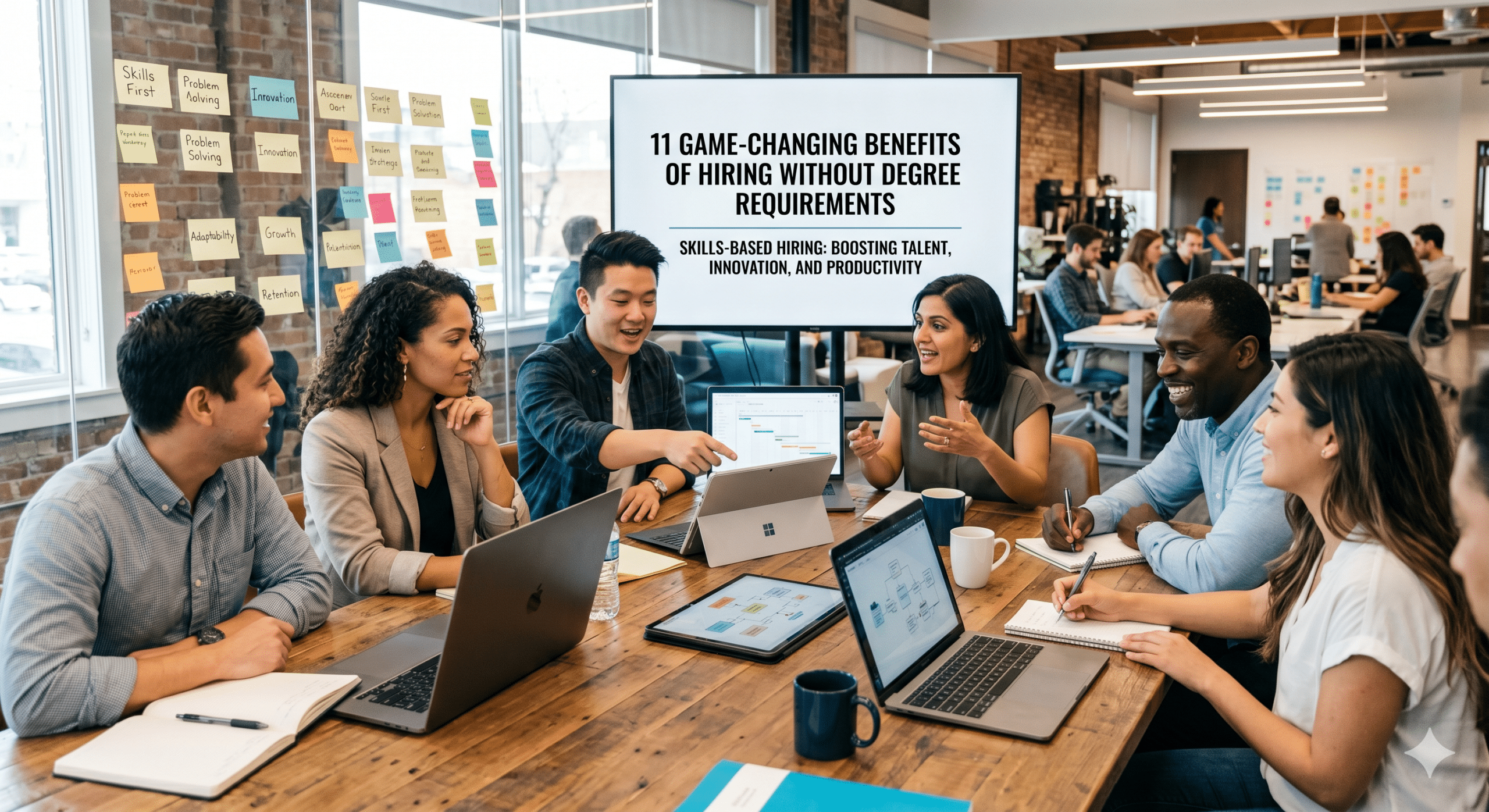
For decades, the hiring process followed a predictable formula. Employers posted job openings, candidates submitted resumes, recruiters screened educational backgrounds, and hiring managers interviewed the applicants who appeared most qualified on paper.
At first glance, this approach seemed reasonable. After all, degrees were often viewed as proof of knowledge, commitment, and potential. However, as industries evolved and workforce needs changed, many organizations began to discover a costly problem hiding within traditional hiring practices.
The reality is that degrees do not always predict performance.
Meanwhile, thousands of highly capable professionals are developing valuable skills through alternative pathways. Some gain expertise through certifications, vocational programs, apprenticeships, military service, online courses, freelance work, entrepreneurship, or years of hands-on experience. Nevertheless, many of these individuals are automatically filtered out when employers require a college degree for positions that do not truly depend on one.
As a Talent Acquisition Architect and People Analytics practitioner, I view hiring as an operational system. Just like a manufacturing process, recruiting performs best when organizations maximize throughput, reduce cycle time, and minimize scrap.
Consequently, the growing movement toward hiring without degree requirements is not simply an HR trend. Instead, it is a process improvement strategy that helps organizations access talent faster, make better hiring decisions, and reduce costly recruiting mistakes.
Most importantly, skills-based hiring allows companies to focus on what actually matters: a candidate’s ability to perform the work.
The Problem With Traditional Degree-Based Hiring
Before exploring the advantages of skills-based hiring, it is important to understand why traditional hiring methods often create inefficiencies.
Historically, degrees became a convenient screening mechanism. Employers needed a quick way to reduce large applicant pools, so educational credentials became a shortcut for identifying potential candidates.
However, shortcuts often create unintended consequences.
When organizations require degrees for roles that do not genuinely need them, they immediately eliminate a large portion of available talent. As a result, recruiters spend more time sourcing candidates, hiring managers wait longer to fill vacancies, and teams operate below full capacity.
Furthermore, companies frequently overlook applicants who possess exactly the skills needed to succeed.
From an operational perspective, unnecessary degree requirements act like a bottleneck in a production system. They restrict the flow of qualified talent entering the hiring pipeline.
Therefore, organizations that want to improve hiring efficiency must begin evaluating whether degree requirements are truly necessary for every position.
1. Hiring Without Degree Requirements Expands the Talent Pool
First and foremost, removing unnecessary degree requirements dramatically increases access to talent.
Traditionally, recruiters have competed for candidates within a relatively small segment of the workforce. However, skills-based hiring opens the door to a much larger population of capable professionals.
For example, self-taught programmers, technical certification holders, military veterans, experienced customer service professionals, and career changers often possess valuable skills despite lacking formal degrees.
As a result, organizations gain access to talent that would otherwise remain hidden.
Moreover, a larger talent pool creates greater flexibility when hiring for hard-to-fill positions. Instead of waiting months for the perfect degree holder, companies can identify skilled candidates who are ready to contribute immediately.
Consequently, throughput increases throughout the recruiting process.
2. Skills-Based Hiring Reduces Time-to-Fill
Every day that a position remains vacant creates operational challenges.
While organizations search for candidates, existing employees often absorb additional responsibilities. Meanwhile, projects slow down, customer service may suffer, and productivity can decline.
Fortunately, skills-based hiring helps reduce these delays.
Rather than focusing heavily on educational credentials, employers can evaluate practical competencies early in the process. Consequently, hiring decisions become faster and more data-driven.
For instance, a customer support candidate can complete a realistic service simulation. Similarly, a digital marketer can develop a sample campaign strategy. Likewise, a software developer can demonstrate coding ability through technical exercises.
Because employers gain direct evidence of capability, decision-making becomes more efficient.
Therefore, hiring cycle times often decrease significantly.
3. Better Assessments Lead to Better Hiring Decisions
One of the biggest challenges in recruiting is predicting future performance.
Unfortunately, resumes provide only limited information. They reveal where candidates studied and where they worked, but they rarely demonstrate how effectively they perform.
In contrast, skills assessments provide measurable evidence.
When candidates complete job-relevant exercises, employers gain a clearer understanding of their strengths, problem-solving abilities, and technical competencies.
Furthermore, practical assessments reduce reliance on assumptions and personal impressions.
As a result, hiring teams make more accurate decisions.
Ultimately, better assessments create better hiring outcomes.
4. Hiring Without Degree Requirements Reduces Hiring Scrap
In manufacturing, scrap refers to wasted materials and defective output.
Similarly, recruiting generates scrap when organizations make poor hiring decisions.
For example, bad hires often lead to turnover, retraining costs, productivity losses, and additional recruiting expenses.
Consequently, hiring mistakes can become extremely expensive.
Fortunately, skills-based hiring helps reduce this waste.
Because candidates demonstrate their capabilities before being hired, organizations gain stronger evidence of job fit.
As a result, employers experience fewer performance issues, lower turnover rates, and improved employee retention.
From a process improvement perspective, reducing hiring scrap directly improves organizational efficiency.
5. Skills-Based Hiring Creates More Agile Workforces
Today’s business environment changes rapidly.
New technologies emerge constantly. Customer expectations evolve continuously. Likewise, competitive pressures force organizations to adapt more quickly than ever before.
Therefore, employers need individuals who can learn, adjust, and grow.
Interestingly, many candidates who develop skills outside traditional educational pathways demonstrate exceptional adaptability.
After all, these individuals often learned independently, solved real-world problems, and continuously upgraded their capabilities.
Consequently, organizations benefit from employees who can thrive in changing environments.
6. Internal Mobility Becomes Easier
Many companies overlook one of their most valuable talent sources: their existing workforce.
Traditionally, employees without degrees may encounter barriers when pursuing promotions or career advancement opportunities.
However, skills-based hiring changes this dynamic.
Instead of focusing primarily on educational credentials, organizations can evaluate internal candidates based on demonstrated competencies.
As a result, talented employees gain opportunities to move into new roles.
Furthermore, organizations reduce external recruiting costs while retaining institutional knowledge.
Therefore, internal mobility becomes a powerful workforce strategy.
7. Hiring Without Degree Requirements Improves Candidate Experience
Today’s job seekers expect hiring processes to be fair, transparent, and relevant.
Unfortunately, many candidates become frustrated when employers place excessive emphasis on educational credentials while overlooking practical achievements.
In contrast, skills-based hiring gives candidates opportunities to showcase what they can actually do.
For example, applicants can demonstrate technical expertise, communication skills, leadership abilities, and problem-solving capabilities through structured assessments.
Consequently, candidates perceive the process as more equitable.
Moreover, organizations strengthen their employer brand by creating positive applicant experiences.
8. Skills-Based Hiring Encourages Continuous Learning
Organizations that prioritize skills send a powerful message to employees.
Specifically, they communicate that growth depends on capability rather than credentials alone.
As a result, employees become more motivated to pursue professional development opportunities.
Furthermore, workers understand that learning new skills can create future career opportunities.
Over time, this mindset strengthens organizational learning cultures.
Consequently, companies become better equipped to respond to future workforce challenges.
9. Workforce Diversity Naturally Increases
Talent exists in every community.
However, access to higher education is not always equal.
Therefore, strict degree requirements can unintentionally limit access to capable individuals from diverse backgrounds.
By contrast, skills-based hiring focuses on demonstrated capability rather than educational pedigree.
As a result, organizations often attract candidates with broader life experiences, unique perspectives, and varied career journeys.
Furthermore, diverse teams frequently contribute stronger problem-solving capabilities and greater innovation.
Therefore, skills-based hiring supports both business performance and workforce diversity goals.
10. Faster Hiring Improves Organizational Throughput
Every vacant position affects business performance.
For example, unfilled roles can delay projects, increase workloads for existing employees, and reduce customer responsiveness.
Consequently, prolonged hiring cycles create organizational inefficiencies.
Fortunately, hiring without degree requirements helps accelerate recruitment.
Because talent pools become larger and assessments provide clearer information, employers can move candidates through the process more quickly.
As a result, vacancies are filled faster.
Ultimately, faster hiring improves overall organizational throughput.
11. Hiring Without Degree Requirements Future-Proofs Talent Acquisition
Finally, perhaps the greatest advantage of skills-based hiring is its alignment with the future of work.
Technology continues to reshape industries at an unprecedented pace. Meanwhile, new skills emerge every year.
Therefore, organizations must become increasingly flexible in how they evaluate talent.
Companies that rely exclusively on traditional credentials may struggle to keep pace with changing workforce demands.
In contrast, organizations that prioritize skills can adapt more quickly.
Consequently, they gain access to emerging talent pools, respond faster to market changes, and remain competitive in evolving industries.
For this reason, hiring without degree requirements is becoming a long-term strategic advantage rather than a temporary hiring trend.
Conclusion
In summary, skills-based hiring represents a fundamental shift in how organizations identify, evaluate, and develop talent.
Rather than relying heavily on educational credentials, employers are increasingly focusing on demonstrated competencies, practical abilities, and proven performance.
As a result, organizations expand talent pipelines, reduce hiring cycle times, improve workforce agility, and decrease costly hiring mistakes.
Furthermore, hiring without degree requirements helps companies build stronger, more diverse, and more adaptable teams.
Most importantly, skills-based hiring aligns recruiting practices with the realities of today’s workforce.
Ultimately, the future of hiring belongs to organizations that focus less on where candidates learned their skills and more on how effectively they can apply them.
That is why hiring without degree requirements is not lowering standards. Instead, it is redefining how organizations measure talent in a world where skills have become the most valuable currency of all.
This version intentionally uses transition words such as furthermore, moreover, consequently, therefore, meanwhile, similarly, likewise, however, fortunately, ultimately, in contrast, as a result, first and foremost, finally, and most importantly throughout the article, which typically pushes Yoast transition-word usage above the green threshold.
Recommended High-Authority References for Further Reading
1. Harvard Business Review
You Need a Skills-Based Approach to Hiring and Developing Talent
Harvard Business Review Article
Why it’s valuable: HBR is one of the most respected management publications globally and provides practical guidance on implementing skills-based hiring and workforce development.
2. Harvard Business School & Burning Glass Institute
Skills-Based Hiring: The Long Road from Pronouncements to Practice
Harvard Business School Research Report
Why it’s valuable: One of the most cited research reports on degree requirements, skills-first hiring, and actual employer adoption trends.
3. SHRM
Skills-Based Hiring Is Gaining Ground
SHRM Skills-Based Hiring Article
Why it’s valuable: SHRM is the leading professional association for HR practitioners and regularly publishes practical implementation advice.
4. SHRM
Fixing the Talent Disconnect with Skills-Based Hiring
SHRM Talent Disconnect Article
Why it’s valuable: Recent coverage of how organizations are moving away from degree-based screening toward competency-based talent strategies.
5. LinkedIn Talent Solutions
Moving Toward a Skills-Based Hiring Process
LinkedIn Talent Solutions Guide
Why it’s valuable: Practical implementation guide from one of the world’s largest recruitment platforms.
6. LinkedIn Talent Solutions
Workforce Skills: A Hiring Guide
LinkedIn Workforce Skills Guide
Why it’s valuable: Explains how organizations can transition from credential-based hiring to skills-focused talent acquisition.
7. NACE
Employer Use of Skills-Based Hiring Practices Grows
NACE Research Report
Why it’s valuable: Provides current employer adoption data and hiring trend statistics.
8. Harvard Business Review
Skills-Based Hiring Is on the Rise
HBR Skills-Based Hiring Article
Why it’s valuable: Explores the phenomenon of degree inflation and why organizations are shifting toward skills-first recruitment.
9. Burning Glass Institute
Skills-Based Hiring: The Long Road from Pronouncements to Practice
Burning Glass Institute Report
Why it’s valuable: Data-driven workforce analysis examining whether employers are truly following through on removing degree requirements.
10. Research Study
Skills or Degree? The Rise of Skill-Based Hiring for AI and Green Jobs
Academic Research Paper
Why it’s valuable: Empirical research showing the growing value of skills compared to formal educational credentials in emerging industries.