

Every company wants to hire the right people, keep top performers, and build teams that can adapt to change. However, many organizations still make workforce choices based on incomplete information. For instance, hiring managers often rely on resumes, annual reviews, or gut feelings instead of using reliable data. As a result, as a Talent Intelligence Consultant, I’ve seen how ignoring organizational intelligence talent decisions frequently leads to expensive hiring mistakes, skill shortages, and poor workforce planning.
This is precisely where organizational intelligence changes everything.
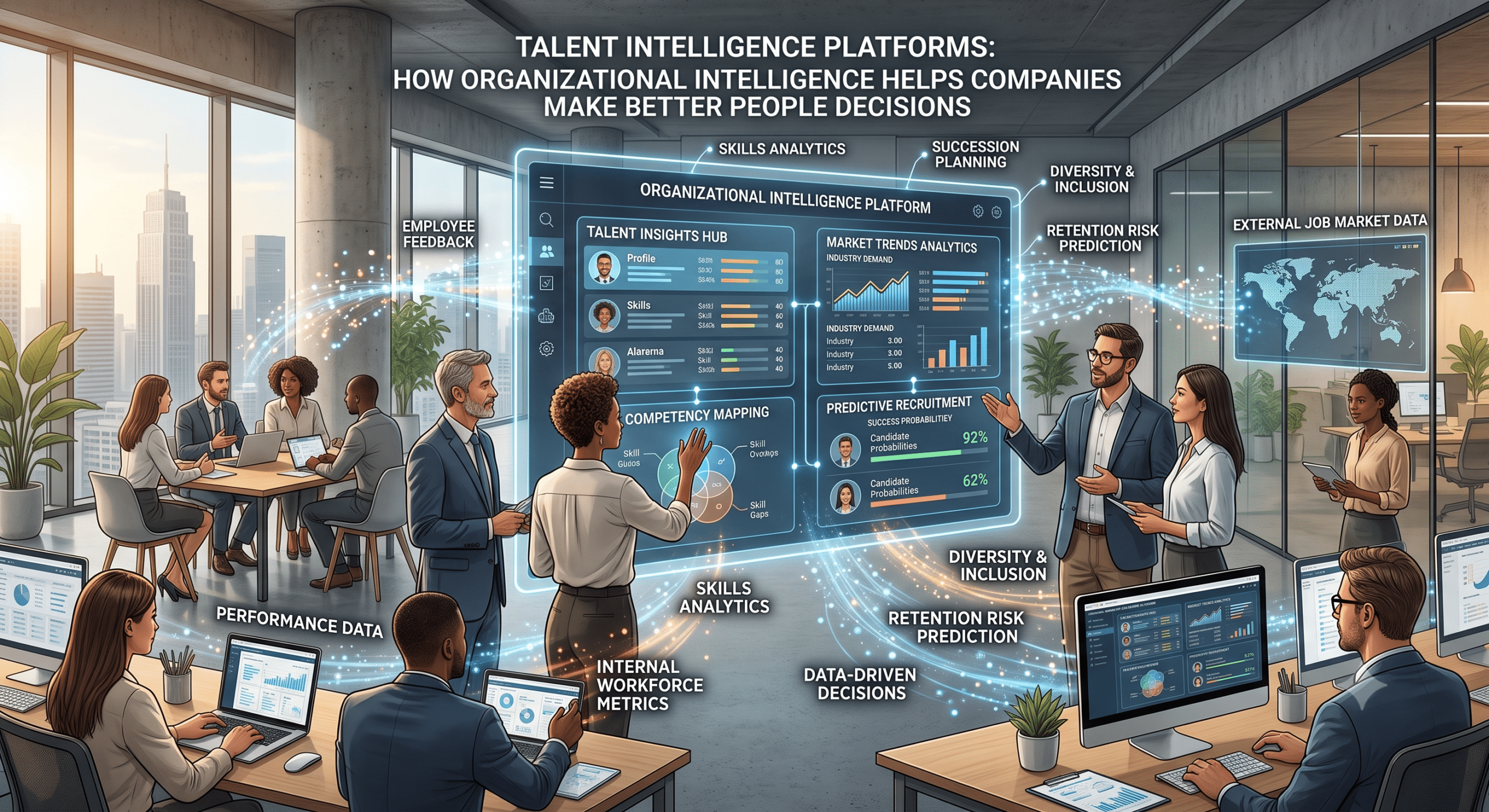
Modern Talent Intelligence Platforms do much more than collect employee information. Specifically, they connect data from recruiting, learning, performance management, workforce planning, and labor market research into one complete picture. Consequently, instead of looking at isolated reports, leaders gain meaningful insights that help them understand where talent exists, what skills are missing, and which employees have the potential to grow into future leadership roles. (Findem)
Furthermore, organizations that invest in better workforce intelligence aren’t simply improving recruiting. Rather, they’re creating smarter businesses that make informed choices based on evidence rather than assumptions. Ultimately, using organizational intelligence talent decisions allows HR teams to become strategic business partners instead of administrative support.
In this guide, I’ll explain how organizational intelligence fits into today’s Talent Intelligence Platforms, why it matters, and the six practical ways companies can build a smarter workforce strategy for long-term success.
What Is Organizational Intelligence?
Organizational intelligence is the ability of a company to gather, understand, and use information about its workforce to make better business decisions.
Think of it as the organization’s “brain.” Just as individuals learn from experience, organizations learn from data.
Instead of asking subjective questions like:
-
Who should we hire?
-
Why are employees leaving?
-
Which skills are becoming important?
-
Who is ready for promotion?
However, organizational intelligence provides answers supported by facts instead of opinions.
To achieve this, it combines information from multiple sources, including:
-
Recruiting systems
-
Human Resource Information Systems (HRIS)
-
Learning Management Systems (LMS)
-
Performance reviews
-
Employee engagement surveys
-
Internal mobility records
-
Labor market intelligence
-
Skills databases
Indeed, when these data sources work together, executives gain a much clearer understanding of the workforce than any single report could provide. (Lontra)
Why Talent Intelligence Platforms Need Organizational Intelligence
Many HR departments already own several software systems, such as:
-
Applicant Tracking Systems (ATS)
-
HRIS platforms
-
Payroll software
-
Learning systems
-
Performance management tools
However, the main problem is that these systems often operate separately. While each contains useful information, none tells the complete story on its own.
A Talent Intelligence Platform brings these pieces together. Rather than storing data in silos, it creates a connected view of employees, candidates, skills, experiences, and workforce trends. In turn, this unified approach allows organizations to move beyond basic reporting and into predictive decision-making. (Findem)
For example, instead of only knowing that an employee completed five training courses, leaders can discover:
-
whether those new skills match future business needs,
-
whether the employee is ready for promotion,
-
whether another department could benefit from those skills, and
-
whether similar skill shortages exist across the company.
Ultimately, that is the difference between simple data collection and true organizational intelligence.
The Evolution of Talent Intelligence Platforms
Talent intelligence has evolved significantly over the past decade.
First Generation: Basic HR Records
Initially, organizations mainly tracked:
-
employee names
-
job titles
-
salaries
-
employment dates
As a result, reporting was mostly historical.
Second Generation: Analytics
Next, companies began measuring:
-
turnover
-
hiring costs
-
training completion
-
performance ratings
While helpful, these reports mostly described what had already happened in the past.
Third Generation: Predictive Intelligence
Today, modern Talent Intelligence Platforms analyze:
-
workforce skills
-
hiring pipelines
-
labor market trends
-
internal mobility
-
employee growth
-
AI-assisted recommendations
Consequently, instead of asking, “What happened?” organizations now ask:
-
What will happen next?
-
Which teams are at risk?
-
Where will future skill gaps appear?
-
Which employees should we develop now?
Therefore, this proactive approach enables far better workforce planning and stronger business outcomes. (Findem)
The Business Value of Organizational Intelligence
Many executives assume organizational intelligence only benefits HR. However, that assumption is outdated. On the contrary, the strongest organizations rely on organizational intelligence talent decisions across the entire business.
For example:
-
Executive Leadership: Leaders gain visibility into workforce readiness before expanding into new markets.
-
Finance: Finance teams forecast hiring investments more accurately.
-
Operations: Operations managers identify staffing risks before productivity declines.
-
Learning and Development: Training teams focus learning investments where skill gaps actually exist.
-
Talent Acquisition: Recruiters spend less time guessing which candidates will succeed because hiring decisions rely on measurable workforce insights.
Thus, when every department works from the same workforce data, organizations reduce unnecessary hiring, improve retention, and build stronger succession plans.
6 Ways Organizational Intelligence Creates Better Talent Decisions
1. Skills Become More Important Than Job Titles
Traditional hiring focused heavily on titles, such as:
-
Senior Developer
-
HR Manager
-
Marketing Director
However, modern organizations recognize that titles often hide real capabilities. After all, two people with identical titles may possess completely different skills. Therefore, organizational intelligence maps actual competencies instead of relying on labels alone.
Consequently, this allows companies to:
-
identify hidden experts
-
discover transferable skills
-
promote internal mobility
-
reduce unnecessary external hiring
Indeed, as a Talent Intelligence Consultant, I’ve found that applying organizational intelligence talent decisions consistently produces stronger workforce outcomes than title-based recruiting alone.
2. Internal Talent Is Easier to Discover
Many organizations hire externally simply because they don’t know who already has the required skills inside the company. Fortunately, organizational intelligence solves this problem.
Talent Intelligence Platforms can identify employees who already possess:
-
technical certifications
-
leadership experience
-
multilingual abilities
-
project management expertise
-
specialized software knowledge
Thus, instead of immediately opening a job requisition, companies can first evaluate internal talent. As a result, making organizational intelligence talent decisions reduces hiring costs while simultaneously improving employee engagement through career growth opportunities. (TalentsForce Blog)
3. Workforce Planning Becomes More Accurate
Business growth often creates new hiring needs. However, without workforce intelligence, organizations estimate future hiring based purely on assumptions. In contrast, organizational intelligence replaces assumptions with evidence.
Specifically, companies can forecast:
-
retirement risks
-
hiring demand
-
future skills
-
business expansion
-
succession readiness
As a consequence, as markets evolve, organizations that continuously monitor workforce data can adjust hiring strategies before shortages become serious problems.
4. Better Hiring Decisions
Recruiters often face thousands of applicants. Yet, resumes alone rarely predict long-term success. Therefore, Talent Intelligence Platforms evaluate multiple factors, including:
-
skills alignment
-
career progression
-
learning ability
-
internal benchmarks
-
workforce trends
In short, using organizational intelligence talent decisions improves hiring quality while reducing bias by emphasizing objective evidence rather than personal assumptions. (arXiv)
5. Smarter Leadership Development
Leadership pipelines shouldn’t depend solely on annual reviews. Instead, organizational intelligence identifies employees who consistently demonstrate:
-
learning agility
-
collaboration
-
influence
-
adaptability
-
business impact
Hence, this allows organizations to invest in leadership development earlier, creating stronger succession plans.
6. Continuous Workforce Improvement
The best organizations never stop learning. Consequently, they continuously monitor:
-
workforce capability
-
employee engagement
-
hiring effectiveness
-
learning outcomes
-
internal mobility
-
business performance
Rather than conducting workforce reviews once a year, organizational intelligence talent decisions provide ongoing insights that help leaders make faster and more confident choices.
Why Organizational Intelligence Is Becoming a Competitive Advantage
Today’s labor market changes faster than ever before. Indeed, new technologies, shifting skill requirements, and changing employee expectations mean that organizations can no longer rely on outdated workforce planning methods. In fact, companies that build strong organizational intelligence capabilities are better prepared to respond to change because they understand not only who works for them today, but also what their people are capable of achieving tomorrow.
Furthermore, Talent Intelligence Platforms are making this possible by connecting workforce data, skills intelligence, and business strategy into one decision-making framework. Therefore, organizations that embrace this approach position themselves to attract stronger talent, improve retention, and create a workforce that is ready for future challenges. (Findem)
Essential Features of Modern Talent Intelligence Platforms
Not every Talent Intelligence Platform offers the same capabilities. For instance, some focus mainly on recruiting, while others support workforce planning, internal mobility, and long-term talent development. However, from my experience as a Talent Intelligence Consultant, the best platforms share several core features that strengthen organizational intelligence across the entire business.
Skills Intelligence
Skills intelligence goes beyond listing qualifications on a resume. Instead, it creates a living inventory of employee capabilities, certifications, experiences, and future skill potential.
For example, a software engineer may also have experience in project management, data visualization, or cybersecurity. However, without skills intelligence, those valuable abilities may never be discovered.
Specifically, this visibility helps organizations:
-
Match employees to projects
-
Fill internal job openings faster
-
Identify future leaders
-
Reduce outside hiring costs
AI-Powered Candidate Matching
Artificial intelligence helps recruiters evaluate candidates based on multiple factors instead of keywords alone. To illustrate, modern systems analyze:
-
Skills
-
Career history
-
Certifications
-
Industry experience
-
Learning potential
-
Similar successful employees
Importantly, the goal isn’t to replace recruiters. Rather, AI helps recruiters spend more time interviewing qualified candidates and less time manually reviewing resumes.
Internal Talent Marketplace
One of the fastest-growing features in Talent Intelligence Platforms is the internal talent marketplace. Through these systems, employees can discover:
-
New projects
-
Temporary assignments
-
Career opportunities
-
Mentorship programs
-
Cross-functional work
Consequently, organizations benefit because valuable talent stays inside the company rather than leaving for outside opportunities. Indeed, internal mobility has become one of the strongest drivers of employee retention.
Workforce Analytics Dashboards
Executives need information they can understand quickly. Therefore, interactive dashboards display important workforce metrics such as:
-
Hiring trends
-
Skill gaps
-
Diversity progress
-
Turnover patterns
-
Promotion rates
-
Learning activity
Thus, instead of reviewing dozens of spreadsheets, leaders can monitor workforce health from a single dashboard.
Labor Market Intelligence
Hiring decisions should not rely only on internal data. Accordingly, leading platforms also analyze external labor market information, including:
-
Emerging skills
-
Salary benchmarks
-
Talent availability
-
Competitor hiring trends
-
Geographic workforce patterns
In summary, these insights help companies stay competitive while planning future hiring strategies. Furthermore, industry analysts have highlighted labor market intelligence as a key advantage for organizations responding to rapidly changing workforce needs.
How Artificial Intelligence Supports Organizational Intelligence
Artificial intelligence has become one of the biggest improvements in Talent Intelligence Platforms. However, AI should be viewed as a decision-support tool rather than an automatic decision-maker. Above all, human judgment remains essential.
That said, AI helps organizations process enormous amounts of workforce information much faster than manual analysis. For example, AI can identify:
-
Employees likely to succeed in leadership roles
-
Departments experiencing increasing turnover risk
-
Skills becoming harder to recruit
-
Learning programs that improve performance
-
Recruiting channels producing better hires
Therefore, instead of replacing HR professionals, AI allows them to execute smarter organizational intelligence talent decisions while focusing on strategy, coaching, and relationship building. Ultimately, that combination of technology and human expertise creates stronger organizational intelligence.
Common Mistakes Organizations Make
Even the best technology cannot solve poor planning. In fact, during consulting engagements, I often see organizations repeat the same mistakes. Fortunately, avoiding these challenges greatly increases the value of Talent Intelligence Platforms.
Mistake 1: Focusing Only on Recruiting
Many companies purchase talent intelligence software solely to improve hiring. However, while recruiting is important, organizational intelligence should support the entire employee lifecycle, including:
-
Hiring
-
Onboarding
-
Learning
-
Career development
-
Leadership planning
-
Workforce forecasting
As a result, organizations receive far greater value when every stage connects together.
Mistake 2: Ignoring Data Quality
Poor information produces poor decisions. For instance, if employee records contain outdated skills, incorrect job titles, or incomplete training history, even advanced AI produces unreliable recommendations. Therefore, successful organizations regularly update workforce information, since good data quality creates trustworthy organizational intelligence.
Mistake 3: Keeping Data in Separate Systems
Some organizations still operate with isolated HR systems. For example, recruiting data remains in one platform, learning records remain elsewhere, and performance reviews stay inside another application. Consequently, without integration, leaders never see the complete workforce picture. Thus, connecting systems remains one of the highest priorities for successful implementations.
Mistake 4: Measuring Only Hiring Speed
Fast hiring does not always mean good hiring. Instead, organizations should evaluate long-term outcomes, such as:
-
Employee retention
-
Performance improvement
-
Internal promotions
-
Career growth
-
Skills development
In short, these long-term outcomes provide a more accurate picture of recruiting success.
Mistake 5: Forgetting Employee Experience
Employees should benefit from organizational intelligence as much as leadership does. Specifically, workers appreciate systems that help them:
-
Find career opportunities
-
Learn new skills
-
Connect with mentors
-
Explore internal projects
-
Understand career paths
Therefore, when employees see personal value, adoption increases naturally.
Building Organizational Intelligence Across the Business
Organizational intelligence is not just an HR initiative; rather, it influences decisions throughout the entire company.
-
Human Resources: HR teams gain better visibility into workforce capabilities. Consequently, instead of reacting to staffing problems, they plan proactively.
-
Executive Leadership: Executives understand whether workforce capabilities support business strategy. In turn, this improves expansion planning, mergers, acquisitions, and organizational growth.
-
Finance: Finance leaders forecast labor costs with greater confidence. Therefore, understanding workforce trends improves budgeting accuracy and long-term investment planning.
-
Operations: Operations managers can identify departments facing skill shortages before productivity declines. As a result, this supports smoother project delivery and better customer service.
-
Learning and Development: Training investments become more targeted. Thus, rather than assigning generic training programs, learning teams focus on skills that directly support future business goals.
Measuring Success
Organizations should define clear success metrics before implementing a Talent Intelligence Platform.
| KPI | Why It Matters |
| Time-to-fill | Measures recruiting efficiency |
| Quality of hire | Evaluates long-term hiring success |
| Internal promotion rate | Indicates career development effectiveness |
| Employee retention | Reflects engagement and workplace satisfaction |
| Skills coverage | Shows workforce readiness |
| Learning completion | Measures employee development |
| Leadership readiness | Supports succession planning |
| Internal mobility | Demonstrates talent utilization |
Clearly, no single metric tells the complete story. However, together, these indicators help leaders understand whether relying on organizational intelligence talent decisions is producing measurable business results.
The Future of Organizational Intelligence
The workplace continues to evolve rapidly. For instance, remote work, hybrid teams, artificial intelligence, automation, and changing employee expectations are reshaping how organizations manage talent.
Consequently, future Talent Intelligence Platforms will likely become even more capable of helping organizations answer critical questions, such as:
-
Which skills should we build next year?
-
Which jobs will change because of automation?
-
Which employees are ready for larger responsibilities?
-
Which learning programs create measurable business value?
-
Where should we expand our workforce?
-
Which talent shortages could affect future growth?
In conclusion, organizations that continuously improve their organizational intelligence will be better prepared for these changes. Rather than reacting to workforce challenges, they will anticipate them and execute organizational intelligence talent decisions with greater confidence.
How to Successfully Implement Organizational Intelligence
Many organizations purchase powerful HR technology but never achieve the results they expected. In most cases, the problem is not the software—it is the implementation strategy.
Therefore, as a Talent Intelligence Consultant, I recommend treating organizational intelligence as a business transformation initiative instead of a simple HR software project.
Here are six practical steps that consistently produce better outcomes:
Step 1: Define Business Goals First
Before selecting a Talent Intelligence Platform, identify what you want to improve, such as:
-
Reducing employee turnover
-
Hiring specialized talent faster
-
Improving internal mobility
-
Building stronger leadership pipelines
-
Closing critical skill gaps
-
Supporting long-term workforce planning
Ultimately, clear objectives make it easier to measure success.
Step 2: Bring Data Together
Organizational intelligence depends heavily on connected information. To start, begin by integrating data from systems such as:
-
Applicant Tracking System (ATS)
-
Human Resource Information System (HRIS)
-
Learning Management System (LMS)
-
Performance management software
-
Employee engagement surveys
-
Payroll and workforce planning tools
In turn, a unified data foundation allows leaders to view workforce trends from a single source instead of switching between multiple applications. Furthermore, modern talent intelligence platforms are designed to combine internal workforce data with external labor market information for a more complete picture. (Findem)
Step 3: Keep Skills Data Current
Employee skills change constantly. Indeed, people earn certifications, complete training, lead projects, and develop new expertise every year. Therefore, organizations should encourage employees and managers to update skill profiles regularly. As a result, current information leads to better recommendations for promotions, learning opportunities, and internal hiring.
Step 4: Train Managers to Use Workforce Insights
Technology alone cannot improve decision-making. Thus, managers should understand:
-
How workforce analytics work
-
How to interpret dashboards
-
When to trust AI recommendations
-
When human judgment should take priority
Ultimately, the most successful organizations combine data-driven insights with experienced leadership.
Step 5: Measure Progress Regularly
Organizational intelligence should evolve over time. Therefore, review workforce metrics quarterly, including:
-
Hiring quality
-
Internal promotions
-
Employee retention
-
Skills growth
-
Leadership readiness
-
Employee engagement
In doing so, regular reviews help organizations adjust strategies before small issues become major problems.
Step 6: Build a Data-Driven Culture
Technology works best when employees trust it. Accordingly, leaders should explain:
-
Why workforce data is collected
-
How information supports career development
-
How employee privacy is protected
-
How AI recommendations are reviewed fairly
In short, transparency increases employee confidence and encourages greater participation.
Why Organizational Intelligence Will Shape the Future of Work
The workforce is becoming more dynamic every year. Indeed, artificial intelligence, automation, hybrid work, global recruiting, and rapidly changing skill requirements mean organizations must make faster and smarter choices than ever before.
Consequently, traditional HR reports are no longer enough. Instead, companies need real-time insights that help answer important questions, such as:
-
Which skills are becoming critical?
-
Which employees can grow into leadership roles?
-
Where are future hiring shortages likely to occur?
-
How can we improve employee retention?
-
Which learning programs deliver measurable business value?
Therefore, organizations that invest in organizational intelligence will be better positioned to answer these questions with confidence. Rather than reacting to workforce challenges, they will anticipate them. Ultimately, executing sound organizational intelligence talent decisions creates stronger teams, improves employee experiences, and supports sustainable business growth.
Final Thoughts
Talent Intelligence Platforms have evolved far beyond basic recruiting software. Today, they serve as strategic decision-making tools that connect workforce data, labor market insights, skills intelligence, and artificial intelligence into one complete ecosystem. Thus, instead of relying on assumptions, organizations can make informed choices based on reliable evidence.
As a Talent Intelligence Consultant, I believe organizational intelligence is one of the most valuable capabilities a business can develop. Not only does it help organizations identify future leaders and uncover hidden skills, but it also improves workforce planning and strengthens employee development. More importantly, executing organizational intelligence talent decisions enables companies to align their people strategy with their long-term business goals.
In the end, the organizations that succeed over the next decade will not necessarily be those with the largest workforce. Rather, they will be the ones that understand their people the best, continuously learn from workforce data, and make decisions that balance technology with human judgment. While Talent Intelligence Platforms provide the foundation, it is organizational intelligence that transforms information into meaningful action.
Frequently Asked Questions (FAQ)
What is organizational intelligence?
Organizational intelligence is the ability of a company to collect, analyze, and use workforce information to make smarter business choices. Specifically, it combines employee data, skills information, performance insights, and labor market trends to improve planning and decision-making.
How is organizational intelligence different from talent analytics?
Talent analytics primarily reports and measures historical workforce data, such as turnover or hiring performance. In contrast, organizational intelligence goes further by connecting multiple data sources, identifying patterns, predicting future needs, and supporting strategic choices across the entire organization. (Phenom)
Why are Talent Intelligence Platforms important?
Talent Intelligence Platforms help organizations:
-
Improve hiring decisions
-
Support workforce planning
-
Identify internal talent
-
Develop future leaders
-
Reduce turnover
-
Build skills-based organizations
Together, these capabilities create a more agile and competitive workforce.
Can small and mid-sized businesses benefit from organizational intelligence?
Yes. While large enterprises often have more workforce data, small and mid-sized businesses can also benefit by improving hiring, employee development, and workforce planning. In fact, many modern platforms offer scalable solutions that fit organizations of different sizes. (Findem)
Does artificial intelligence replace HR professionals?
No. Artificial intelligence helps HR professionals analyze large amounts of workforce data more efficiently. However, final hiring, promotion, and workforce choices should always include human judgment, ethical oversight, and business context.
What are the biggest benefits of organizational intelligence?
The biggest benefits include:
-
Better hiring quality
-
Improved employee retention
-
Stronger succession planning
-
Increased internal mobility
-
Better workforce forecasting
-
More informed business decisions
References
-
TalentsForce Blog – Best Talent Intelligence Platforms for 2026 Compared
-
arXiv / Semantic Scholar – A Comprehensive Survey of Artificial Intelligence Techniques for Talent Analytics
To learn more about practical implementation, check out How to use AI to make better talent decisions, which explains how organizational intelligence and AI transform complex workforce data into actionable recruitment and retention strategies.